“It was not recognized how serious a problem that is until… about 2017 or 2018.”
Among other things, the James Webb Space Telescope is designed to get us closer to finding habitable worlds around faraway stars. From its perch a million miles from Earth, Webb’s huge gold-coated mirror collects more light than any other telescope put into space.
The Webb telescope, launched in 2021 at a cost of more than $10 billion, has the sensitivity to peer into distant planetary systems and detect the telltale chemical fingerprints of molecules critical to or indicative of potential life, like water vapor, carbon dioxide, and methane. Webb can do this while also observing the oldest observable galaxies in the Universe and studying planets, moons, and smaller objects within our own Solar System.
Naturally, astronomers want to get the most out of their big-budget observatory. That’s where NASA’s Pandora mission comes in.
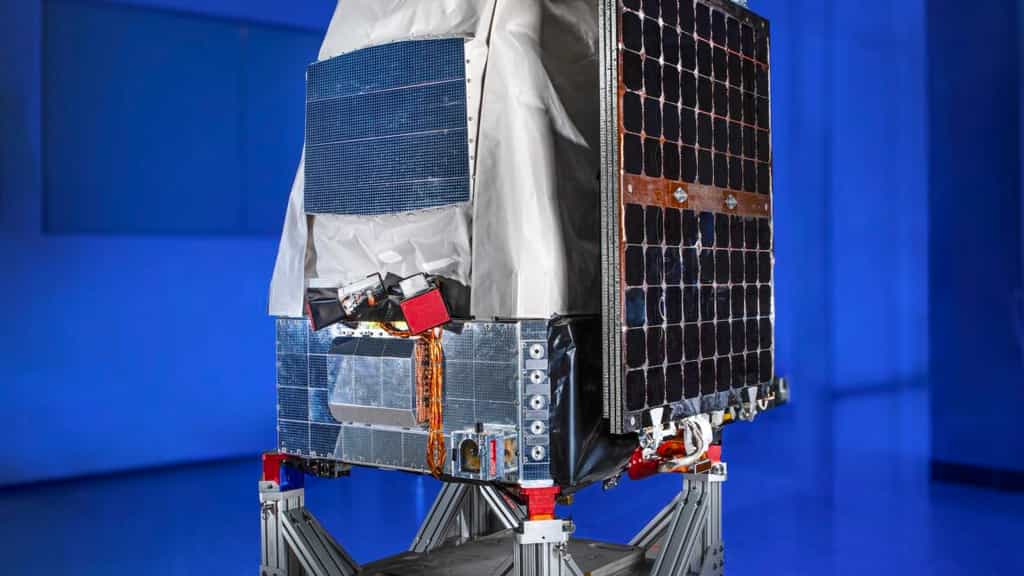
The Pandora satellite rocketed into orbit early Sunday from Vandenberg Space Force Base, California. It hitched a ride with around 40 other small payloads aboard a SpaceX Falcon 9 rocket, launching into a polar Sun-synchronous orbit before deploying at an altitude of roughly 380 miles (613 kilometers).
Over the next few weeks, ground controllers will put Pandora through a series of commissioning and calibration steps before turning its eyes toward deep space. Pandora is a fraction of the size of Webb. Its primary mirror is about the size of the largest consumer-grade amateur telescopes, less than one-tenth the dimension of that of Webb. NASA capped Pandora’s budget at $20 million. The budget to develop Webb was more than 500 times higher.
So what can little Pandora add to Webb’s bleeding-edge science? First, it helps to understand how scientists use Webb to study exoplanets. When a planet passes in front of its parent star, some of the starlight shines through its atmosphere. Webb has the sensitivity to detect the filtered starlight and break it apart into its spectral components, telling astronomers about the composition of clouds and hazes in the planet’s atmosphere. Ultimately, the data is useful in determining whether an exoplanet might be like Earth.
“I liken it often to holding a glass of wine in front of a candle, so that we can see really what’s inside,” said Daniel Apai, a member of Pandora’s science team from the University of Arizona. “We can assess, basically, the quality of the wine. In this case, we use the light that filters through the star’s [atmosphere] through the planetary atmosphere to judge what chemicals, gases in particular, may be present. Water vapor is one that we are the most sensitive to.”
But there’s a catch. Stars shine millions to billions of times brighter than their planetary companions, and starlight isn’t constant. Like the Sun, other stars have spots, flares, and variability over hours, days, or years. Hot spots and cool spots rotate in and out of view. And the star’s own atmospheres can contain some of the same molecules scientists are seeking to find on exoplanets, including water vapor.
Therefore, a star’s spectral signature easily outshines the signal coming from a nearby planet. Astronomers discovered this signal “contamination” when they started looking for potentially habitable worlds, injecting confounding uncertainties in their findings. Were the promising spectra they were seeing coming from the planet or the star?
“One of the ways that this manifests is by making you think that you’re seeing absorption features like water and potentially methane when there may not be any, or, conversely, you’re not seeing the signatures that are there because they’re masked by the stellar signal,” said Tom Barclay, deputy project scientist and technical lead on the Pandora mission at NASA’s Goddard Space Flight Center.
The problem became apparent in the 2010s as astronomers used more powerful telescopes to see the finer details of exoplanets.
“This is something that we always suspected as a community,” Apai told Ars in an interview. “We always suspected that stars are not perfect. At some point, it becomes a problem. But it was not recognized how serious a problem that is until, I would say, about 2017 or 2018.”
Scientists quickly got to work looking for a solution, and NASA selected the Pandora mission for development in 2021, just months before the launch of Webb.
“When we’re trying to find water in the atmospheres of these small Earth-like planets, we want to be really sure it’s not coming from the star before we go tell the press and make a big stink about it,” said Elisa Quintana, Pandora’s lead scientist at NASA’s Goddard Space Flight Center. “So we designed the Pandora mission specifically to solve this problem.”
From its perch in low-Earth orbit, Pandora will observe exoplanets and their stars simultaneously, allowing astronomers to correct their measurements of the planet’s atmospheric composition and structure based on the ever-changing conditions of the host star itself. Webb could theoretically do this work, but scientists already fill every hour of Webb’s schedule. Pandora will point and stare at 20 preselected exoplanets 10 times during its one-year prime mission, collecting 24 hours of visible and infrared observations with each visit. This will capture short-term and longer-term changes in each star’s behavior.
SpaceX launched Pandora into a so-called “twilight orbit” that follows the boundary between day and night on Earth, allowing the satellite to keep its solar panels illuminated by the Sun while performing its observations.
“We can send this small telescope out, sit on a star for a really long time, and sort of map all the star spots, and really disentangle the star and planet signals,” Quintana said in a recent panel discussion at NASA Goddard. “It’s filling a really nice gap in helping us to sort of calibrate all these stars that James Webb is going to look at, so we can be really confident that all of these molecules that we’re detecting in planets are real.”
“I think this is really the most important scientific barrier that we have to break down to fully unlock the potential of Webb and future missions,” Apai said.
Ben Hord, a member of Pandora’s science team at Goddard, singled out one example in a presentation at an American Astronomical Society meeting last year. This planet, named GJ 486 b, is a “super-Earth” discovered in 2021 circling a relatively cool red dwarf star. Hord said astronomers had trouble determining if the planet has a water-rich atmosphere based on Webb’s observations alone.
“We want to know if water is in the atmospheres of these exoplanets, and this stellar contamination from the spots on the star can mask or mimic features like water,” Hord said. “Our hope is that Pandora will help James Webb data be even more precise by providing context and understanding for these host stars and these planetary systems.”
Planets around small dwarf stars are some of the best candidates for finding a true Earth analog. Because these stars put out a fraction of the heat of the Sun, a potentially habitable planet could lurk very close to its host, completing a year in a handful of days. This allows astronomers to see the planet over and over again as it passes in front of its star, rapidly building a dataset on its size, structure, and environment.
Scientists hope they can extend the lessons learned from Pandora’s observations of a sample of 20 exoplanets to other worlds in our galactic neighborhood. As of late last year, astronomers have confirmed detections of more than 6,000 exoplanets.
“With a well-corrected spectrum we can say there’s water, there’s nitrogen,” Quintana said. “So with every mission, as we evolve, we’re chipping away and taking bigger and bigger steps toward that question of OK, we know Earths are out there. We know they’re abundant. We know they have atmospheres. How do we know if they have life on them?”
A mission like Pandora was not possible until recently, certainly not on the $20 million budget NASA devoted to the project. With Pandora, the agency took advantage of a fast-growing small satellite industry churning out spacecraft at a fraction of what it cost 10 or 15 years ago.
The Pandora spacecraft weighed approximately 716 pounds (325 kilograms) at launch and likely would have required a dedicated rocket to travel to space before SpaceX started offering shared rides on its workhorse Falcon 9 rocket. NASA did not disclose what it paid SpaceX for the launch of Pandora, but publicly available pricing suggests SpaceX charges a few million dollars to launch a satellite of the same size. Before the rideshare option became available, NASA would have paid tens of millions of dollars for the launch alone.
The Pandora mission is part of NASA’s Astrophysics Pioneers program, an initiative set up to solicit ideas for lower-cost astronomy missions.
“It’s been very, very challenging to try and squeeze this big amount of science into this small cost box, but that’s kind of what makes it fun, right?” Barclay told Ars. “We have to be pretty ruthless in making sure that we only fund the things we need to fund. We accept risk where we need to accept the risk, and at times we need to accept that we may need to give up performance in order to make sure that we hit the schedule and we hit the launch [schedule].”
Editorial Context & Insight
Original analysis and synthesis with multi-source verification
Methodology
This article includes original analysis and synthesis from our editorial team, cross-referenced with multiple primary sources to ensure depth, accuracy, and balanced perspective. All claims are fact-checked and verified before publication.
Primary Source
Verified Source
Ars Technica
Editorial Team
Senior Editor
Aisha Patel
Specializes in Technology coverage
Quality Assurance
Associate Editor
Fact-checking and editorial standards compliance