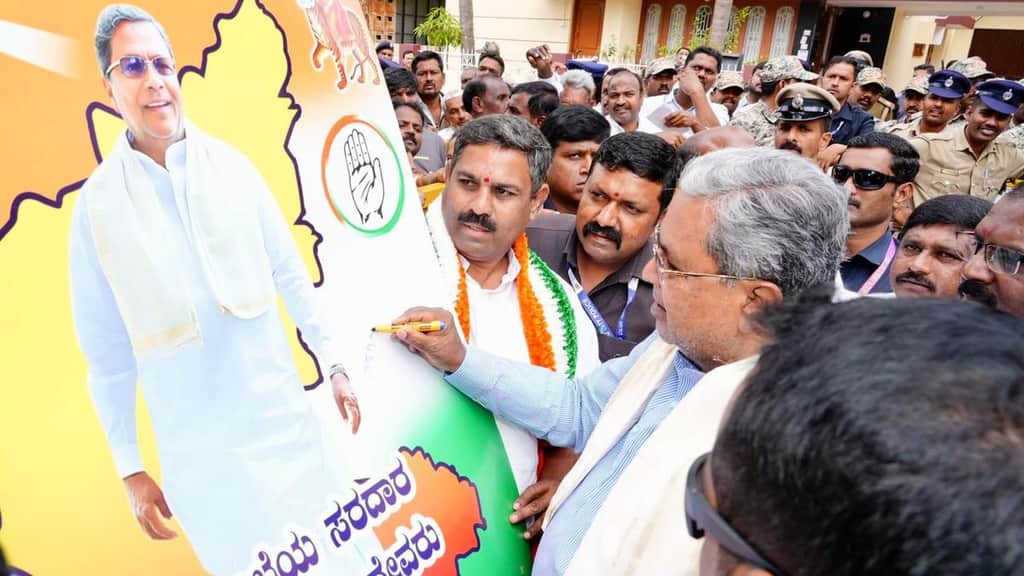
Seventy-eight-year-old Congress leader Siddaramaiah on January 7, 2026, becomes the longest-serving Chief Minister of Karnataka by eclipsing the record held by his role model and the party’s social justice icon D. Devaraj Urs.
Urs held the post for two terms and was in office for seven years and 239 days. While Urs served as the Chief Minister from 1972 to 1977 and from 1978 to 1980, Mr. Siddaramaiah has been holding the post since May 2023, after serving a full term during 2013-18.
Both backward class leaders hail from Mysuru, and both have been able to connect with the last man in the social hierarchy through pro-poor schemes. S. Nijalingappa of the Congress now stands third on the list, having served two terms, for seven years and 175 days.
While the implementation of land reforms during Urs’s tenure was considered a game-changer and revolutionary move in redistribution of lands, Mr. Siddaramaiah’s welfare schemes, branded “Bhagya” schemes during his first term and as five “guarantees” in the present, earned him the reputation as “champion of the poor”.
Multiple research studies have shown that the guarantee schemes have contributed to women’s financial autonomy, access to basic services, and overall household well-being. In addition to the earlier three socio-political revolutions in Karnataka – land reforms, reservation, and decentralisation – the Bhagyas/guarantees are considered the fourth passive revolution after the reorganisation of the State.
Mr. Siddaramaiah, who also handles the finance portfolio, already holds a record of presenting the highest number (16) of State budgets till now. The 16th budget (2024-25) presented by him, crossed ₹4 lakh crore (₹4,09,549 crore) mark.
Mr Siddaramaiah, who served as the Deputy Chief Minister twice, has been a member of the Legislative Assembly for eight terms, although not continuously. Mr. Siddaramaiah did not continue in the office immediately after completing his first term, as the Congress failed to muster a majority in the 2018 elections. Following a hung verdict, the Congress-JD(S) coalition government was formed, which subsequently collapsed, after more than a dozen of Congress and JD(S) MLAs crossed over to the BJP, enabling it to rule from 2019 to 2023.
Amidst the leadership tussle with his deputy and KPCC president D K Shivakumar, who belongs to the dominant Vokkaliga community, backward class organisations have already begun the celebrations to mark Mr. Siddaramaiah’s achievements to consolidate the AHINDA (acronym for minorities, backward classes and Dalits), Mr. Siddaramaiah’s major political support base.
It was as part of this AHINDA legacy that Mr. Siddaramaiah introduced the The Karnataka Scheduled Castes Sub-Plan and Tribal Sub-Plan (Planning, Allocation and Utilisation of Financial Resources) Act, 2013, in his first tenure. He implemented internal reservation during his second tenure, though it now faces legal challenges. The first-ever caste survey of Karnataka was held during his first tenure, but was not accepted by successive governments for various political compulsions. A second survey held during his second tenure is due for submission. It remains to be seen if he will be able to accept and implement it this time.
Political journeys are seldom linear, and Mr. Siddaramaiah’s career too has been marked by dramatic twists and turns over four decades of his political career.
Born into an underprivileged family of the shepherd community (Kuruba, an OBC caste), Mr. Siddaramaiah, who began his career as a lawyer, entered the Karnataka Legislative Assembly in 1983 from the Chamundeshwari constituency in Mysuru. In mid-term polls in 1985, he was re-elected from the same constituency and became the Minister for Animal Husbandry and Veterinary Services in the Ramakrishna Hegde government.
Mr Siddaramaiah served in various capacities in successive governments of the Janata Dal, including as Deputy Chief Minister in the J.H. Patel government in 1996 and the Leader of the Opposition during the BJP regime. He was upset with the Janata Dal (Secular) supremo and former Prime Minister H.D. Deve Gowda, who was reluctant to back him for the Chief Minister’s post in 2004. After being expelled from the JD(S) in 2005, Mr. Siddaramaiah joined the Congress in 2006. He served a brief stint as Deputy Chief Minister in the first Janata Dal (S)-Congress coalition government (2004-05).
It has often been said that while Mr. Siddaramaiah remained an unchallenged leader in his first term, it has been less so in the second. The alleged irregularities in Mysore Urban Development Authority (MUDA) land allotment to his family members is among the factors contributing to it.
While a historic 320-km padayatra from Bengaluru to Ballari against alleged illegal mining activities of the Reddy brothers (BJP) and their associates was among the major factors that led to the Congress victory in 2013, a decade later, the alleged corruption during the previous BJP government and five “guarantees” promised by the Congress are considered as the driving forces that installed the party to power in 2023.
On both occasions, Mr. Siddaramaiah ended up holding the coveted post. Now, amidst talk on the change of leadership, whether Mr. Siddaramaih will complete the full five-year term remains to be seen.
Editorial Context & Insight
Original analysis & verification
Methodology
This article includes original analysis and synthesis from our editorial team, cross-referenced with primary sources to ensure depth and accuracy.