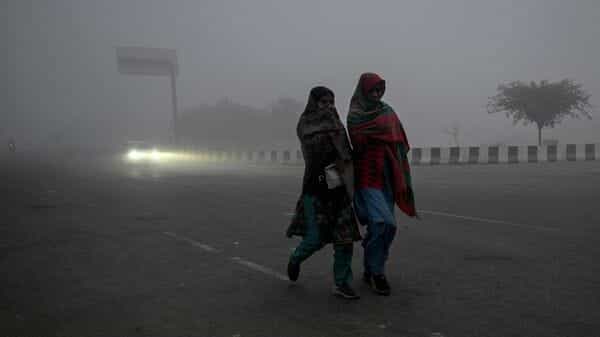
Cold conditions are likely to ease gradually after 14 January, bringing relief to people in North India, especially Rajasthan, Punjab, Haryana, Delhi, Himachal Pradesh and Uttarakhand.
“Cold wave to severe cold wave conditions are very likely to continue over Rajasthan, Punjab, Haryana, Delhi, Himachal Pradesh and Uttarakhand on 12-13 January, with cold wave conditions in isolated pockets on 14 January, with reduction thereafter,” said the India Meteorological Department (IMD) in its latest update.
Meanwhile, Palam in Delhi recorded a minimum temperature of 3.0°C on 11 January 2026, making it the second-lowest minimum since 2010, after 7 January 2013, when the temperature dropped to 2.6°C. The all-time lowest minimum for Palam remains -2.2°C, recorded on 11 January 1967.
According to the IMD, cold conditions prevailed across large parts of northern and central India over the last 24 hours until 8:30am on Sunday. Minimum temperatures dipped below 0°C at many places in Jammu-Kashmir-Ladakh-Gilgit-Baltistan-Muzaffarabad, a few locations in Himachal Pradesh, and isolated areas of Uttarakhand.
Temperatures ranged between 1°C and 5°C at a few places in Punjab, Haryana, Chandigarh, Delhi and North Rajasthan. Several regions of Uttar Pradesh and Madhya Pradesh recorded temperatures between 5°C and 10°C, while similar conditions were observed in parts of Odisha, Bihar, Gujarat, and East Rajasthan. Isolated pockets of Chhattisgarh, Jharkhand, West Bengal, Sikkim, Assam, Meghalaya, and Maharashtra also experienced low temperatures.
Meanwhile, dense fog conditions are likely to continue during morning hours over North-West India and Bihar during the next five days. Also, cold day conditions are likely to prevail in isolated parts of Bihar during 11-16 January.
The IMD, in its agromet advisory, has suggested that farmers in Himachal Pradesh, Uttarakhand, Punjab, Haryana, West Uttar Pradesh, and Rajasthan apply light and frequent irrigation to standing crops in the evening hours to protect crops from low-temperature stress or cold injury.
However, scientists said the cold and foggy conditions so far have not had a significant impact on winter crops, as no incidents of frost—which can damage crops—have been reported. “We are expecting a good harvest this year, as there has been an increase in rabi acreage,” said D.K. Yadava, deputy director general (crop science), Indian Council of Agricultural Research (ICAR).
India’s rabi, or winter, crop sowing in 2025-26 has increased by more than 1.64 million hectares to 63.41 million hectares as on 2 January, according to data released by the ministry of agriculture and farmers’ welfare on 6 January. The sown area is 2.65% higher than a year earlier. The season’s average coverage is 63.78 million hectares.
The expansion in sown area was largely supported by higher acreage under wheat, rice, pulses, and oilseeds. Wheat coverage rose by 613,000 hectares, while the area under rice increased by 267,000 hectares compared to the previous year.
Pulses saw an overall increase of 344,000 hectares, driven mainly by a sharp rise of 466,000 hectares under gram. The area under oilseeds, led by rapeseed and mustard, also expanded to 9.63 million hectares, up by 304,000 hectares from last year.
Editorial Context & Insight
Original analysis and synthesis with multi-source verification
Methodology
This article includes original analysis and synthesis from our editorial team, cross-referenced with multiple primary sources to ensure depth, accuracy, and balanced perspective. All claims are fact-checked and verified before publication.
Primary Source
Verified Source
mint - news
Editorial Team
Senior Editor
Emma Watson
Specializes in Business coverage
Quality Assurance
Fact-Check Editor
Fact-checking and editorial standards compliance