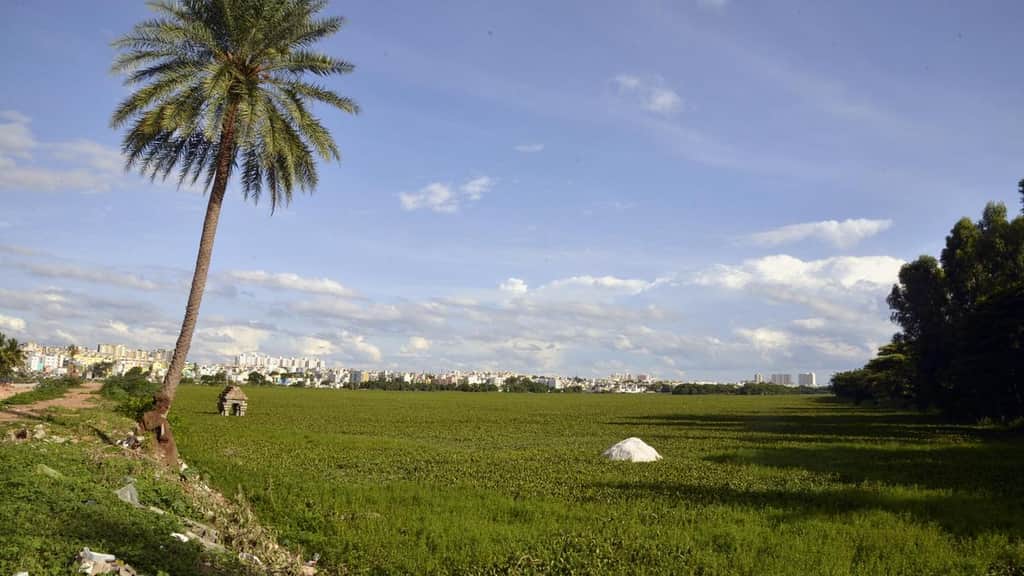
Rejuvenation efforts at Madiwala Lake is nearing completion, however it looks like they are restricted to beautifying the waterbody like building walkways, a park, and gazebo, etc., rather than desilting it.
The bund was breached in 2016 which led to flooding, indicating reduction in its water retention capacity, making desilting all the more important. However, the proposal to desilt the lake, drafted last year, has been gathering dust.
The lake, spanning 276 acres, according to the K.B. Koliwada report, connects more than six lakes in the southern and southeastern parts of the city. The lake was handed over to the BBMP in 2023 from the Forest Department, and it was last desilted nearly 18 years ago.
A senior officer from the South City Corporation confirmed that the works currently under way are limited to the development of walkways, bridges, a park, and gazebos. There is no order to begin desilting.
The Hindu learnt that the BBMP’s Lakes Division had drafted a proposal for desilting, estimated to cost around ₹35 crore. However, the proposal has remained as it is, and no further discussions have been held. Calls and messages to South City Commissioner K.N. Ramesh to seek an update on the proposal went unanswered.
V. Ramprasad of Friends of Lakes pointed out that lakes primarily serve the purpose of flood mitigation and groundwater recharge, but over time, civic bodies have focused more on beautification and turning them into recreational hotspots rather than addressing their core functions.
“Despite commercial fishing activities spoiling the lake’s health due to contractors’ greedy practices, they are allowed in many lakes. On the other hand, lakes have not been desilted for decades. This selective focus will only increase flooding and deteriorate groundwater levels,” he told The Hindu.
In the case of the Madiwala Lake, desilting is necessary to increase its water-holding capacity, as areas around the lake such as BTM Layout, Tavarekere, and Madiwala are prone to flooding.
In addition, storm-water drain lines from Puttenahalli Lake, Sarakki Lake, Arekere Lake, and Hulimave Lake converge at Madiwala Lake and then flow to Agara Lake via Kodichikkanahalli and Silk Board, forming the K-209 line, according to a National Green Tribunal document. The network highlights the crucial role the Madiwala Lake plays.
During the last monsoon, minor flooding was witnessed in BTM Layout and Tavarekere, indicating the possibility of large-scale overflow in the event of heavy rainfall.
Mr. Ramprasad noted that if the lake is not desilted and the storm-water drain lines are not strengthened, it could end in a full-fledged crisis.
It may be recalled that the lake had earlier breached its bund in 2016 and flooded the surrounding areas, disrupting normal life. Since then, the lake has undergone several upgrades and was even used for boating activities. However, it subsequently ran into a slew of problems, including the release of drain water into it and its use as a waste-dumping site.
An engineer from the South City Corporation admitted that desilting is necessary, as the lake has been filled with garbage, vessels, and heaps of junk. “Last year, when we deployed a weed-removal machine, it excavated a refrigerator and other kinds of waste. This is a sign that we should desilt it soon,” the officer added.
Currently, the South City Corporation is nearing the completion of beautification works and is aiming to meet the March-end deadline. The GBA has also deployed a new machine to remove weeds, a process expected to take two to three months given the extent of weed growth, which is a result of untreated sewage being let into the lake.
Editorial Context & Insight
Original analysis & verification
Methodology
This article includes original analysis and synthesis from our editorial team, cross-referenced with primary sources to ensure depth and accuracy.