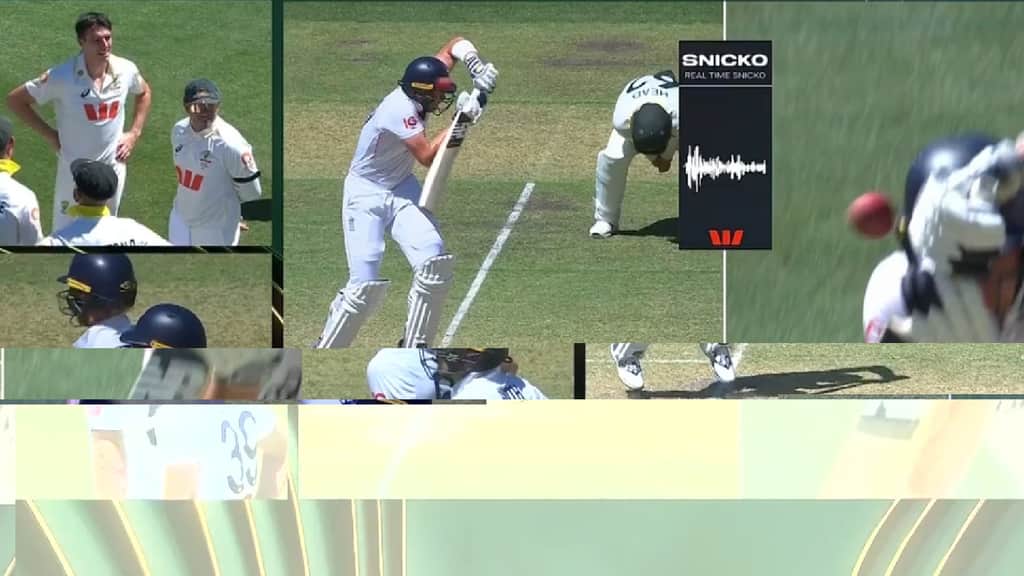
The Jamie Smith incident where the Snicko gave him a lifeline, much to the anger of Australia. (Screengrab via Fox Sports Australia)
Former international umpire Simon Taufel has stated that he would like to see the International Cricket Council (ICC) own the technology used in cricket, rather than broadcasters having to supply and pay for it. The 54-year-old stated that there was no accountability when third-party authorities made decisions, regardless of whether it involved those providing the technology or the broadcasters.
Taufel’s comments about ICC owning the technology came a few weeks after Australian paceman Mitchell Starc had suggested that cricket’s governing body should consider footing the bill for the technology used in the game and questioned why there was no uniformity in the technology used globally.
“I’d love to see the ICC actually own technology, rather than it being supplied by the broadcasters and paid for by the broadcasters. I think if the ICC was able to look at a way to fund owning the technology and actually be in control – because now we have more, we have more third-party people who are responsible for decision-making, whether that’s the technology provider or the broadcaster – and there’s no accountability for what they do.”
“So I think, you know, umpires’ decisions are very transparent out there, and they own their decisions. I’d certainly like to see the umpires’ soft signal come back. I’d like to see umpires provide a starting point for fair catches and obstruction and those sorts of things,” Taufel told Cricbuzz.
One of the main talking points in the ongoing Ashes series has been the use of the Decision Review System (DRS) and its ability to eliminate the howlers and offer clear verdicts on contentious calls. Taufel admitted that DRS was not foolproof and did not sort out every error.
“DRS is not foolproof. It doesn’t fix every mistake. And it doesn’t give us 100%. You know, players run out of reviews. On average, players get it right 25% of the time. Umpires, on average, get it right 92-93% of the time. What DRS does for us is raise 92-93% to 97-98%.”
“It doesn’t get us to 100. So you feel it is better to be there than not? Sure, but it’s always that mix of technology and human beings. You know, if you went the all-technology route, that wouldn’t give you 100%. If you went all-human route, that wouldn’t give you 100% either. But certainly, it gets us more decisions right – but that comes at a cost. A financial cost, but also a time cost to the game because you’ve got, you know, technology involved,” he said.
Editorial Context & Insight
Original analysis & verification
Methodology
This article includes original analysis and synthesis from our editorial team, cross-referenced with primary sources to ensure depth and accuracy.
Primary Source
The Indian Express