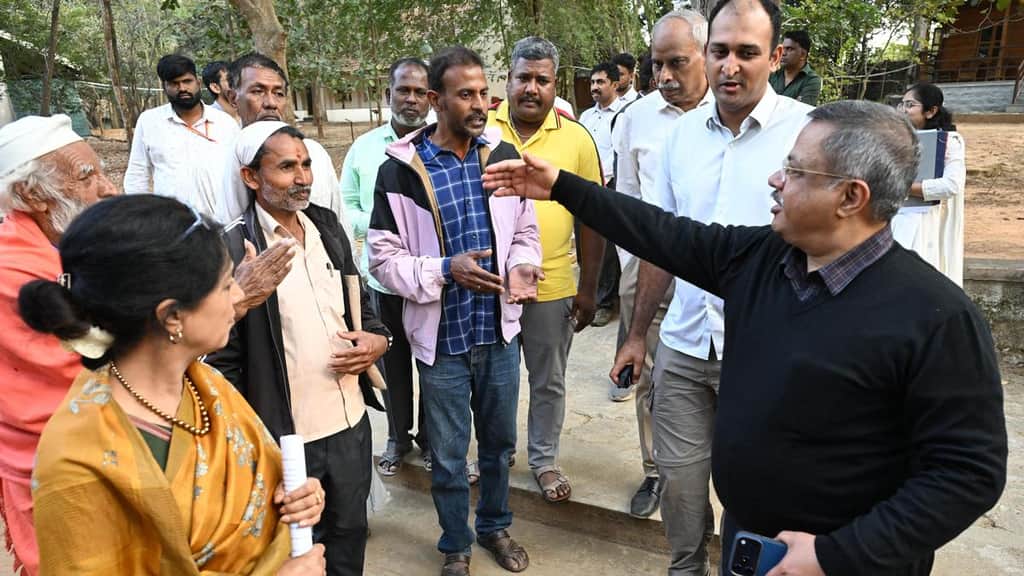
The Central Empowered Committee (CEC), constituted by the Supreme Court to look into the reduction in the Eco-Sensitive Zone (ESZ) around the Bannerghatta National Park (BNP), in its report submitted to the apex court on Wednesday, has recommended to restore a 2016 draft notification and cancel a 2020 notification which reduces the ESZ.
The report was filed following a recent visit by a CEC member to the BNP in response to a petition arguing that the notification regarding the reduction of the ESZ has excluded ecologically critical areas surrounding established elephant corridors from the ESZ and that the adoption of a one-km ESZ norm for the protected area of the forest ignores site-specific ecological requirements.
According to the report, the ESZ initially proposed around BNP in the draft notification dated June 15, 2016, covering an area of 268.96 sq. km was reduced to 181.57 sq. km. and thereafter to 168.84 sq. km. in the final notification dated March 11, 2020.
“The CEC notes that these successive reductions were effected without any demonstrable scientific, ecological or landscape level assessment being placed on record to justify such curtailment of the ESZ extent,” the report states.
In its recommendation, the CEC said that the final ESZ notification of 2020 insofar as it excludes scientifically identified elephant corridors and ecologically important patches forming part of the BNP landscape, warrants reconsideration and shall be withdrawn by the Ministry of Environment, Forest and Climate Change (MoEFCC), forthwith.
It added that the original ESZ extent of 268.96 sq. km, as in the 2016 draft notification, shall be fully restored and said that the identified elephant corridors connecting BNP with adjoining forest landscapes require continued protection and strengthening through regulatory and management measures.
“In view of the increasing incidence of human-elephant conflict in the southern, western, south-eastern and south-western parts of BNP, particularly in and around the villages of Herandyapanahalli, Tippuru, Bijahalli, Bommasandra, Hosadurga, Salbanni and Guddeveeranahosahallu, where the ESZ is presently delineated at 100 metres and which lie along elephant movement pathways between the Cauvery Wildlife Sanctuary and BNP, a review of the existing ESZ delineation, including buffer width, shall be considered to strengthen the forest habitation interface and support mitigation of human elephant conflict,” it further added.
It has also recommended that the entire exercise to re-notify the ESZ of BNP be completed within the next six months.
The CEC has also noted that the decision to reduce the ESZ was taken in the Cabinet Sub-Committee meeting Chaired by the Karnataka Environment Minister in 2017 and that this is contrary to para 6.2 of the 2011 Guidelines for Declaration of ESZ around National Parks and Wildlife Sanctuaries.
The guidelines require the State government to constitute a committee comprising the Chief Wildlife Warden, an ecologist, a representative of the local self-government and an officer of the Revenue Department to assess and recommend the appropriate extent of the ESZ for its management and the activities incorporated in the master plan for the region.
“The revised proposal for reduction in ESZ is in violation of the 2011 guidelines,” it said.
Editorial Context & Insight
Original analysis & verification
Methodology
This article includes original analysis and synthesis from our editorial team, cross-referenced with primary sources to ensure depth and accuracy.