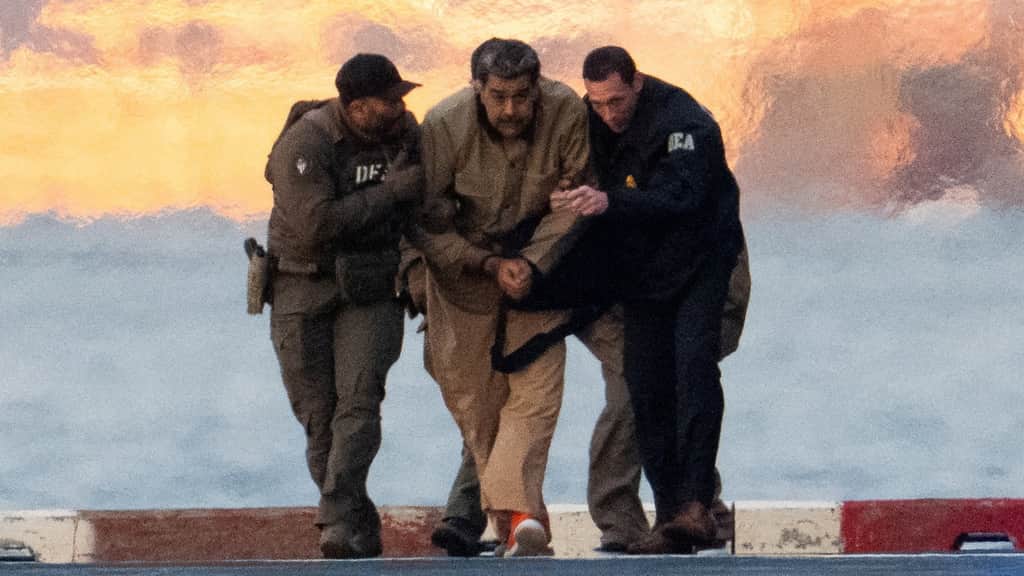
On January 3, as part of Operation Absolute Resolve, the US military captured Venezuelan President Nicolás Maduro and his wife, Cilia Flores, and flew them out to New York, where Maduro was produced before a federal judge to face charges. The Trump administration has conveniently labelled him a “narco-terrorist.”
In August 2025, a clandestine team of the CIA had infiltrated Venezuela and started collecting information on Maduro, especially about his routines and security. As per Chairman of the Joint Chiefs of Staff General Dan Caine, even with the US embassy in Venezuela shut, exceptionally detailed intelligence was gathered. In the interim, to make Maduro relent to demands, the US reportedly began a military buildup in the Caribbean Sea, and conducted over 30 controversial military strikes on alleged “drug-boats” in the Caribbean and eastern-Pacific, allegedly killing over 115 people. Around the end of December, Trump ordered a quasi-blockade aimed at seizing oil tankers moving in and out of Venezuela. Maduro’s capture came after he rejected the US offer of taking asylum in Turkey.
Although Trump has justified “Absolute Resolve” as an operation against drug trafficking, Venezuela is a very minor player in the drug trade vis-à-vis other countries. Trump had maintained he opposed foreign occupation(s) by the US, while his officials told congressional leaders that regime change in Venezuela wasn’t an objective. Yet on January 3, Trump stated the US would run Venezuela and rebuild its oil infrastructure. In shades of the Monroe Doctrine, he added, “American dominance in Western Hemisphere will never be questioned again.” Secretary of War Pete Hegseth announced “Southern Spear,” the regime change operation in Venezuela. US homeland security advisor Stephen Miller claimed the Venezuelan oil industry was “the largest recorded theft of American wealth and property.” US Southern Command chief General Laura Richardson listed the Lithium Triangle in Argentina, Bolivia, and Chile, Venezuela’s gold and oil, Guyana’s crude, and 31 per cent of the planet’s fresh water as “national security” interests.
No mention of democracy, human rights, or the usual blah-blah anywhere. On January 4, Venezuela’s apex Court directed Vice-President Delcy Rodríguez to assume the role of Acting President. She then called Maduro the country’s rightful leader and demanded that the US free him. Trump then threatened her, “If she doesn’t do what’s right, she is going to pay a very big price, probably bigger than Maduro.”
Overall, with the US quite adept at labelling anyone it doesn’t like as a “terrorist,” this entire intelligence and military operation in a foreign country, dubbed as a “legal, law enforcement operation,” and done without approval of Congress, raises serious questions about its legality. Shorn of diplomatic niceties, it’s just a mafia-style abduction devoid of even a passing semblance of international law – and sets a new low for a country which lectures others incessantly about rules-based order, democracy, human rights, and demonises other nations solely for retaining its status as a pre-eminent power. The real reason why Maduro was deposed lies in oil and petro-dollars. Venezuela, at 303 billion barrels (BB), has the world’s largest proven oil reserves (followed by Saudi Arabia at 267 BB; Iran 209 BB; Iraq 145 BB).
In July 1944, the US, to cobble up a new global economic system, had gathered representatives of 44 countries at Bretton-Woods and imposed the “gold standard” on them. In 1971, however, President Nixon ended the Bretton-Woods-adopted gold standard and moved the US dollar to a fiat currency system. In 1974, the US made a deal with Saudi Arabia, in return for US military and political protection, and the latter agreed to price oil in US dollars. This artificial demand for US dollars worldwide allowed them to print unlimited money, survive with massive debt/deficit spending, fund the MIIC (military-industrial-intelligence-complex), and remain the dominant economic power while imposing hegemony.
However, in 2018, Venezuela announced it would “free itself from the US$” and then began selling its oil in return for Yuan, Euros, and Rubles. It also petitioned to join BRICS, which was building payment systems to bypass the US dollar, and began building direct payment channels with China, which bypasses SWIFT (China has built CIPS, an alternative to SWIFT, with 4,800 banks in 185 countries). In sum, Venezuela had enough oil to fund the de-dollarisation for decades, and given the decline of the petro-dollar, the US decided to intervene to control Venezuela’s oil and thwart other nations from shifting away from the petro-dollar. And its redux Operation PaperClip (1945), Iran 1953, Iraq 2003, and Libya 2009-2011.
After Nazi Germany’s surrender, US troops, while searching the European landscape, were stunned by the German weapons and technologies. The Pentagon’s “we need these for ourselves” led to Op PaperClip. This initially envisioned transporting 88 captured Nazi scientists to the US, “whitewashing” their pasts, re-designating them as “prisoners of peace”, and putting them to work on US projects. But it expanded, and the US Joint Intelligence Objectives Agency took out over 1,600 Nazi/German scientists, engineers, and technicians. It also dismantled and relocated numerous plants, factories and facilities; and confiscated large amounts of German materials, patents, copyrights and trademarks.
Iran was ruled by a democratically elected prime minister, Mohammad Mosaddegh. Western firms had for decades controlled the region’s oil wealth – but after Mossadegh nationalised the Iranian oil industry, the CIA overthrew him under Operation Ajax and brought in the Shah. In 2000, Saddam Hussein announced that Iraq would sell oil in Euros instead of US dollars. So, in 2003, the US invaded Iraq, killed tens of thousands, captured and hanged Saddam; no WMDs were found because they never existed. Iraq switched back to the US dollar. In 2009, Gaddafi proposed the African-backed “gold dinar” for oil trade. In 2011, the US-led NATO bombed Libya and killed Gaddafi. Sidney Blumenthal’s email to Hillary Clinton, quoting an intelligence memo, is illustrative. The aftermath saw mass looting of Libyan armouries, which then further fueled terrorism globally.
What the US is trying to convey is: Emulate the Saudi Arabia of yore.
The writer is a retired Army officer, was the principal director in the National Security Council Secretariat
Editorial Context & Insight
Original analysis & verification
Methodology
This article includes original analysis and synthesis from our editorial team, cross-referenced with primary sources to ensure depth and accuracy.
Primary Source
The Indian Express