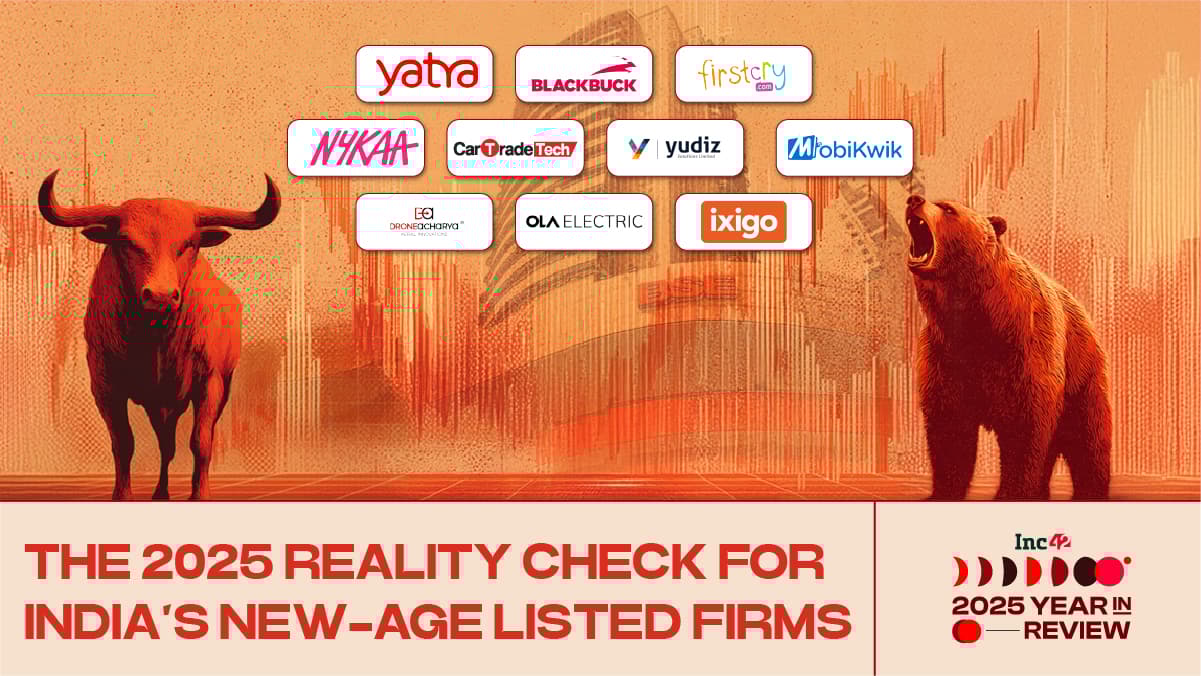
With 18 new listings, 2025 was a record year for the homegrown startup ecosystem on the public markets front. New-age tech companies like Meesho, Wakefit, Lenskart, cumulatively raised a staggering INR 41K Cr from the public market via their IPOs during the calendar year. But who were the biggest gainers and losers among the new-age tech stocks in 2025?
The going wasn’t all easy for the 31 new-age tech companies that were already listed before this year. Only 11 ended 2025 with gains in their share prices on a full-year basis, while the remaining 20 stocks ended the year in the red.
CarTrade emerged as the biggest gainer this year, while shares of Yatra and Nykaa made remarkable turnarounds. Others like ixigo, BlackBuck, Paytm also ended the year with substantial gains.
On the flip side, it was not a smooth ride for companies like Nazara, Ola Electric and DroneAcharya. Investor interest for such companies diminished as they found themselves in the middle of controversies, subdued financials, and other concerns.
On a broader level, both the Sensex and the Nifty ended the year in the green despite recurring global headwinds. The year opened with elevated valuations and high expectations, but momentum cooled as FII outflows, swaying interest rates and geopolitical tensions triggered periodic corrections.
Those pullbacks, however, proved short-lived. Domestic institutional flows, led by steady SIP inflows, consistently stepped in, helping benchmark indices claw back losses and push gradually higher over the course of the year.
Large-cap stocks anchored the rally, while mid- and small-cap companies saw phases of correction as liquidity tightened and valuations reset. During this period, IT stocks struggled to sustain rallies amid muted global demand while new-age tech names saw selective gains driven by profitability-focussed narratives.
Meanwhile, new new-age tech stock listings in 2025 proved to be a mixed bag. While big names like Groww and Meesho enjoyed strong debut gains, a significant number of new stocks now trade below their listing price. Overall, the trend points to moderate and uneven performances across new startup listings this year.
As we near the end of the year, Inc42’s ‘Year In Review’ series brings you the top gainers and losers among the listed new-age tech companies in 2025.
Investors were the most bullish on CarTrade this year. The auto tech major’s shares climbed around 85% in 2025, rising steadily between January 1 and December 16. The rally, which sustained mostly throughout the year, came on the back of CarTrade’s consecutive profitable quarters this year.
While the stock was already trending higher through the first half of the year, it saw sharper moves on the back of quarterly results.
While CarTrade’s consolidated profit after tax (PAT) jumped 85% YoY to INR 46.1 Cr in Q4 FY25, the bottom line doubled YoY to INR 47 Cr in Q1 FY26 and then soared another 109% YoY to INR 64.1 Cr in Q2.
Following a string of strong quarterly results throughout FY26, brokerages highlighted CarTrade’s ability to scale its consumer marketplace and remarketing businesses while keeping costs in check. The sharp improvement in EBITDA margins and consistent cash generation led several analysts to upgrade earnings estimates and reiterate positive views on the stock’s medium-term trajectory.
Brokerages also underscored that the company’s diversified revenue streams, spanning consumer classifieds, dealer solutions and auctions, provides CarTrade resilience across auto cycles.
Elara Securities reiterated its Buy rating for the company in September and raised its target price to INR 3,840, citing CarTrade’s “disciplined execution, operating leverage, and margin expansion” as fundamental drivers of sustainable profitability. Elara also underlined the company’s “asset-light model and healthy cash position of INR 1,080 Cr” as positives that support long-term growth visibility.
Despite general turbulence in travel, it was perhaps the best business year for online travel aggregator (OTA) Yatra. Buoyed by three consecutive strong quarterly financial performances, the company’s stock gained significantly throughout the year.
Overall, the company’s shares surged over 55% while closing the trading session on December 16 at INR 179.85. The stock touched an all-time high of INR 201.85 in November.
The OTA maintained a robust financial performance over the past five quarters, maintaining its quarterly operating revenue above INR 200 Cr. However, its top line surged to over INR 350 Cr in the September quarter, representing a 48% YoY and 67% QoQ uptick.
Important to highlight that the second quarter was comparatively weaker for its larger competitors in the segment. The robust performance was driven by Yatra’s dominance in the B2B MICE (meetings, incentives, conferences and exhibitions) business, making it a dominant player in the Indian market.
Based on its strong performances, brokerages maintained a broadly positive stance on Yatra Online in 2025, with optimism anchored in the company’s earnings turnaround and improving unit economics.
Firms such as JM Financial and Axis Capital pointed that sequential margin expansion and disciplined cost control could lead to narrowing of its valuation gap with peers, with several brokerage revising earnings estimates upwards through FY26 and FY27.
Beyond the numbers, the brokerages have also been bullish on Yatra’s strengthening competitive positioning. Analysts have cited the company’s deepening supplier relationships and a re-balanced product mix, skewed toward business travel, as differentiators that could drive both revenue visibility and customer loyalty.
With quick commerce experiments yielding results and the fashion vertical picking up pace, business for Nykaa was firing on all cylinders throughout this year. The strong unit economics and consistent profitability translated to strong investor interest for the Falguni Nayar-led company.
After starting the year on a tepid note, investor interest in the company picked pace throughout the year. The rally took the stock to a fresh 52-week high of INR 273.2 in November. It settled at over 50% year-to-date (YTD) gains by mid-December.
The strong performance for the company came on the back of a steady growth in its core beauty and personal care (BPC) segment and improving profitability trends across the business. After a series of quarterly milestones, including about 25-30% YoY rise in revenue and a more than doubling of profit in Q2 FY26, sell-side firms highlighted that Nykaa’s BPC gross merchandise value (GMV) and margins remain resilient.
JM Financial maintained its Buy rating with a INR 260 target, calling Nykaa “one of the cleanest consumption-led plays in India” and emphasising margin expansion and fashion segment recovery as key upsides. Nuvama Institutional Equities also retained its bullish stance, raising its target to INR 285, highlighting continued GMV growth, margin improvement, and broad-based growth in both BPC and fashion net sales value (NSV).
Online travel aggregator ixigo saw its share price climb almost 48% on the D-Street this year to INR 248.35 from INR 167.8 at the end of December in 2024.
The stock was on a gaining spree in the first half of the year. In July, after the Q1 numbers were announced, its shares jumped over 15% to INR 206.40.
ixigo reported a consolidated net profit of INR 18.9 Cr in Q1 FY26, an increase of 27% from INR 14.9 Cr in the year-ago quarter. On a quarter on quarter (QoQ) basis, profit rose 13% from INR 16.8 Cr. This profitability came on the back of its operating revenue, which surged 73% YoY to INR 314.5 Cr in Q1 FY25.
However, in the subsequent quarter, it slipped into the red, reporting a net loss of INR 3.5 Cr as against a net profit of INR 13.1 Cr in the year-ago quarter. ixigo attributed the net loss to one-time ESOP expenses of INR 26.9 Cr incurred during the quarter.
After making a muted public market debut late last year, shares of the logistics major maintained a bullish momentum throughout 2025. The company’s shares gained over 30% in the past year to reach INR 634 on December 19, 2025 from INR 481.55 at the end of last year.
The company’s turnaround was underpinned by sustained revenue growth and profitability after years of investment in its logistics marketplace and telematics offerings.
In Q2 FY26, BlackBuck reported 53% YoY growth in revenue to INR 151.1 Cr and a net profit of INR 29.2 Cr, reversing a net loss of INR 308.3 Cr in the year-ago quarter, signalling improved operating leverage and stronger core demand.
The company attributed its business growth to the launches of Superload and vehicle finance businesses in the quarter. “Superload’s business has made strong progress on establishing the playbook. We plan to add 10 new cities over the course of next 6 months,” the company said in its Q2 shareholders’ letter.
Brokerages also took note of this momentum. Ambit Capital initiated coverage with a Buy rating and a target of INR 885, highlighting BlackBuck’s emergence as “India’s largest commercial vehicle technology platform” and pointing to expansions in tolling and telematics services as drivers of future growth.
However, it must be noted that the company’s bull run on the bourses this year came to a slight halt after the company’s cofounders Rajesh Yabaji, Chanakya Hridaya and Ramasubramanian Balasubramaniam cumulatively offloaded shares worth INR 243.5 Cr in November. Further, the bull run also allowed investors like Sands Capital, Wellington Management, Accel and Flipkart to rake in huge windfalls from stake sales in the latter half of the year.
Delayed financial disclosures and continued regulatory overhang led to an increased selling pressure for BSE SME-listed DroneAcharya throughout the year. After starting the year at INR 116.7, the dronetech company’s shares plunged by about 60% to INR 46.14 by middle of December.
The selling pressure for the company began at the start of the year, when it signed and subsequently dissolved a merger agreement with dronetech company AITMC Ventures. The latter went on to file for its IPO later in the year.
The company’s shares fell to under INR 60 by May, around when it announced the halt on the merger. Subsequently, concerns around the company’s performance reignited in June, when it deferred announcing its H2 FY25 results.
After deferring the results multiple times, the company announced a loss making H2 FY25, along with informing investors of an ongoing SEBI investigation.
Important to note that the company’s shares recovered some ground after it returned to the black in H1 FY26. However, the recovery was short lived.
Towards the end of November, the markets regulator’s investigation led it to find and allege misleading corporate announcements, pre-IPO side deals, revenue inflation and diversion of IPO proceeds by the promoters. As one could expect, this triggered a board room exodus for DroneAcharya in November as well as consistent selling from its investors.
The company’s shares crashed to an all-time low of INR 32.68 at the beginning of December. However, with the SAT setting aside the SEBI ruling on December 20 has triggered another spike in the company’s share performance.
MobiKwik’s shares came under sustained pressure in 2025 as weak financial performance and operational setbacks dented investor confidence. The stock declined almost 60% to INR 235.8 from INR 586.9 from December last year.
The stock trended lower through much of the year as the company swung back into losses, reporting a net loss of over INR 120 Cr for FY25 after having posted a profit the previous year.
Quarterly earnings offered little relief, with losses widening in Q4 FY25 and remaining elevated in the first two quarters of FY26 amid slower growth in high-margin financial services revenue and rising costs.
Each set of results reinforced concerns around the company’s ability to translate scale in payments into sustainable profitability, keeping the stock firmly on the back foot.
Sentiment worsened further in September after MobiKwik disclosed a technical glitch that led to unauthorised settlements worth around INR 40 Cr, prompting account freezes and an FIR.
The incident sharpened market concerns around risk controls and systems robustness, triggering fresh selling pressure and heightened volatility in the stock. While the company said it had contained the issue and initiated recovery, the episode compounded existing worries around earnings visibility and governance, leaving MobiKwik’s shares among the weaker performers in the new-age tech cohort this year.
Ola Electric’s stock endured one of the worst years as sustained losses, collapsing sales and continuing regulatory challenges eroded investor confidence. Its share price declined almost 60% to INR 34.5 from INR 85.75 last year.
The EV maker, which not too long ago commanded a market capitalisation of $5.4 Bn, saw its m-cap shrink to around $1.6 Bn.
The company’s financials showed a sharp deterioration, with Q4 FY25 revenue from operations plunging around 60% YoY to roughly INR 611 Cr. Net losses more than doubled to about INR 870 Cr, as deliveries slumped steeply and margins deteriorated into deep negatives.
This weak performance continued into Q2 FY26, where sales fell around 43% YoY and operating losses remained wide, underscoring structural challenges in converting scale into profit amid intense competition and high cash burn. Such results, along with the company cutting its FY26 guidance, reinforced bearish sentiment, with ratings agencies downgrading credit facilities and flagging a prolonged road to profitability.
Ola Electric’s share slide was in line with its earnings stress, making it one of the year’s laggards among EV and new-age tech stocks. The shares tumbled sharply throughout 2025 and repeatedly hit fresh multi-year lows as weak sales data and promoter stake pledges amplified risk perceptions.
Foreign institutional investors like SoftBank and Tiger Global diluted their stake, while technical indicators remained bearish, reflecting broad investor unease over profit prospects and competitive pressures.
Occasional upticks provided only short-lived relief against the dominant downtrend.
Blockchain and IT development company Yudiz Solutions saw its stock slump nearly 57% to INR 28 from INR 64.75 in the last year.
The slide was driven by weak financial performance, including contraction in revenue and widening losses. Yudiz Solutions’ consolidated net loss widened nearly 10X to INR 1.1 Cr in H1 FY26 compared to INR 11.3 Lakh in the year-ago period.
Operating revenue declined 7.4% to INR 10.3 Cr in the six-month period ended September 2025 from INR 11.1 Cr in the year ago period.
Besides, the company’s promoter Suraj Chokhani, which held 50% stake, was also arrested by the ED in March for allegedly laundering the proceeds of crime in the Mahadev betting app case. The Supreme Court granted bail to him later in the year.
FirstCry’s stock had a turbulent 2025 as weak financials and multiple regulatory and legal overhangs dented investor confidence. Its shares plunged about 56% YTD, maintaining a consistent bearish trajectory through the year.
The company’s parent, Brainbees Solutions, continued to report significant losses through FY25 and FY26, including a widened net loss in Q4 FY25 despite modest revenue growth. After reporting a net loss of INR 111.5 Cr (up 158% YoY) in Q4, the company managed to trim its burn in the subsequent two quarters of FY26.
However, despite the company tightening its losses, sentiment was further hit by regulatory and legal developments that amplified execution risk perceptions.
In September, the Central Consumer Protection Authority (CCPA) imposed a INR 2 Lakh penalty on FirstCry’s ecommerce arm for misleading pricing practices, finding that the platform displayed “MRP inclusive of all taxes” but charged GST at checkout.
Adding to the overhang, an insolvency plea was filed against FirstCry’s subsidiary GlobalBees over alleged unpaid dues, spotlighting risks in its roll‑up strategy and integration execution. Although the company contested the petition, the uncertainty around GlobalBees’ financial position weighed on sentiment and reinforced cautious positioning by investors, keeping FirstCry’s stock under pressure in 2025.