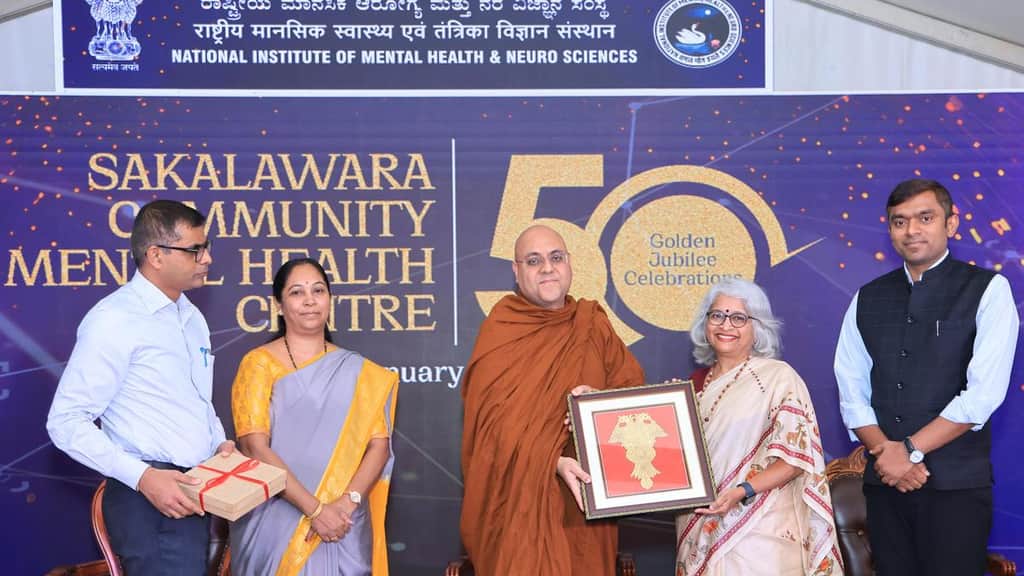
NIMHANS on Saturday marked the 50th anniversary of the Sakalawara Community Mental Health Centre (SCMHC), recalling the evolution of one of India’s earliest community-based mental healthcare initiatives.
Established in 1976, when mental health services in the country were largely urban and institution-based, the Sakalawara centre was conceived as a rural mental health facility. It aimed to take care of communities, experiment with new service and training models, and contributed to the development of the District Mental Health Programme (DMHP), which later became a key component of public mental healthcare in India.
Over the years, the centre expanded from outpatient services and community outreach to long-term rehabilitation and consolidated care. In recent years, it has adopted technology-enabled services, including tele-mental health, in line with national mental health priorities. During the COVID-19 period, services were continued through tele-enabled platforms.
The commemorative programme began with the inauguration of an exhibition documenting five decades of the centre’s work. Designed by the Department of Mental Health Education, NIMHANS, the exhibition traced key milestones from 1976 onwards and highlighted the integration of service delivery, training, and public engagement.
On the occasion, a portrait of Acharya Buddharakkhita, founder of the Maha Bodhi Society, who had established the Mahabodhi Rural Health and Service Centre at Sakalawara in 1965, was unveiled. The centre was taken over by NIMHANS in 1976.
As part of the celebrations, India Post released a commemorative postal cover marking 50 years of the centre’s service. The NIMHANS also released publications documenting the centre’s journey, including an anecdote book, a photo book, and a brochure on the services of the Psychiatric Rehabilitation Services.
A recorded video message from former Union Minister Karan Singh, who had laid the foundation stone of the Rural Mental Health Centre at Sakalawara in 1976, was screened during the programme. Two documentary films tracing the centre’s evolution, outreach and rehabilitation work were also released.
Addressing the gathering, speakers referred to the long association between NIMHANS and the Maha Bodhi Society and the centre’s contribution to community-based mental healthcare. NIMHANS director Pratima Murthy said the Golden Jubilee marked the sustained efforts of several generations of professionals, staff, service users and community partners who contributed to the centre’s work.
The programme concluded with a felicitation of retired faculty and former staff members, followed by a session of reminiscences by those associated with the centre across different phases.
Apart from Dr Murthy, Bhikkhu Sugatananda, Secretary of the Maha Bodhi Society, Bengaluru, V. Tara, IPoS, Director, Postal Services, Bengaluru Headquarters Region, senior administrators, faculty, staff and former associates of the centre attended the event.
Editorial Context & Insight
Original analysis & verification
Methodology
This article includes original analysis and synthesis from our editorial team, cross-referenced with primary sources to ensure depth and accuracy.