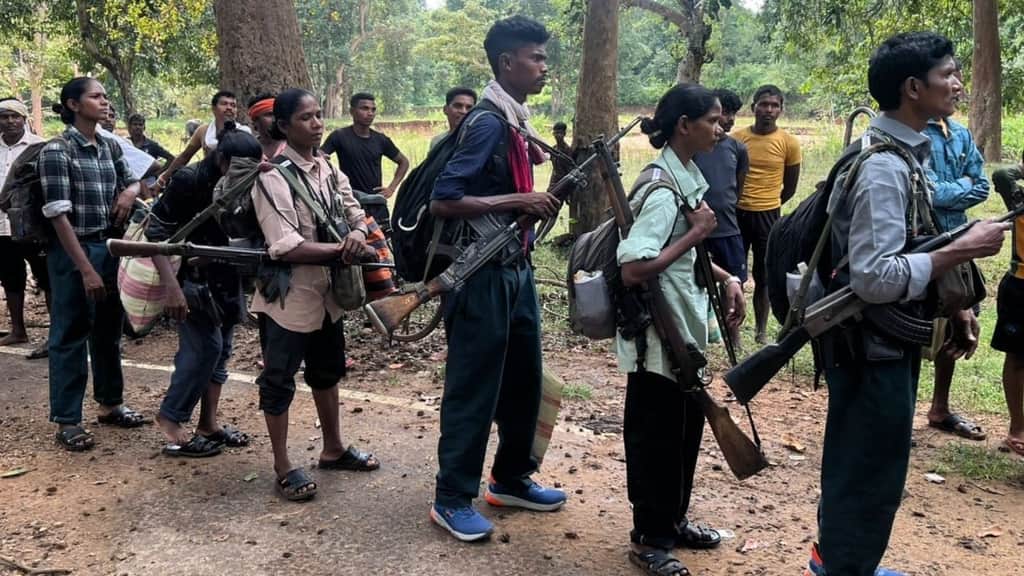
Rarely do the careers of top Maoist leaders from the same village end differently. But that’s how the lives of Barsa Deva alias Barsa Sukka, a top commander of the People’s Liberation Guerrilla Army Battalion 1, and his mentor Madvi Hidma — the most wanted leader within Naxal ranks and the man responsible for some of the bloodiest attacks on security forces — finally did.
Both commanders in Battalion 1 of the People’s Liberation Guerrilla Army (PLGA) — the most dreaded armed wing of the banned outfit — Barsa Deva and Hidma belonged to the same Puwarti village in Sukma, the southernmost district of Chhattisgarh’s Maoist-hit Bastar region.
Hidma, who did not heed appeals by the Centre and the Chhattisgarh government to surrender despite Deputy Chief Minister Vijay Sharma meeting both his and Deva’s families, was killed in an encounter with security forces in Andhra Pradesh in November. On the other hand, his protégé Barsa Deva chose to live and surrendered before Telangana Police Saturday. According to sources in the Telangana Police, Deva’s decision came after a close call — he was allegedly surrounded by elite anti-Maoist units from multiple states near the Telangana border and given an option to surrender.
“He was told that any move to escape would be his last moment on Earth. He understood the gravity of the situation, he understood what happened to his boss Madvi Hidma, and made the wise choice to surrender,” one official said.
The decision had significant import for Hidma’s lieutenant.
“Deva’s decision not to follow his mentor Hidma’s ‘do or die’ diktat is a first because he worshipped Hidma and was his loyal lieutenant. Deva saw what happened to Hidma and he wisely decided to give up violence and try integrating into the mainstream of society,” the official said.
Deva’s surrender came nearly two months after Hidma was killed in an encounter on November 18. That day, Hidma alias Santosh, his wife and four others were fleeing Chhattisgarh when they were surrounded by security forces in the Maredumilli forest in Alluri Sitarama Raju district between 6 am and 7 am.
A member of the Dandakaranya Special Zonal Committee and a key leader of the banned CPI (Maoist), Deva is among the most wanted Maoist commanders, accused of involvement in several attacks on security forces, including the ambush on Congress leaders in Sukma district in May 2013.
Deva carried a bounty of over Rs 50 lakh. His rapid rise from a volunteer of the Dandakaranya Adivasi Kisan Mazdoor Sangh (DKMS) to a ruthless member of the Dandakaranya Special Zonal Committee (DKSZCM) caught Hidma’s attention, who took him under his wing. Deva later went on to oversee Maoist operations in Bastar, Dantewada and Sukma, which he held with an iron hand.
After Hidma was killed in the November encounter, Deva took over as the leader of PLGA Battalion 1, officials said.
“He was Hidma’s deputy tribal warlord who had participated in attacks and is accused of killing over 100 security personnel. Alongside Hidma, he was a deadly leader in the Sukma region, and the cache of arms that he and his cadres surrendered with — including 48 light machine guns (LMGs) — says a lot,” one official said.
He added: “Deva has a lot of blood on his hands, and security forces in several Maoist-affected states are baying for his blood, which explains his choice to surrender in Telangana, where he is not wanted.”
Telangana Police see Deva’s surrender as the end of the Maoist movement not only in the hotbed of Sukma but also in Chhattisgarh. Speaking to The Indian Express a day before Deva’s surrender, Telangana DGP B Shivadhar Reddy said that after the death of Hidma and the surrender of Deva, “there is no one else to carry forward violent Maoist activities”.
After the surrender, Reddy said Deva sought to visit his native village in Chhattisgarh to meet his family.
“We’re okay with that. He cannot rejoin the Maoist movement because it has been finished in that area. His own villagers will not allow him to do anything untoward because they are done with Maoists. We will keep tabs for some time,” he said.
Editorial Context & Insight
Original analysis & verification
Methodology
This article includes original analysis and synthesis from our editorial team, cross-referenced with primary sources to ensure depth and accuracy.
Primary Source
The Indian Express