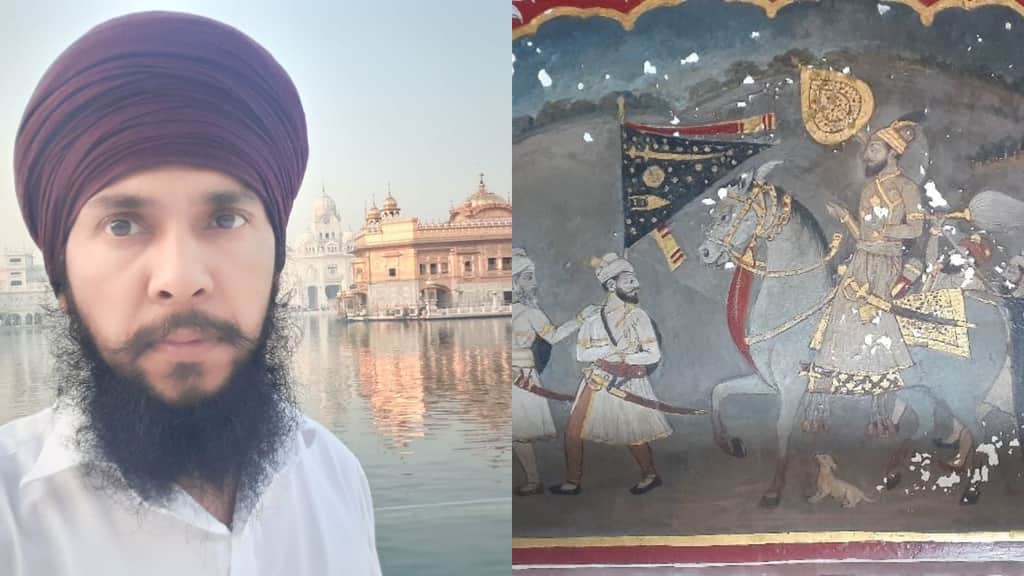
Balbinder Kumar (Left); The fresco he is restoring, which is a replica of the first and the only "realist" painting of Guru Gobind Singh (Right) (Express photo)
Two hundred years after Maharaja Ranjit Singh commissioned the Guru Gobind Singh painting that hangs inside the Golden Temple, hiring an artist from Kangra, the shrine has turned to the same Himachal Pradesh district for its restoration and a second copy.
A PhD in Pahari miniature painting, Balbinder Kumar has been working on the Guru Gobind Singh fresco since August last year. Kumar, who is employed as an Assistant Professor in the Department of Interdisciplinary Studies at the Indian Institute of Himalayan Studies, Himachal Pradesh University, and belongs to Kangri village in Kangra, was first contacted for the restoration of old paintings of the 9th Sikhu Guru, Tegh Bahadur, at the historical Baba Bakala gurdwara near Amritsar in 2021.
Then came the Golden Temple assignment. Says Kumar: “I usually come on the weekends from Shimla to do this work. I am not doing it for money. I feel lucky that the Guru chose me.”
For the duration of the work, Kumar has decided to keep unshorn hair as per the Sikh code. “I decided not to cut my hair after I was assigned the seva. Nobody asked me, there was no condition. It was my own decision, as the Guru guided me.”
The UK-based Guru Nanak Nishkam Sewak Jatha, which takes care of the goldplating of Golden Temple, contacted Kumar for the restoration work. Its representative Inderjit Singh said, “We hired Balbinder Kumar as he comes from the same region, Kangra, from where the first artist who made the painting of Guru Gobind Singh came. We thought he would be the best person to restore the old one and remake the new one.”
The work is painstaking, Kumar says. “The fresco secco masterpiece created during Maharaja Ranjit Singh’s era has weathered centuries, its natural pigments flaking due to natural reactions. I am using the same painting techniques and natural pigments for restoration.”
The stress is on using the same techniques “without any changes”. “There are two types of fresco (mural painting on plaster) – fresco secco (on dry plaster) and fresco buono (on wet plaster). In this case, the work was done in secco, which means that colours are prepared and then their layers applied. With passage of time, layers tend to come off the wall due to dampness or climate issues,” says Kumar.
In her book on the Golden Temple, Madanjit Kaur wrote about the fresco: “In this painting, Guru Gobind Singh, the tenth Master of the faith, is shown on horseback in the company of five beloved ones (Panj Piyaras), with an attendant holding a chauri (flywhisk) behind the horse. One of the leading persons holds a falcon in his right hand, whereas the second one is carrying the Sikh standard. We find some typical motifs of weapons depicted on this flag. A running dog has also been painted near the horse.”
Kumar, who calls his mother Rooma Devi who used to make paintings of Sikh Gurus as his first teacher, says he was inspired to take up higher studies in Kangra style of painting by Samuel Gill, the late student of artist Phulan Rani. He attributes his unique interest to belonging to the same region as Kangra King Maharaja Sansar Chandra, who is credited with patronising the painting style. Kumar’s village Kangri lies about 15 km from what is considered the birthplace of Sansar Chandra.
After he won Kangra, Maharaja Ranjit Singh had found what is considered the first and only “realist” painting depicting Guru Gobind Singh in the collection of Sansar Chandra. The latter declined to give the painting to Ranjit Singh, and so the Maharaja hired an artist from the family of the painter of the original one for a replica at Darbar Sahib.
While the original painting is estimated to have been built in the period between the end of the 17th century and the beginning of the 18th, Maharaja Ranjit Singh got the replica made in the first half of the 19th century.
Kumar says he is cognizant of the legacy he is carrying forward. “The other two artists were from Kangra. It is the blessing of the Guru that I have got this opportunity… I cannot exactly say when my work will be completed, perhaps it will take a couple more visits and I will be done by March… Time doesn’t matter here.”
Editorial Context & Insight
Original analysis & verification
Methodology
This article includes original analysis and synthesis from our editorial team, cross-referenced with primary sources to ensure depth and accuracy.
Primary Source
The Indian Express