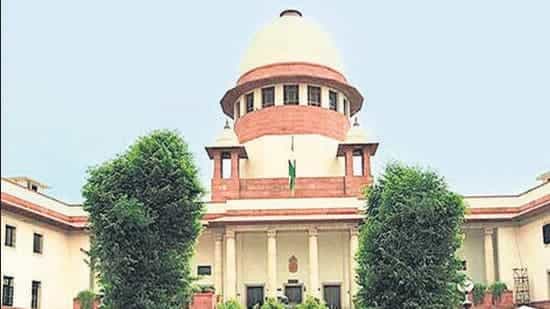
The Supreme Court on Monday held that honesty and transparency are indispensable attributes in persons applying for public employment as it set aside the appointment of a candidate who failed to disclose his criminal antecedents while applying for a job with the Uttar Pradesh government.
“Proper and complete disclosure in applications for government employment is not a simple procedural formality, but a basic requirement rooted in fairness, integrity, and public trust,” said a bench of justices Sanjay Karol and N Kotiswar Singh.
The court was deciding an appeal filed by the Uttar Pradesh government challenging a decision of the Allahabad high court passed on May 22, 2025 which held that non-disclosure of criminal antecedents cannot be fatal to cost a person’s job.
Terming it a “serious lapse”, the top court said, “When an applicant withholds information about criminal antecedents, it undermines this process (of recruitment) by depriving the appointing authority of the opportunity to make a fully informed assessment of suitability.”
Setting aside the HC order, the bench held, “While the law recognizes that non-disclosure, depending on the nature of the offence and surrounding circumstances, may not invariably be fatal to a candidature, it nevertheless remains a serious lapse….Such strikes at the core of trust reposed in candidates for public service, where honesty and transparency are indispensable attributes, and justify a far stricter view by the authorities.”
The case involved one Dinesh Kumar who applied for the post of Sahayak Samiksha Adhikari advertised by the UP Public Service Commission in March 2021. He was selected after he disclosed in the attestation form and verification form that he had no criminal cases pending against him.
This was far from truth as at the time of filling the form, he suppressed information about the pendency of two criminal cases of 2018 and 2019 - one filed for causing grievous hurt among other provisions of the Indian Penal Code (IPC) and another under the Protection of Children from Sexual Offences Act (POCSO).
The truth came to light when the appointing authority asked the concerned Superintendent of Police for character verification. The knowledge of his criminal offences led the authority to seek the opinion from the District Magistrate pursuant to which his appointment was cancelled.
The HC relied on the fact that the candidate was later acquitted in the two cases. The top court, however, failed to take a sympathetic view. It said, “The gravity is significantly compounded when the non-disclosure is repeated (in attestation and verification forms), as it ceases to be accidental or inadvertent and instead reflects deliberate concealment.”
The acquittal and dropping of proceedings against him were subsequent developments, the bench held, while observing that the disclaimer made it clear that concealment of information would render the applicant ineligible/unfit for government service.
“The factum that he said ‘no’ to pending proceedings against him not once but twice, shows demonstrated mal-intent and is in direct contravention of the disclaimer(s) given in the forms. Subsequent acquittal or the fact that he attempted to come clean about the suppression of facts cannot accrue to his benefit,” the bench said.
Editorial Context & Insight
Original analysis and synthesis with multi-source verification
Methodology
This article includes original analysis and synthesis from our editorial team, cross-referenced with multiple primary sources to ensure depth, accuracy, and balanced perspective. All claims are fact-checked and verified before publication.
Editorial Team
Senior Editor
James Chen
Specializes in India coverage
Quality Assurance
Associate Editor
Fact-checking and editorial standards compliance