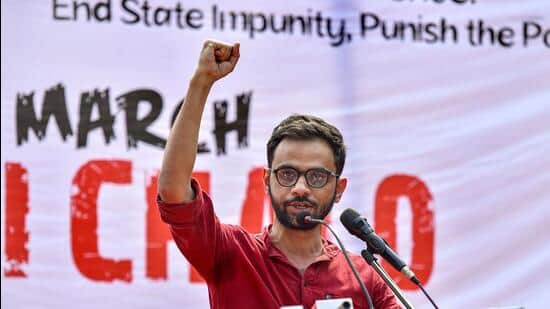
NEW DELHI: The Supreme Court will on January 5 pronounce its verdict on the bail pleas of seven accused, including former JNU scholar Umar Khalid and activist Sharjeel Imam, in the “larger conspiracy” case linked to the 2020 Delhi riots.
A bench of justices Aravind Kumar and NV Anjaria on December 10 reserved its judgment after hearing detailed arguments from the accused and the Delhi Police, which has invoked the Unlawful Activities (Prevention) Act (UAPA) to oppose their release.
Besides Khalid and Imam, the bail pleas pertain to Gulfisha Fatima, Meeran Haider, Shifa ur Rehman, Mohd Saleem Khan and Shadab Ahmed, all of whom are facing prosecution for allegedly being part of a coordinated conspiracy that culminated in communal violence in northeast Delhi in February 2020, in which 53 people died, and hundreds were injured.
During the December 10 hearing, the Supreme Court repeatedly questioned the Delhi Police on the applicability of Section 15 of the UAPA, which defines a “terrorist act” to speeches and protest-related activities relied upon by the prosecution.
The bench specifically asked the police how it proposed to bring the alleged acts within the ambit of terrorism. “How do you bring Section 15 of the UAPA into this case?” the court asked, referring to the defence argument that the material against the accused was confined mainly to speeches made prior to the riots.
Referring to submissions by senior advocate Siddharth Dave, appearing for Imam, the bench observed that the speech relied upon by the prosecution was delivered weeks before the violence.
The bench had also pointed out that, at best, the allegations could attract Section 13(1)(d) of the UAPA, dealing with “unlawful activity”, but sought clarity on whether they crossed the threshold of a terrorist act.
Opposing bail, additional solicitor general SV Raju, appearing for the Delhi Police, contended that the speeches could not be viewed in isolation and had directly led to subsequent actions that threatened the integrity and security of the country.
Raju submitted that Imam’s speech in December 2019, delivered just weeks before the riots, explicitly spoke of violence to follow and referred to “chakka jam”, blocking roads, disrupting essential supplies and “cutting off Assam from the rest of the country”.
Referring to Section 15, Raju argued that the provision covers acts intended to threaten not only territorial integrity but also economic security. “It can’t be said it is just a speech. His speech led to so many other actions for which he is responsible,” the law officer told the court.
On Khalid’s role, the ASG referred to what he described as Khalid’s antecedents, including the controversial 2016 JNU protest, alleging that Khalid had raised the slogan “Bharat tere tukde tukde honge”. Raju said this FIR had been relied upon in the supplementary charge sheet filed in November 2020.
The bench, on the day, had also sought clarification on the prosecution’s assertion that the accused had sought to engineer a “regime change”, an argument that defence counsel said did not find mention in the original charge sheet.
In response, Raju said that the evidence placed before the trial court, particularly WhatsApp chats, demonstrated that regime change was indeed part of the conspiracy. He said multiple WhatsApp groups were created to mobilise protests and coordinate activities.
While Khalid argued that he was not an administrator of these groups and could not post messages, the ASG alleged that Khalid had suppressed the fact that until March 11, 2020, all members could post messages. He further claimed that conversations were deliberately deleted and members were asked to migrate to the Signal app.
A central plank of the bail arguments advanced by the accused was the length of incarceration, with no realistic prospect of a prompt trial.
Khalid has been in custody since September 13, 2020, while Imam has been incarcerated since January 28, 2020, weeks before the riots broke out. The accused argued that the prosecution was adopting a tactic of arresting one accused at a time to artificially extend the alleged conspiracy and delay the trial.
The police, however, blamed the accused for the delay, stating that they had insisted on physical copies of the entire evidence running into nearly 30,000 pages, despite soft copies being offered. Raju told the court that the prosecution was willing to proceed with the trial irrespective of further arrests.
He also relied on Supreme Court precedents to argue that once cognisance is taken of criminal conspiracy under Section 120B of the IPC, the acts and evidence against one accused are admissible against the co-accused.
The bail pleas before the Supreme Court arise from the Delhi high court’s refusal on September 2 to grant bail to the nine accused, including Khalid and Imam.
A bench of justices Navin Chawla and Shalinder Kaur (since retired) held that the material collected by investigators prima facie pointed to a coordinated conspiracy, describing Khalid and Imam as the “intellectual architects” of the violence.
The high court had noted that while Khalid was not physically present in Delhi during the riots, and Imam was in custody when violence broke out, their absence from riot sites was immaterial since mobilisation and planning had already taken place.
The accused had sought parity with fellow student activists Natasha Narwal, Devangana Kalita and Asif Iqbal Tanha, who were granted bail in 2021. The high court, however, rejected this plea, holding that Khalid and Imam’s roles were prima facie more serious. It stressed that while the right to protest is constitutionally protected, conspiratorial violence masquerading as demonstrations cannot be permitted.
Editorial Context & Insight
Original analysis & verification
Methodology
This article includes original analysis and synthesis from our editorial team, cross-referenced with primary sources to ensure depth and accuracy.