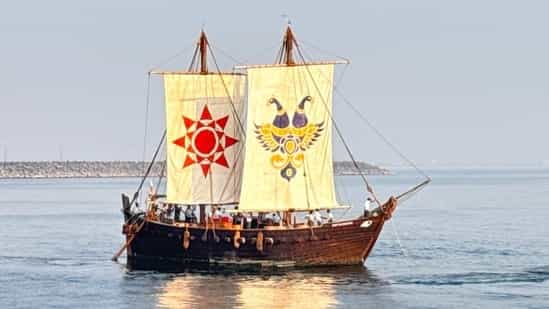
In late December, INSV Kaundinya left Porbandar, in Gujarat, on a 15-day journey to Muscat, in Oman, “symbolically retracing historical maritime routes” that once connected India with the wider Indian Ocean world.
Named for a semi-legendary mariner, Kaundinya is a “stitched ship”, a term referring to vessels built by stitching wooden planks together using coir rope, that formed part of Indian Ocean traffic in and around the first millennium of the Common Era. The vessel’s sails carry the Gandaberunda, the royal emblem of the Kadambas, who once ruled over the Konkan, while its prow features the Simha Yali, a mythical creature often depicted in south Indian temple architecture.
Built in Goa, the vessel is part of a government-led effort to revive traditional knowledge systems. The initiative is driven by Sanjeev Sanyal, a member of the Economic Advisory Council to the Prime Minister and the author of The Ocean of Churn, among other books.
When the ship departed Porbandar, several senior political figures, from Prime Minister Narendra Modi to BJP MP Tejasvi Surya, marked the moment on social media, highlighting the use of an “ancient Indian” stitched-ship technique and India’s rich maritime traditions. On Monday, as the vessel moved closer to Muscat, Sanyal posted on X: “Day 15. We are now well inside Omani waters, north of Sur. Winds are down and back to glassy seas. So close and yet immobile. Nonetheless, the main objective of the Kaundinya now stands proved: we have demonstrated how ancient “stitched” ships from India could cross the oceans, we know the strengths and drawbacks of this design, and have good idea of the human experience of ancient mariners.”
Historians of the Indian Ocean, however, say while the voyage may have wide appeal as an exercise in cultural diplomacy, there is a need to distinguish symbolic reconstruction from historical practice.
The stitched-ship technique is not uniquely Indian. It is part of a wider Indian Ocean littoral tradition, stretching from Oman to Malaysia, says Indian Ocean historian Himanshu Prabha Ray. “It varies from place to place. Even within Oman there were different kinds of stitched boats depending on their purpose. There was never a single template that everyone followed.”
The Kaundinya itself is not a replica of an excavated vessel. It has been reconstructed primarily from a fifth-century mural at the Ajanta Caves, which depicts a stitched ship at sea. Maritime historian Rila Mukherjee questions this approach. She points out that ships shown in the Ajanta murals have been interpreted very differently by scholars over time: as Indian, South Asian, or even Southeast Asian vessels. “There is no consensus,” she says, arguing that a painting, on its own, is an uncertain foundation for reconstructing an early Indian Ocean–going ship.
Around fifteen years ago, Oman undertook a similar exercise. The Jewel of Muscat was built using evidence from a ninth-century shipwreck discovered off the coast of Indonesia. Like the Kaundinya, it was constructed by Babu Shankaran, but its design was based on material recovered from the seabed rather than visual representations alone. “The Jewel was meticulously researched; Kaundinya’s origin, design, and historical veracity remain speculative,” says Mukherjee.
According to Ray, the disagreement, over how far experimental voyages can be read as evidence of historical practice, is inevitable because Indian Ocean history itself was never simple. Movement at sea involved not just long-distance trade, but also coastal communities, fishermen, pilgrims and seasonal travel. Ships and sailing practices varied by region and purpose, and changed over time. That is why there was never a single model of sailing or shipbuilding in the Indian Ocean world.
The Kaundinya voyage needs to be seen in the context of Project Mausam, a Ministry of Culture initiative for UNESCO's transnational nomination of cultural routes across the Indian Ocean in collaboration with other nations, says Ray. This initiative, announced in 2014, has failed to build partnerships with countries that are a part of this shared heritage, or develop a sustained collaborative research and study programme on maritime archaeology.
Radhika Seshan, who has written extensively on Indian Ocean trade and maritime Asia, is more accommodating of the voyage’s symbolic value, but stresses how recently India has begun to look seaward again. For decades, maritime history barely featured in universities, and institutions followed slowly — the Coast Guard itself was established only in 1977. In the process, living traditions were allowed to fade. Catamarans, once central to fishing and coastal travel along the Tamil Nadu coast, have largely been replaced by fibreglass boats, while navigation knowledge survived mostly outside formal archives.
There is now more work being done than before, Seshan says, much of it driven by younger, independent researchers studying coastal communities, boat traditions and oral histories. But without sustained investment in museums, archives and archaeology, she adds, India’s maritime past risks being invoked more often than it is understood.
Editorial Context & Insight
Original analysis and synthesis with multi-source verification
Methodology
This article includes original analysis and synthesis from our editorial team, cross-referenced with multiple primary sources to ensure depth, accuracy, and balanced perspective. All claims are fact-checked and verified before publication.
Editorial Team
Senior Editor
Dr. Elena Rodriguez
Specializes in India coverage
Quality Assurance
Copy Chief
Fact-checking and editorial standards compliance