



Key takeaways
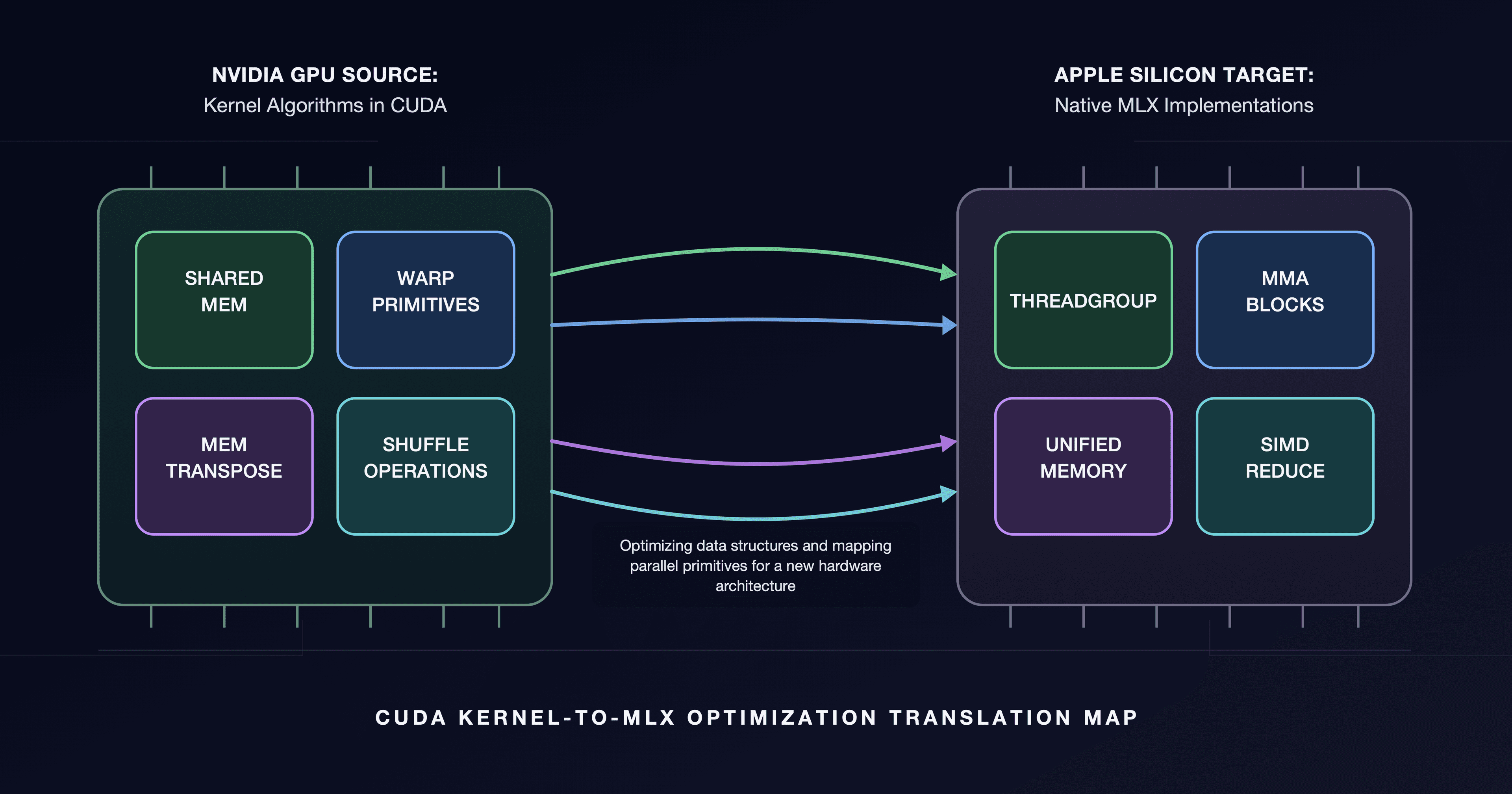
- Figure 1: CUDA-to-MLX optimization translation map.
- Software is changing just as fast, and AI coding tools now generate in minutes what took months of effort a few years ago.
- Transferring a kernel from one vendor’s hardware to another is harder still, and often means rediscovering the same optimizations from…
What happened
Figure 1: CUDA-to-MLX optimization translation map. CUDA optimization knowledge can be translated into architecture-native MLX strategies rather than copied instruction-for-instruction. We face a new epoch in computing. Hardware is changing rapidly — not just faster GPUs, but a growing range of chips from different vendors, each with its own architecture and often tailored to specific AI workloads.
This gap is what motivates the rest of this post. K-Search is an evolutionary kernel optimization framework originally developed by our first author Shiyi Cao at UC Berkeley Sky Lab. Given a naive kernel and a hardware specification, it runs an iterative optimization loop: an LLM reasons about which optimizations to try next, a code-writing model generates candidate kernels, and those candidates are compiled and benchmarked on real hardware.
Measurements feed back into the search, which keeps refining, pursuing promising directions and dropping dead ends until performance converges. Algorithm 1: K-Search via co-evolving world models. The search alternates between selecting the most promising action, instantiating and evaluating code until improvement stagnates, and evolving the world model through insert, update, and prune operations. Adapted from Cao et al. (2026).
Search is grounded by a Spec: a domain-specific document encoding hardware rules, optimization patterns, and mathematical constraints which keeps generated code from hallucinating invalid primitives and ensures candidates will actually compile and run efficiently. 5 Pro Preview) plays both roles: it maintains the reasoning state and writes the kernels.
The reasoning half is prompted as a “GPU kernel performance engineer” and asked to work through a fixed analysis before proposing anything: classify the kernel (reduction, scan, attention/softmax, …), rewrite the reference computation in canonical form, map out data layout and access patterns, and hypothesize the likely bottleneck (bandwidth, latency, compute, or synchronization) in each runtime regime.
Only then does it emit candidate optimizations, each as a single change implementable in one iteration. We call the persistent reasoning state a world model. Rather than a flat list of things to try, it is a decision (prefix) tree: each root→leaf path composes a full optimization plan, and sibling branches are competing alternatives.
Why it matters
Software is changing just as fast, and AI coding tools now generate in minutes what took months of effort a few years ago. With so much of computing now centered on AI, GPU kernels are a crucial component of its success. These are the low-level programs that run inside the GPU, and writing efficient ones is far from obvious — it takes years of expertise to get right.
Transferring a kernel from one vendor’s hardware to another is harder still, and often means rediscovering the same optimizations from scratch. The CUDA ecosystem, for example, has accumulated decades of hard-won kernel expertise: hand-tuned implementations of attention, state space models, and other critical operations representing thousands of engineering hours. Newer hardware ecosystems (Apple Silicon, custom AI accelerators, and others) are growing fast but lack this depth.
In this work we ask whether that expertise can be transferred automatically. We built on K-Search, an evolutionary kernel search framework introduced by Cao et al. at Berkeley Sky Lab that uses AI to optimize GPU kernels, and extended it with a backend for MLX — Apple’s machine-learning framework for its own Apple Silicon chips.
We developed a novel structured CUDA-to-MLX translation layer that lets K-Search take existing CUDA kernels as a knowledge base and adapt them into high-quality GPU kernels for Apple Silicon, rather than rebuilding from scratch.
97x speedup compared to the native MLX Attention kernel, and up to a 20x prefill speedup over the community mlx-lm implementation on the Mamba SSM kernel; we report the numbers, and how much of the gain comes from the translation layer, in the sections below.
Although we focus on MLX kernels for Apple Silicon, the method is not specific to MLX and applies to any ecosystem where CUDA expertise is transferable. Apple’s MLX framework has seen remarkable adoption since late 2023. With Apple Silicon in hundreds of millions of MacBooks and Mac Studios, MLX enables local AI inference without cloud costs.
The unified memory architecture makes it especially attractive for mid-sized models (7B–70B parameters on M series chips). Yet beneath this momentum lies a significant gap: many performance-critical kernels that the NVIDIA ecosystem takes for granted: paged attention, optimized SSM scan kernels, fused MoE routing are either absent or naive without hardware-specific tuning. MLX runs models correctly but often leaves significant performance on the table.
What to watch
Every node is scored — an overall_rating in [0, 10], a confidence in [0, 1], and per-node impacts on memory bandwidth, register pressure, and compute/hardware fit — so the search can rank partial plans and expand the most promising ones.
The tree persists and grows across rounds: refining an idea adds a child node rather than overwriting its parent, and if the best score fails to improve for a few rounds (a stagnation window) the search backs off to explore an alternative branch.