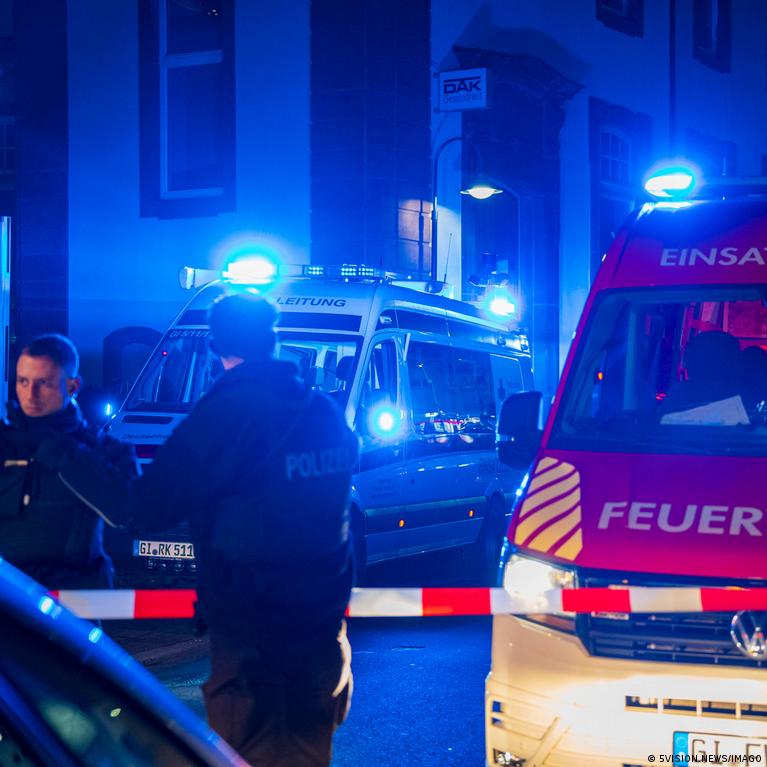
A 32-year-old man drove his car into a bus stop in the town of Giessen, 50 kilometers (31 miles) north of Frankfurt, on Monday afternoon, injuring at least four people, one of them seriously.
Police said the man — an Azerbaijani national who lives in Giessen — had previously crashed into two other vehicles at a junction before continuing, driving into the bus stop shortly after.
Only after driving a bit further did he then stop before being arrested.
"The exact circumstances of the incident are currently unknown and are the subject of the investigation," a police spokesperson said, but declined to comment on whether the incident was believed to be an accident or deliberate behavior.
The area has been cordoned off by police.
A plane carrying 141 Afghan nationals landed in the city of Hanover, Germany's Interior Ministry confirmed.
This comes after the the German government promised them that they'll be taken in to Germany after the Taliban took over.
The plane took off from Islamabad, Pakistan, with the Pakistani government telling Germany it has to take Afghans over until the end of the year before it will deport them to their home country.
The 141 will be distributed among Germany's federal states.
German exports to the United States have dropped sharply this year after significantly higher tariffs took effect.
An analysis by the Institute for the German Economy (IW) said shipments to the US fell 8% in the first three quarters of 2025 compared with the same period last year.
The institute said the decline has hit key industrial sectors hardest. Nearly 70% of the export drop came from the automotive, chemicals, and mechanical engineering industries, which have traditionally been pillars of transatlantic trade.
The automotive sector has been particularly affected. Exports of passenger cars and auto parts were down about 15% over the period, the analysis found.
Mechanical engineering exports have suffered from especially steep US tariffs on steel and aluminum, as well as products made from those metals, which currently stand at 50%. For chemical products, the IW said lower output in Germany linked to higher energy prices has also weighed on exports.
The downturn marks a clear break from previous years. Between 2016 and 2024, German exports to the US had grown by an average of about 5% per year, according to the institute.
To view this video please enable JavaScript, and consider upgrading to a web browser that supports HTML5 video
Most German companies are not filled with festive cheer, even as economic prospects improve slightly.
A new Ifo Institute survey shows fewer than 15% of firms expect their situation to improve in 2026, while 59% foresee no change and 26% anticipate a deterioration.
"The companies remain very restrained — there is no sign of a fresh start anywhere," said Ifo survey head Klaus Wohlrabe.
The Munich-based institute surveys several thousand firms each month for its business climate assessments.
Industry, Germany's largest sector, is marginally more upbeat than average, with 18.2% of companies expecting better conditions. But pessimism is widespread in construction and retail.
In construction, 33.2% of firms expect their situation to worsen next year, while only 10.3% see improvement — despite the federal government’s plans for major infrastructure spending.
"The figures are surprising, because the sector could actually hope for the announced investment package," Wohlrabe said.
Germany’s Federal Criminal Police Office (BKA) has recorded more than 1,000 suspicious drone flights since the beginning of 2025, according to a report by the mass-circulation Bild newspaper.
The drone threat assessment has been conducted since the start of the year and incorporates findings from Germany's military, the Bundeswehr.
"Military installations in Germany are frequently overflown, including places where Ukrainian soldiers are being trained — who may be carrying smartphones," BKA President Holger Münch told Bild.
"The drone records which smartphones are present on site and may then later be able to identify them again on the Ukrainian front."
He also said apprehending and questioning drone pilots remains a challenge. When asked whether the drones were always controlled by Russian actors, Münch said this has not been established with "100% certainty" but also voiced suspicions that many instances of drone activity were directed by state actors aiming to create insecurity.
Nearly half of Germans now doubt that Germany's conservative-led coalition will last until the next scheduled election, according to a new survey.
A YouGov poll for the DPA news agency found that 49% do not expect the government to survive the full term, with 17% predicting a coalition collapse as early as next year.
Another 32% believe the Chancellor Friedrich Merz's CDU/CSU and center-left Social Democrats (SPD) will make it through 2026 but fail to reach the end of the legislative period.
The center-right CDU/CSU bloc and the center-left SPD secured a narrow majority in the Bundestag after the February 23 election, winning 328 seats together. A coalition needs at least 316 seats in order to rule.
The CDU/CSU won 28.5% and the SPD 16.4% in the vote. However, both parties have since slipped in opinion polls, with the Union now at 24–27% and the SPD at 13–14%, leaving them short of a majority in every recent survey.
After seven and a half months marked by frequent disputes, only 9% of respondents believe the level of infighting will ease next year, while 49% expect tensions to remain unchanged and 21% think they will intensify.
The coalition is set to navigate five state elections in 2026.
German defense companies have carried out explosive tests of warheads for a kamikaze drone.
Defense firms TDW and Stark Defence said the industrial trial on a test range in Bavaria was successful, producing a powerful detonation that punched deep holes through armored steel plates.
The companies said the test laid the groundwork for rapidly fielding the drone system with the German armed forces.
The weapon, known as Virtus, is classified as so-called loitering munition — a drone fitted with a warhead that can circle over a target area for extended periods before being directed via data link to strike.
Germany's industrial demand for raw materials has kept shrinking as both domestic production and imports fell again last year, according to the Federal Institute for Geosciences and Natural Resources (BGR) in Hanover.
The latest research, published on Monday, looks into the data recorded in 2024. According to the report, domestic output of mineral raw materials dropped to a new low of 475 million tons, down from 534 million tons in the already weak previous year.
BGR Vice President Volker Steinbach said the decline reflects ongoing economic stagnation, with high interest rates, persistent inflation, and elevated energy and transport costs weighing on industry and reducing demand.
The downturn has been broad. Over five years, Germany's domestic raw material production has fallen by about one third. Imports also declined, slipping 2.8% from the previous year to 288 million tons.
Energy raw materials saw the sharpest pullback. Imports of coal, oil, and gas fell again, while imports of metals and non-metallic raw materials edged slightly higher compared with 2023.
Guten Tag from the former West German capital, Bonn, in the heart of Europe.
Join us as we browse key news from Germany, including reports of suspicious drones overflying military sites where Germany helps train Ukrainian soldiers, and the poll that found that 49% of German voters think the current government will not hold together until the end of its term.
Follow us here for this and the latest headlines throughout the day.