When Virat Kohli fell for twin ducks on his return to international cricket against Australia in October last year, it felt like an ageing star fast losing his grip over his art. But the assumptions of Kohli’s decline in ODIs are grossly exaggerated, he would prove in subsequent outings. Those failures seem to have lit a fire within him that continues to shine brightly.
The century-record holder in this format, fell seven runs shy of another three-figure mark, but the 91-ball knock was another sumptuous effort and played a central role in India’s four-wicket win over New Zealand in the first of the three-match series, at the BCA stadium. Needing 301 for win, he entered in the ninth over of India’s chase, with the score on 39 for 1. When he departed 30 overs later, India could see the finish line in the Vadodara skies. India nearly made a meal out of it, losing three wickets for eight runs. But the platform Kohli had erected sufficed for India to surpass the total in the 49th over.
It was a classical Kohli knock, vibrant and unruffled, seizing the drift of the game and scoring runs without fuss or taking risks. It was as though he was on cruise mode, comfortably riding the waves on a surface where the odd ball gripped. With Rohit Sharma having set the early tone, there wasn’t a desperate need to reenergise the innings.
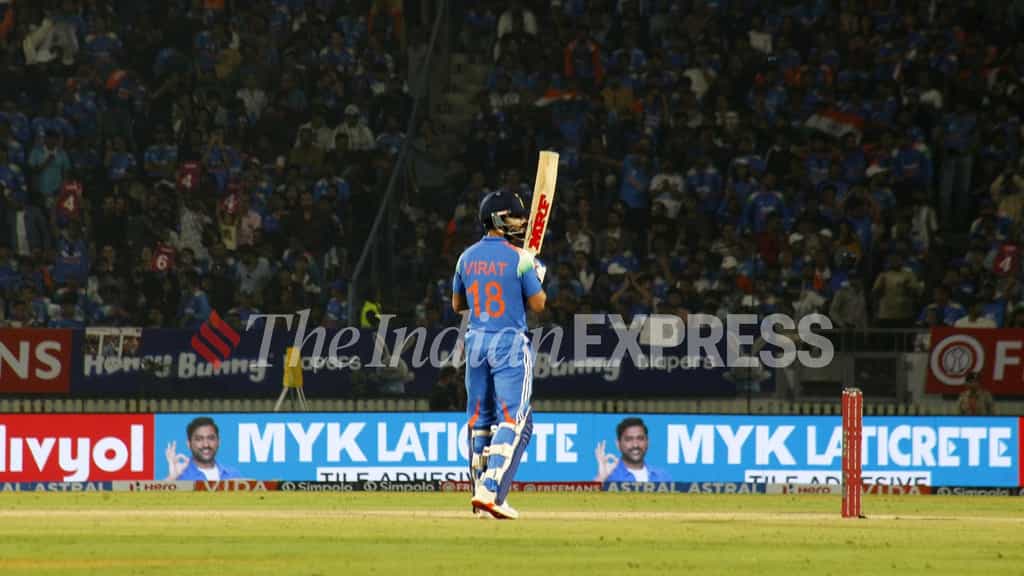
Virat Kohli plays a shot in the 1st ODI match vs New Zealand at Vadodara on Sunday. (Express Photo | Bhupendra Rana)
Yet, he set a scorching pace. The methods stood out. He batted serenely, keeping desperate slogs and premeditated risks asunder, reverting to modes that had stood by him over the years of constructing one of the greatest 50-over careers in the sport. Such was his confidence and authority that he batted with emphatic precision. A sublime on-drive, a carpet-burning cover drive and an imperious pull shot over fine leg regaled the audience. Even when Kohli took the aerial route, it felt calculated—a deliberate choice to disrupt lengths, to surprise the bowler into retreat. Otherwise, it was all along the ground, all classical riffs, all very Kohli.
After the game, he explained his approach to the broadcasters. “If we were batting first, I’d have gone harder. The experience does kick in, but the main thing was to get the team ahead and to a winning position. The basic idea is I bat at No. 3 and if the situation is tricky, I try to counterattack without playing outrageous shots. I felt today, we can string in a quick partnership in the first 20 balls,” he said.
The bowlers were forced into reactive mode. Lengths were readjusted, but with little effect. Fields were shuffled in a mild panic. He even met good balls with such decisiveness that they disappeared into the fence. Anything fractionally short was punished; anything over-pitched was driven with authority. The pressure he exerted was not just through scoring, but the inevitability that he would run away with the game. His aura.
The difference was not the aggression. Since the South Africa ODIs, he has batted with a newfound freedom. But the timing, a friend that temporarily kept away. Noticeable is a slight change in approach too, precisely in taking half-risks. These days, he chooses the moments to take risks early, rather than wait for the innings to unfold. In doing so, he flipped the usual script. The powerplay and the early overs, the supposedly cautious phase, especially at the start of the innings, have become a platform to dominate. He completed his fifty off 44 balls in the 22nd overs. By then, he had also helped Shubman Gill prosper after a sluggish start.
India’s Virat Kohli walks off after getting dismissed against New Zealand in the first ODI at Vadodara. (Express Photo by Bhupendra Rana)
The captain played second fiddle, first to Rohit and then to Kohli. But one shot turbocharged his innings. In the fourth ball of the 160th over, bowled by debutant Kristian Clarke, he strode his front foot to the pitch of a full delivery and finessed it down the ground, between Kohli’s legs. However, just when he was shifting through the gears he handed Adithya Ashok his first wicket.
Walked in Shreyas Iyer, another batsman on comeback trail. He last played for India in October but was given the perfect platform to bat, with the pressure of the chase eased by Gill and Kohli’s 118-run stand. Sensing that Kohli was in the zone, Iyer paced his innings smartly, rotating the strike and combining them with the odd big six to keep the New Zealand bowling on its toes. Kohli looked set to get to his 54th ODI ton, but then he failed to a familiar red-ball nemesis of his, the beanpole Kyle Jamieson. In his attempt to loft a ball past cover, he mistimed the ball to mid-off. A stutter ensued, but KL Rahul kept his cool and saw the hosts home, with a little help from Harshit Rana’s cameo. But it was yet another night of Kohli.
Brief Scores: India 306 for 6 (Kohli 93, Gill 56, Iyer 49, Jamieson 4-41) beat New Zealand 300 for 8 (Mitchell 84, Nicholls 62, Conway 56, Siraj 2-40, Prasidh 2-60, Rana 2-65) by four wickets.
Editorial Context & Insight
Original analysis and synthesis with multi-source verification
Methodology
This article includes original analysis and synthesis from our editorial team, cross-referenced with multiple primary sources to ensure depth, accuracy, and balanced perspective. All claims are fact-checked and verified before publication.
Primary Source
Verified Source
The Indian Express
Editorial Team
Senior Editor
Dr. Elena Rodriguez
Specializes in India coverage
Quality Assurance
Copy Chief
Fact-checking and editorial standards compliance