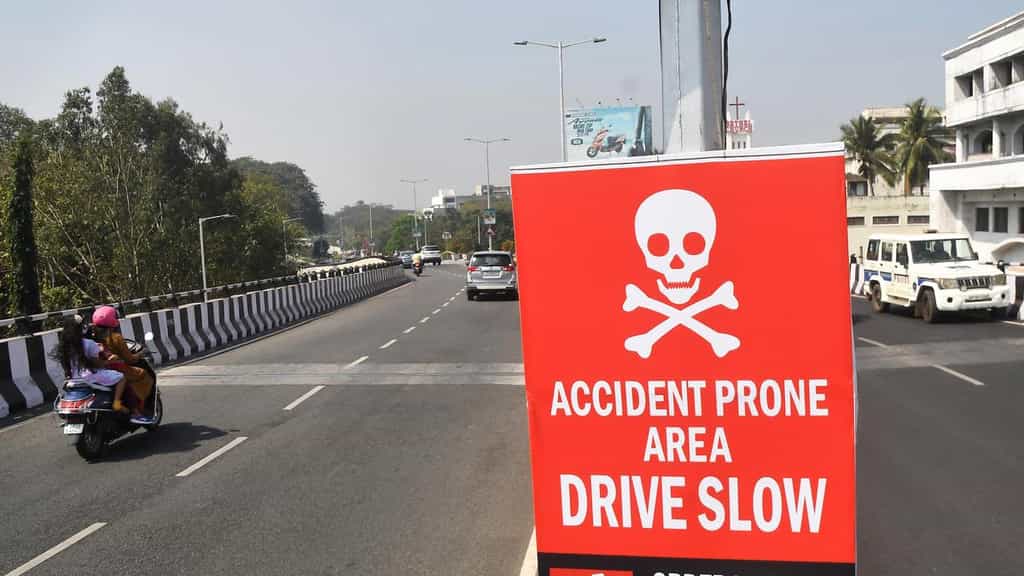
The Union Ministry of Road Transport and Highways, in collaboration with the NGO Save Life Foundation, has identified 100 districts in the country with the highest number of road crashes to launch a data-driven zero-fatalities programme, in line with the government’s pledge to reduce road fatalities by 50% by 2030.
The 100 districts span 15 States, with the programme already rolled out in all 20 identified districts in Uttar Pradesh, 19 in Tamil Nadu, 11 in Maharashtra, and nine in Karnataka.
“Districts have been identified as key units of change, as 63% of road accident fatalities occur outside National Highways, such as on State Highways and State expressways, major district roads, other district roads, and local roads. Since crash deaths are often influenced by local factors such as road design, traffic enforcement, and hospital preparedness, effective interventions are best coordinated at the district level, where administration converges through measures like traffic policing and emergency medical care,” said Founder and CEO of Save Life Foundation, Piyush Tewari, at a press conference held at the recently concluded two-day conference of Transport Ministers, Secretaries and Commissioners of all States and Union Territories.
A pilot project conducted by the Save Life Foundation in Nashik, Maharashtra, identified the specific months and hourly windows with the highest fatality rates, and this information was shared with the police. Head-on collisions, rear-end crashes, and pedestrian accidents together made up 60% of the fatalities.
The study also identified 379 critical crash locations responsible for 54% of deaths in the district, which were further narrowed down for targeted interventions. Additionally, 21% of fatalities were attributed to speeding and rash driving. The analysis found that 19 of the district’s 39 police stations accounted for 76 fatalities.
This is how the project aims to promote a data-driven approach to crash mitigation and fatality reduction, enabling police stations to allocate manpower and resources more effectively.
An analysis across the 100 identified districts recorded nearly 89,000 road deaths in 2023 and 2024. The foundation mapped 17,331 critical crash locations, which together accounted for 58% of total fatalities. It also identified high-risk time windows during which most crashes occurred, enabling law enforcement agencies to better target resource deployment.
An analysis of the accidents showed that rear-end collisions accounted for 26% of fatalities, head-on collisions for 23%, and pedestrian crashes for another 23%. Together, these three categories were responsible for 72% of all road deaths.
The framework for the zero-fatalities programme adopts a multi-pronged approach. It includes engineering audits and the implementation of low-cost, quick-build safety interventions, such as correcting faulty road intersections. The programme also features a data-driven enforcement strategy, moving beyond sporadic drives to deploy enforcement teams based on analysed data on high-risk locations and time periods.
A key pillar is trauma care response, with measures to improve ambulance response time standards, map hospital catchment areas, establish clear referral protocols, and train first responders. The framework also emphasises community behaviour change, including the formal recognition of community first responders, coordination among education authorities, transport unions, and urban local bodies, and safeguards for good Samaritans who rush the injured to hospitals.
Minister for Road Transport and Highways Nitin Gadkari said the District Collectors, Transport Ministers, and Members of Parliament from the 100 identified districts will be part of an accident prevention committee and will be invited to New Delhi for a conference.
India’s ambition to reduce road crash deaths by 50% by 2030 is in line with the Stockholm Declaration on Road Safety (2020), which calls for a safe systems approach to cut road traffic deaths and injuries by at least 50% by 2030, as well as with the UN Sustainable Development Goals that have set the same target.
Editorial Context & Insight
Original analysis & verification
Methodology
This article includes original analysis and synthesis from our editorial team, cross-referenced with primary sources to ensure depth and accuracy.