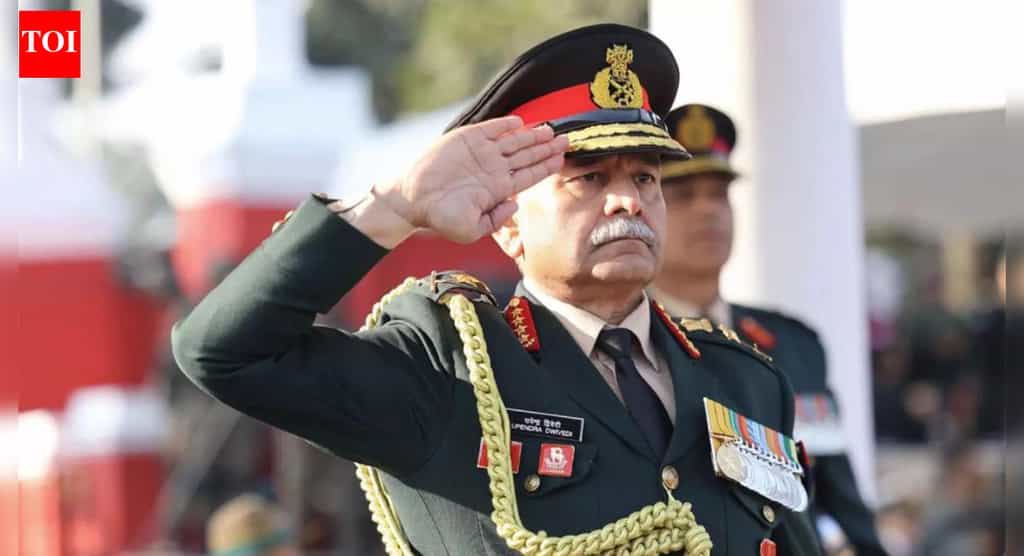
NEW DELHI: Army chief General Upendra Dwivedi on Tuesday reflected on Operation Sindoor, describing the counterterror military action as “ongoing” and warning Pakistan, that any “future misadventure will be resolutely responded.”General Dwivedi issued a direct warning to Islamabad, saying, “At least 6 terror camps still active across the LoC & 2 across the International Border after Operation Sindoor against Pakistan. Will act, if any (nefarious) attempts are carried out.”Addressing the annual Army Day press conference, General Dwivedi said a “clear decision to respond decisively was taken at the highest level.” He added, “Operation Sindoor was conceptualised and executed with precision.
Through 22 minutes of initiation on 7th May and an orchestration that lasted 88 hours up to 10th May, the operation reset strategic assumptions by striking deep, dismantling terror infrastructure, and puncturing the longstanding nuclear rhetoric.
The Army successfully destroyed seven out of the nine targets and thereafter played a pivotal role in ensuring a calibrated response to Pak actions.”Upendra Dwivedi highlighted the heavy losses suffered by the Pakistan Army, saying that about 100 of their personnel were killed in firing along the LoC and IB during heightened military tensions.
The Army chief stressed that the counterterror operation, launched in retaliation to the Pahalgam terror attack, remains “ongoing,” and reiterated the warning of a “resolute response” to any future misadventures. He also acknowledged the coordinated national effort behind the operation, saying, “I must acknowledge the proactive role of all stakeholders at the national level, including CAPFs, Intelligences, civic bodies, state administration and other ministries, whether it's MHA, Railways and many more...”Calling the mission a benchmark in joint operations, General Dwivedi said, “Operation Sindoor was the best example of tri-service synergy under clear-cut political directive and full freedom to act or respond.”He also added that military responses in future will be a combined action and reflected on PM Modi's vision, General Dwivedi said, "Now the battle of the future will not be won by a single arm or even a single service.
It will be a national level enterprise. The Prime Minister captured this vision through the mantra of 'Jai' where jointness integrates our effort, Atmanirbharta empowers our capability and accelerated innovation drives ideas into action.
So, based on the lessons drawn during Operation Sindoor and in line with the Indian Army's belief that change must come at the velocity of relevance. We prefix the verb acceleration to all our nouns, that is initiatives."Commenting on the broader security situation in the North, the Army chief said, “The situation along the Northern Front remains stable, but needs constant vigil. Apex-level interactions, renewed contact, and confidence-building measures are contributing to the gradual normalisation of the situation that has also enabled grazing, hydrotherapy camps, and other activities along the Northern Borders." On India-China border, he said "With our continued strategic orientation on this front, our deployment along the Line of Actual Control remains balanced and robust.
Concurrently, capability development and infrastructure enhancement are progressing through a whole-of-government approach.”The Army chief also responded to and rejected China’s repeated claims on Jammu and Kashmir’s Shaksgam Valley, reiterating India’s position: “India considers the 1963 agreement between Pakistan and China on Shaksgam Valley.”In the intervening nights of May 6 and May 7, Indian armed forces carried out precision strikes under Operation Sindoor, destroying nine major terror hideouts in Pakistan-occupied Kashmir (PoK) and mainland Pakistan. The strikes targeted headquarters of Jaish-e-Mohammad in Bahawalpur and
in Muridke.Following the operation, India clarified that the strikes were aimed solely at terror infrastructure and not Pakistan’s state machinery. However, Islamabad attempted retaliatory missile and drone attacks, all of which were intercepted and neutralised by India’s air defence systems, preventing any loss of life or property.India then launched retaliatory strikes on Pakistan’s military installations, destroying key airbases, including Rahim Yar Khan and the Nur Khan airbase.
Editorial Context & Insight
Original analysis and synthesis with multi-source verification
Methodology
This article includes original analysis and synthesis from our editorial team, cross-referenced with multiple primary sources to ensure depth, accuracy, and balanced perspective. All claims are fact-checked and verified before publication.
Primary Source
Verified Source
Times of India
Editorial Team
Senior Editor
Aisha Patel
Specializes in India coverage
Quality Assurance
Associate Editor
Fact-checking and editorial standards compliance