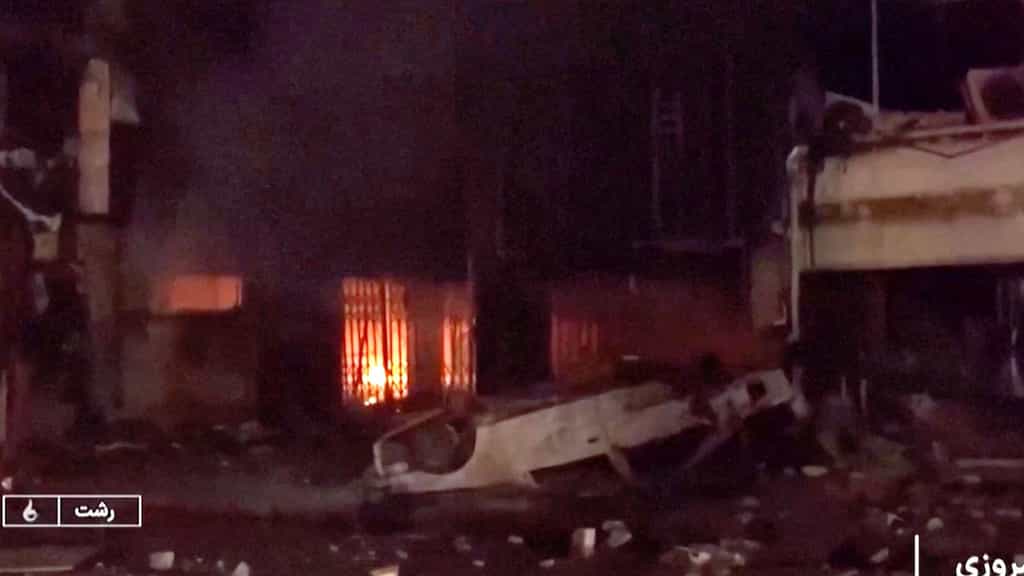
That is how a young Iranian woman describes what she witnessed on the streets of Tehran before managing to escape the country on a flight to Dubai.
What is happening inside Iran has been even harder than usual to verify after the country was plunged into a near-total internet blackout.
For five days, most Iranians were unable to contact the outside world. Only now have limited phone connections begun to return.
This woman, who fears for the safety of family members still in Iran, asked not to be identified. For the purposes of this article, I will call her Leila.
She believes what she saw - and what she carried out with her - is information the world urgently needs to hear.
"Everyone was being shot in the head," she says, describing the protests that erupted nightly in her neighbourhood in northern Tehran.
"I don't think they have space in the jails anymore, so they're just killing us."
Leila left Iran on Sunday night, after several days of escalating unrest that began on Thursday, when much of the country lost contact with the outside world.
Each evening, she says, protesters gathered in the streets. Others shouted from their apartment windows: "Death to Khamenei" and "Bring back Reza Pahlavi," calling for an end to the Islamic Republic and a return of the Shah.
"There were lots and lots of people being sprayed with tear gas. It burned our lips and our eyes," she says.
She describes watching a member of Iran's Revolutionary Guard point a gun at a mother sitting in a car with a toddler in the back seat. The child was crying.
The woman was not shot - but others were.
"I saw two guys by a mosque," Leila says. "One of them was just shot in the head.
"We hid in a side street. When we came back a few minutes later, the body was already gone."
Leila says people she knew personally were killed, too.
"My friend's cousin was shot five times. He died," she says. "People around me were being killed."
In recent days, Iranian authorities have insisted the situation is "under control". State television has announced that schools, banks and businesses will remain closed this week - officially due to pollution.
Leila's account paints a very different picture.
During the day, she says, the streets were quieter. People spoke in hushed voices. She overheard whispered conversations: "Did you hear my friend's brother is dead?"
By evening, the streets filled again.
On Friday, she says the area around Tehran University resembled a war zone. On Saturday and Sunday, protests began even earlier - around 6pm.
"It wasn't just young people," she says. "There were old people, religious people, women wearing hijab.
"Even very Islamic people were protesting and calling for the return of the Shah."
Leila holds dual nationality and had already planned to leave Iran this week. Her original flight was cancelled.
With internet access cut, she travelled to the airport in person on Sunday to see whether she could get out.
After securing a seat on an Iranian airline, her mother begged her to delete the photos and videos she had taken of the protests. The images included bloodstained streets and a dead body.
At the departure gate, she says she was approached by a member of Iran's security services.
"He knew my final destination," she says. "He asked how long I had lived there and why. He asked to see my phone and went through my photos.
"I was terrified - it felt like he knew everything about me."
She believes that if the images had been found, she would have been imprisoned indefinitely.
Like many Iranians now speaking from outside the country, Leila says she wants international intervention - including from the United States.
"Without help from the outside, they just kill everyone," she says. "This time, everybody is out on the streets. It doesn't matter if you're rich or poor, religious or not, old or young.
"Everybody wants these people gone. But it's super difficult," she adds. "They've cut the internet. They're killing people.
"Everyone is scared to bring the information out."
Editorial Context & Insight
Original analysis and synthesis with multi-source verification
Methodology
This article includes original analysis and synthesis from our editorial team, cross-referenced with multiple primary sources to ensure depth, accuracy, and balanced perspective. All claims are fact-checked and verified before publication.
Editorial Team
Senior Editor
Shiv Shakti Mishra
Specializes in World coverage
Quality Assurance
Fact-Check Editor
Fact-checking and editorial standards compliance