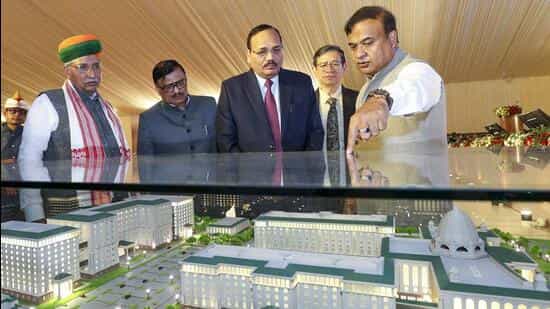
Guwahati: Chief Justice of India Surya Kant on Sunday said that the law must never appear remote, forbidding or out of reach, and laid emphasis on integrated court complexes with adequate space for young lawyers.
The CJI laid the foundation stone of an integrated judicial complex in North Guwahati’s Rangmahal, where the Gauhati High Court will be relocated. Besides Assam, the Gauhati High Court caters to Arunachal Pradesh, Nagaland and Mizoram as well.
Addressing the ceremony, which was attended by Assam chief minister Himanta Biswa Sarma, several judges of the Supreme Court, the chief justices of the high courts of Manipur, Meghalaya and Tripura, and Union Minister for Law and Justice Arjun Ram Meghwal, CJI Kant said, “The foundation stone-laying ceremony represents far more than the commencement of a project. It is the reaffirmation of the constitutional guarantee that the law must never appear remote, forbidding or out of reach.”
The new integrated high court complex, which will have 31 courtrooms, will be built at a cost of ₹479 crore in the first phase. A judicial township, which would include a district court complex with 65 courtrooms, will be constructed near the high court at a later stage and is expected to cost another ₹1,227 crore.
“Integration (of a judicial complex) is not just an architectural concept, it is how the system works as a whole... As the head of the Indian judiciary, my priority is the development of future infrastructure that empowers those (lawyers) who are yet to find their footing rather than catering to those who have already reaped the full harvest of this profession,” the CJI said.
The entire complex will spread over an area of 128 bighas (over 42 acres). Once completed, the high court will be relocated from its present location at Uzanbazar.
More than 1,300 lawyers associated with the Gauhati High Court Bar Association (GHCBA) have been opposing the relocation and have staged a hunger strike.
Members of the association said they have opposed the proposal since it was announced a year and a half ago, arguing that the relocation will severely affect access to justice for thousands of litigants across the region, as shifting to Rangmahal would require an additional 10–15 km of travel, adding logistical burdens on litigants, many of whom come from remote districts of Assam and neighbouring states.
“I was surprised when it was brought to my notice that some members of the bar association are opposed to the new complex. I believe either they are ill informed or, unfortunately, they are not realising the need and the necessity for the young members of the bar and those who are in queue to join the profession,” CJI Kant said.
“I hope and firmly believe that each one of them will realise that personal vested interests — only because you might be having a good office near the old complex — should not be valid or justified grounds to hamper the development of a modern-day infrastructure which has a completely futuristic approach,” he added.
The CJI appealed to the state government and the Chief Justice of the Gauhati High Court to ensure that every young lawyer, irrespective of socio-economic background or professional seniority, is provided space in the new complex to practise their profession.
Editorial Context & Insight
Original analysis and synthesis with multi-source verification
Methodology
This article includes original analysis and synthesis from our editorial team, cross-referenced with multiple primary sources to ensure depth, accuracy, and balanced perspective. All claims are fact-checked and verified before publication.
Editorial Team
Senior Editor
Shiv Shakti Mishra
Specializes in India coverage
Quality Assurance
Associate Editor
Fact-checking and editorial standards compliance