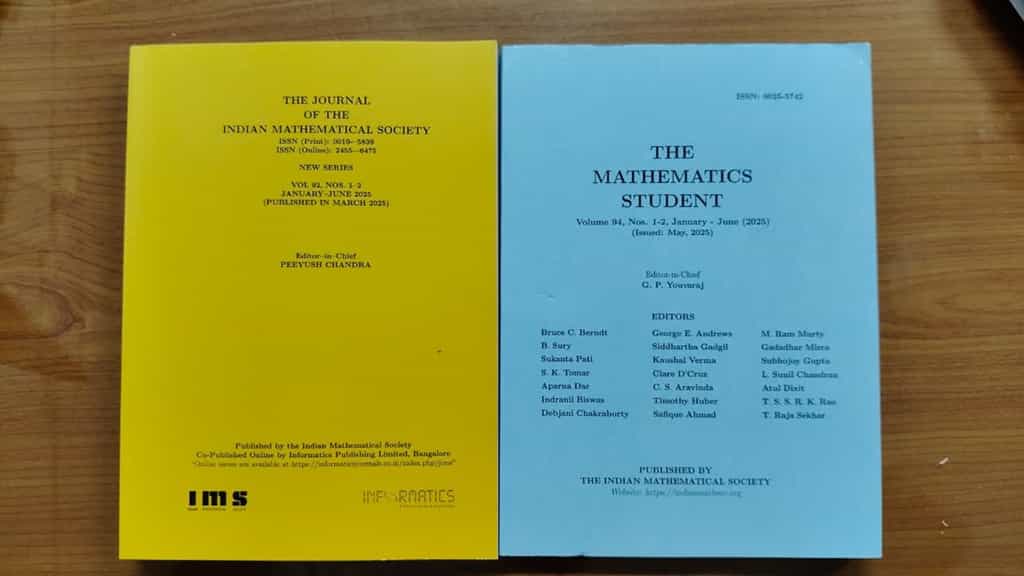
The story of legendary Indian mathematician Srinivasa Ramanujan is well known. Born into a poor family in Tamil Nadu and without a formal educational degree, Ramanujan’s letters to Cambridge mathematician G H Hardy in 1913 shook the world of mathematics in the UK, leading to an invitation to work there. Considered one of the greatest minds of all time, he went on to publish groundbreaking papers across many fields of mathematics until his untimely death at the age of 32. What is less known, however, is that his journey began with a Pune-based journal: the Journal of the Indian Mathematical Society (JIMS).
Ramanujan’s first-ever published paper, appeared in the third volume of the Journal of the Indian Mathematical Society. (File Photo)
Born in 1887 in Erode, Ramanujan got married in 1909 to a 10-year-old girl and started looking for a job. He was always brilliant in mathematics but had exited college around 1906 as he could not pass other subjects.
According to the 1927 book Collected Papers of Srinivasa Ramanujan, he met V Ramaswami Aiyar, the founder of IMS and then deputy collector at Tirukoilur, in 1910. Greatly impressed by Ramanujan’s mathematical skills, Aiyar sent him with a recommendation to P V Seshu Aiyar at the Presidency College in Madras. Seshu Aiyar helped Ramanujan land a job in Madras and also communicated his work to the Indian Mathematical Society (IMS).
Ramanujan’s first-ever published paper, titled ‘Some properties of Bernoulli’s numbers’, appeared in the third volume of the Journal of the Indian Mathematical Society in 1911. Over the course of the next eight years, Ramanujan published at least 10 more papers in the journal on diverse topics like simultaneous equations, complicated integrals, the sum of series, and others.
Speaking to The Indian Express, Professor Yashwant Borse, Head of the Mathematics Department at Savitribai Phule Pune University, highlighted an interesting result published by Ramanujan in the same journal in 1913. The paper took on an age-old problem in geometry called Squaring a Circle, wherein a square with area equivalent to a given circle has to be constructed in a finite number of steps using just a compass and a ruler with no markings.
Theoretically, it was known that an exact solution to this problem was not possible. Ramanujan derived an approximate solution for the problem solution which was so accurate that if the area of the given circle was 1.4 lakh square miles, then the error in the calculated side of the square would be just about an inch.
A different solution of similar accuracy was already given by Dutch mathematician Jacob de Gelder in the previous century, but Ramanujan was not one to be stopped. He published a second version of his own solution in 1914 in the Quarterly Journal of Mathematics, giving a significantly more accurate result.
The society was originally founded as The Indian Mathematical Club by V Ramaswami Aiyar in April 1907 with its headquarters at Pune. Its name was changed to The Indian Mathematical Society in 1910. Even though most of the founders were from Chennai, they felt that a more central location like Pune was more suitable for the society.
The society’s office moved around to other locations, like the Madras University in Chennai, for operational convenience. Finally, in 2007, IMS’s Centenary Year Conference was held in Pune, and it was decided that a permanent office would be set up at the Center for Advanced Studies in Mathematics (CASM) at SPPU. The society is now a registered non-profit organisation with more than 3,500 lifetime members.
However, its operational struggles continue. IMS currently operates out of a small room shared with an IGNOU centre. Maruti Shikare, Emeritus Professor at JSPM University and General Secretary of IMS, said, “Originally, it was planned that IMS would get a full floor at the math department at SPPU. However, the plan fell through.”
In 2025, the 92nd volume of JIMS was published. The society has also published another journal, The Mathematics Student, since 1932. The journals are still in good repute and indexed in Scopus, but attracting the top talent of the world to publish here will require effort and changes, Shikare explained. “We appoint or invite very good people to be on the editorial board. But right now, we send the paper to just one referee. But the top journals send the paper to two referees,” he said.
“All the established societies from developed countries, they have their own offices, they have their own staff, and that’s why they are doing well. Our editor is in Delhi, the managing editor is in Dhule, the journals are printed in Pune, and they are distributed in Bangalore. So you imagine how all these things are coordinated,” he added.
The IMS bought a flat in Aundh in 2010 to be used as an office, but it is currently used only as a store room, as it is small in size. The society also purchased an acre of land in 2020 on Alandi Road near Pune International Airport and plans to build a Ganit Bavan (Mathematics House) with a cost of over Rs 13 crore. The society has been appealing to mathematicians through its newsletter and its website for donations.
Editorial Context & Insight
Original analysis & verification
Methodology
This article includes original analysis and synthesis from our editorial team, cross-referenced with primary sources to ensure depth and accuracy.
Primary Source
The Indian Express