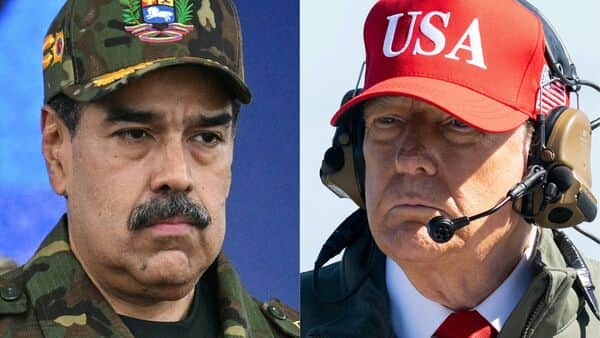
Venezuela bombing today: The United States on Saturday, 3 January 2026, carried out strikes on Venezuela and captured President Nicolas Maduro amid allegations of the leader turning the country into a “narco-state” and manipulating elections.
The Venezuelan government said in a statement that Caracas, along with the states like Miranda, Aragua and La Guaira, were attacked. At least seven attacks were reported, and low-flying aircraft were heard around 2 am (local time) in the national capital.
“The United States of America has successfully carried out a large scale strike against Venezuela and its leader, President Nicolas Maduro, who has been, along with his wife, captured and flown out of the Country,” said US President Donald Trump in his recent post on TruthSocial.
1. Nicolas Maduro's assassination attempt: In August 2018, several drones, which were armed with explosives, were headed towards President Nicolas Maduro as an attempt at assassination during a military parade.
Maduro escaped the scene without any injuries, but the following day, the interior minister announced that six people had been arrested in connection with the attack.
According to a CNN report, in October 2018, one of the suspects in Maduro's assassination attempt fell to their death from the 10th floor of a building. The country's intelligence department said the cause of death was suicide.
2. Maduro wasn't Chávez's preferred successor: Hugo Chávez, who was elected as the president of Venezuela in the 1998 elections, died after a long-standing battle with cancer in March 2013.
Hugo Chávez's preferred successor was Henrique Capriles, and not Nicolas Maduro, who won by a narrow margin in the elections held after Chávez's death.
Britannica data showed that Capriles challenged the outcome of the election results and called for a full recount of the votes over allegations of voting irregularities.
The National Election Council ordered an audit, but later Capriles himself refused to participate when the Council chose not to examine the signatures and fingerprints of voters on the registers in its investigation. Nicolas Maduro was soon sworn in as the President in the month of April 2013.
3. Is Venezuela rich in minerals? Venezuela is a country which is rich in minerals with deposits of petroleum, natural gas, iron ore, gold, bauxite, other minerals, along with hydropower and diamonds, CIA data showed.
The country uses 24.4% of its land for agricultural purposes (2023 data), 53.5% is forests, and 22.1% is for other usage. However, the country is also at risk of being subject to floods, rockslides, mudslides and periodic droughts.
4. Hyperinflation: Venezuela is a country which has recorded hyperinflation in its economy, with the average consumer prices rising 682.1% annually as of 2026 data collected from the International Monetary Fund (IMF) website.
The country's real gross domestic product (GDP) growth was at a negative 3% as of 2026, with the unemployment rate at 35.6% in the Venezuelan economy.
CIA data showed that the inflation rate in the economy rose 200.9% in 2022, 1,588.5% in 2021, and 2,355.1% in 2020, according to the official data.
5. Venezuela's biggest export partner: Venezuela's largest export partner as of 2023 was the United States, with more than 50% of the shipments to the country. China, at 10%, Spain at 9%, Brazil at 6%, and Turkey at 5% were the other trading partners.
Venezuela exports its top 5 commodities like crude petroleum, petroleum coke, scrap iron, alcohols, and fertilisers.
6. Mandated military service: In Venezuela, the voluntary military service for women of the age of 25 years is 18-30 months.
In case of minimum service obligation, the tenure is 24-30 months for people, and 17 to 39 months for Militia service. However, all the citizens of the nation within the military service age of 18 to 50 years are mandated to register for military service and will be subject to military training.
7. Venezuela's drug problem: The US authorities have tagged Venezuela as a major illicit drug-producing and drug-transit country, and a major precursor of chemical production.
Although there is limited data, Venezuela's drug problem involves the production of Schedule 1 and Schedule 2 drugs like Marijuana, cocaine, and fentanyl, among other illicit drugs.
Due to the geographical location of the country, drug traffickers use Colombia, Ecuador and Panama to transport the illegal substances into the United States via boats, aeroplanes, among other things.
8. Oil reserves: World Population Review data showed that Venezuela has the largest oil reserves in the world, with over 303 billion barrels as of 2024, followed by Saudi Arabia and Iran.
These oil reserves have made the country a high-priority concern for the United States. According to a news report from Progressive International, US oil companies have historically played a major role in exploiting Venezuela's oil fields.
The report also highlighted that the United States has tried every conceivable means to break Venezuela in 2014 and 2017, and now has launched an attack against the country in 2026.
9. Venezuela's corruption: The Borgen Project report from late 2019 highlighted that the Maduro Administration’s first attempt to silence political opposition was in March 2017.
The government stripped the legislative powers and immunity of the opposition-led parliament and allegedly used torture, unhinged homicides and extrajudicial executions to maintain support in the years following this scandal, as per the report.
10. Venezuelan Death Squad: The Borgen Project report also cited the United Nations, which claimed that the government backed death squads killing nearly 7,000 people between 2018 and May 2019.
The report also alleged that Maduro attempted to legitimise the killings by using the Venezuelan Special Police Force (FAES) to conduct the raids, which were claimed to have been staged through family separation techniques and the illegal planting of contraband and narcotics.
Editorial Context & Insight
Original analysis & verification
Methodology
This article includes original analysis and synthesis from our editorial team, cross-referenced with primary sources to ensure depth and accuracy.
Primary Source
mint - news