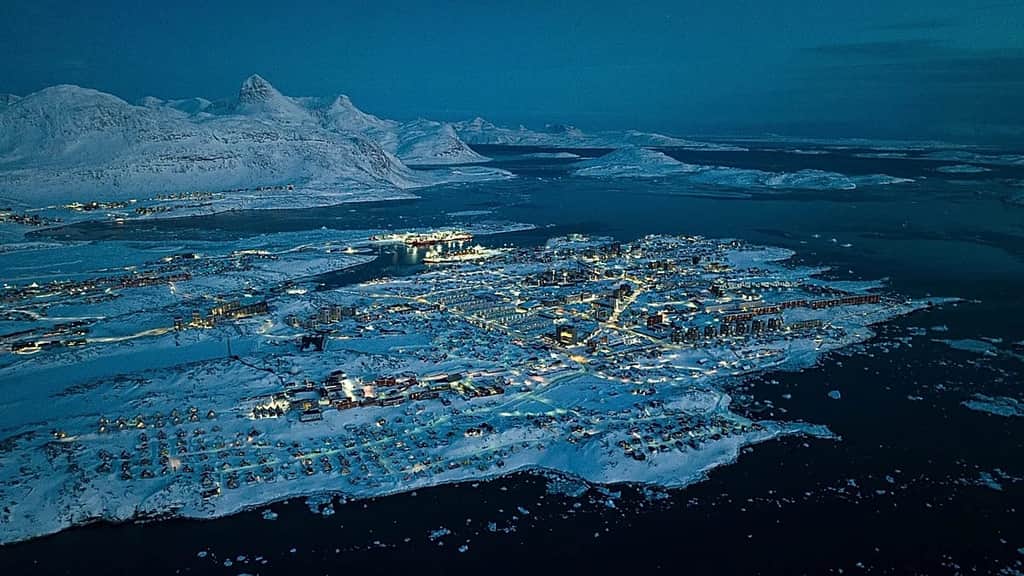
The use of the "US military is always an option" in President Donald Trump's bid to annex Greenland and bring it under Washington's control, the White House said late on Tuesday.
Trump floated the idea of purchasing Greenland, which is part of the kingdom of Denmark, in his first term in office but after the weekend military operation which saw Venezuela’s President Nicolás Maduro seized, Trump has renewed calls for the US to take over Greenland, citing strategic reasons.
"President Trump has made it well known that acquiring Greenland is a national security priority of the United States and it’s vital to deter our adversaries in the Arctic region," White House press secretary Karoline Leavitt said in a statement.
"The president and his team are discussing a range of options to pursue this important foreign policy goal, and of course, utilising the US military is always an option at the commander in chief's disposal."
Leavitt’s comments are notable since Trump's newly-appointed special envoy to Greenland, Jeff Landry, and deputy White House chief of staff Stephen Miller, both suggested that military action wouldn't be necessary.
Asked on Tuesday if he felt comfortable taking military action in Greenland, Republican House Speaker Mike Johnson said, "No. I don't think it's appropriate."
The White House statement followed the leaders of France, Germany, Italy, Poland, Spain and the United Kingdom joining Danish Prime Minister Mette Frederiksen in issuing a statement reaffirming that the strategic, mineral-rich Arctic island "belongs to its people."
Their statement defended the sovereignty of Greenland, which is a self-governing territory of Denmark and thus part of the NATO military alliance.
"Greenland belongs to its people," it said. "It is for Denmark and Greenland, and them only, to decide on matters concerning Denmark and Greenland."
Canadian Prime Minister Mark Carney also expressed his support, and announced a visit to Greenland early next month by Canada's Governor General Mary Simon, who is of Inuit descent, and Foreign Minister Anita Anand.
"The future of Greenland and Denmark are decided solely by the people of Denmark," Carney said, standing next to Frederiksen at the Canadian Embassy in Paris.
Also on Tuesday, Louisiana Governor Jeff Landry, who Trump appointed last month as US special envoy to Greenland, said when it comes to making a deal with Greenland, he isn't interested in talking to people in Denmark who "absolutely have made their position clear."
Nor does Landry want to talk to European diplomats. Instead, he said, he wants to have conversations directly with residents of Greenland.
"I want to talk to people who want an opportunity to improve the quality of life in Greenland," Landry said on a Fox News radio show.
He said he has already exchanged emails with Greenlanders who had reached out to him.
"They tell me they like to hunt, they like to fish, they like to have a good time. I'm like, y'all belong in Louisiana. I'm gonna call it culinary diplomacy," Landry quipped.
Stephen Miller, the White House deputy chief of staff, said on Monday that Greenland should be part of the United States in spite of a warning by Frederiksen that a US takeover would amount to the end of NATO.
"The president has been clear for months now that the United States should be the nation that has Greenland as part of our overall security apparatus," Miller said during an interview with CNN on Monday.
The Danish leader, together with Greenland's prime minister Jens-Frederik Nielsen, has firmly rejected Trump's renewed call for the island to come under US control.
Trump has argued the US needs to control Greenland to ensure it security in the face of rising threats from China and Russia in the Arctic.
"It's so strategic right now," he told reporters Sunday.
"Greenland is covered with Russian and Chinese ships all over the place," Trump said. "We need Greenland from the standpoint of national security, and Denmark is not going to be able to do it."
Miller wondered during his interview on Monday whether Denmark can assert control over Greenland.
"What is the basis of their territorial claim," Miller said. "What is their basis of having Greenland as a colony of Denmark?"
But he also said it wasn't necessary to consider whether the US administration was contemplating an armed intervention.
"There is no need to even think or talk about this in the context that you are asking, of a military operation. Nobody is going to fight the US militarily over the future of Greenland," Miller said.
Greenland had been a colony of the Danish kingdom for hundreds of years, becoming an integral part in 1953.
The US government recognised Denmark's right to the whole of Greenland at the beginning of the 20th century.
Legislation in 2009 that extended self-government to Greenland also recognised a right to independence under international law, an option favoured by a majority of Greenlanders.
Greenland sits off the northeastern coast of Canada, with more than two-thirds of its territory lying within the Arctic Circle. That location has made it crucial to the defence of North America since World War II.
The US Department of Defence operates the remote Pituffik Space Base in northwestern Greenland.
Constructed after a 1951 defence agreement between Denmark and the US, the base supports missile warning, missile defence and space surveillance operations for the US and NATO.
Greenland guards part of the GIUK Gap, named for the initials of Greenland, Iceland and the United Kingdom, where NATO monitors Russian naval movements in the North Atlantic.
Greenland also has large deposits of rare earth minerals needed to make everything from computers and smartphones to the batteries, solar and wind technologies that will power a transition away from fossil fuels.
The US Geological Survey also has identified potential offshore deposits of oil and natural gas.
Editorial Context & Insight
Original analysis & verification
Methodology
This article includes original analysis and synthesis from our editorial team, cross-referenced with primary sources to ensure depth and accuracy.
Primary Source
Latest News From Euronews | Euronews RSS