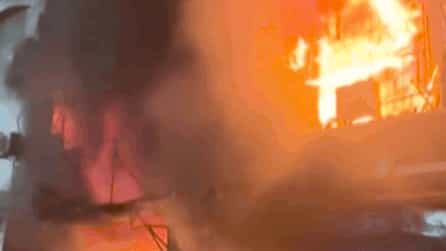
At least 5,000 people were killed during protests across Iran, including about 500 security personnel. Speaking anonymously, an official told Reuters that the deadliest clashes occurred in Kurdish areas in north-west Iran.This came after, Iran's Supreme Leader Ayatollah Ali Khamenei has admitted that thousands of people were killed during the country’s recent nationwide protests, a rare acknowledgment from the clerical leadership amid a harsh crackdown that has drawn international attention, Fox News reported.Speaking in a televised address on Saturday, Khamenei said the unrest, which began in late December over economic hardships and wider political grievances, resulted in "several thousand" deaths.
He described some of the casualties as caused by "inhuman, savage" conditions, but pointed the finger at the United States and other foreign actors rather than Iran’s own security forces.
Supreme Leader Khamenei also accused US President Donald Trump of encouraging the recent demonstrations in Iran, which began over rising costs and inflation but later turned into broader anti-regime protests. Khamenei called Trump a "criminal" for commenting on and supporting the movement from afar.
He claimed protesters were being manipulated by foreign powers and warned that authorities would not allow what he termed "criminals" to go unpunished, Fox News reported.Human rights organisations have condemned the crackdown, estimating that more than 3,000 people have died in clashes between demonstrators and security forces. Exact figures remain difficult to verify, in part due to intermittent internet shutdowns imposed by Iranian authorities.
Meanwhile, Donald Trump intensified his rhetoric against Iran, calling for an end to Khamenei’s 37-year rule.Trump said it was "time to look for new leadership" in Iran. In an interview with Politico, he criticised the clerical establishment’s handling of the unrest and condemned Khamenei’s role in the violence, calling him unfit to lead.Thousands of protesters across the country have been killed over the past three weeks, prompting Trump to repeatedly warn of possible military action.
On Tuesday, he urged Iranians to continue protesting and “take over institutions,” adding that “help is on its way.”"What he is guilty of, as the leader of a country, is the complete destruction of the country and the use of violence at levels never seen before," Trump said. "Leadership is about respect, not fear and death."He added, "The man is a sick man who should run his country properly and stop killing people. His country is the worst place to live anywhere in the world because of poor leadership."The exchange comes as global attention focuses on Iran’s political stability and the possibility of further international pressure.
“We consider the US president a criminal for the casualties, damage and slander inflicted on the Iranian nation,” Khamenei said. He described the recent protests as “an American plot” and accused Washington of seeking to “devour Iran.”Meanwhile, Khamenei continued to accuse the US, posting on X: "The recent sedition was orchestrated by the US.
The US did the planning and took action. The US's goal is to devour Iran."
Iran has slipped into an uneasy calm following a harsh crackdown on protests that began on December 28 over the country’s struggling economy. The group, which has tracked protests in Iran for years, says it relies on a network of activists inside the country to verify fatalities. The Associated Press said it has not been able to independently confirm the death toll.Iranian officials have repeatedly accused the United States and Israel of stoking the unrest. On Friday, President Masoud Pezeshkian echoed those claims during a phone call with Russian President Vladimir Putin, accusing Washington and Tel Aviv of interfering in Iran’s internal affairs.
There have been no signs of fresh protests for several days in Tehran, where shops have reopened and street life has largely returned to normal.
Iranian state media have also reported no new unrest.During the protests, authorities shut down internet access nationwide on January 8. On Saturday, however, text messaging and very limited internet services briefly resumed in parts of the country, witnesses said.Mobile text messaging began working overnight, while some users were able to access local websites through Iran’s domestic internet network. A few also reported limited access to international sites using virtual private networks, or VPNs.The scope of the restored access and the reason behind it were not immediately clear. It is possible authorities reactivated some systems ahead of the start of the working week, as the shutdown has disrupted businesses, especially banks handling transactions.Internet traffic monitoring service Cloudflare and internet access advocacy group NetBlocks reported slight increases in connectivity on Saturday morning. Iran’s semiofficial Mehr news agency also confirmed limited internet access, without offering an explanation.
Curated by Aisha Patel