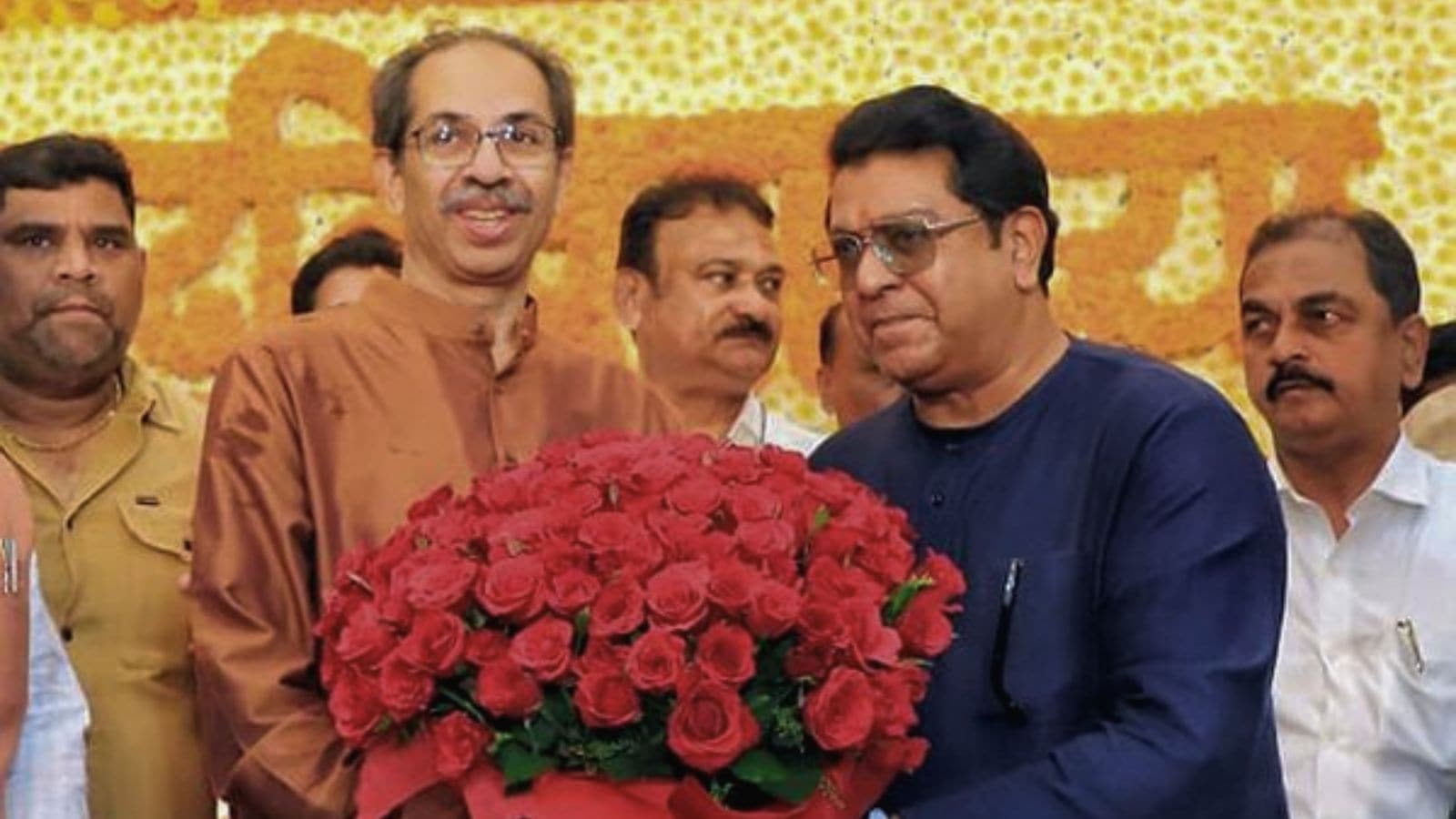
On January 30, 2003, Raj Thackeray, then a senior leader of the Shiv Sena, proposed the name of his cousin Uddhav Thackeray for the post of working president of the party. The moment stood out because Raj had often, in private, criticised Uddhav’s way of functioning. Yet in public, he backed a decision that would go on to alter the party’s future.
The proposal was accepted by the Shiv Sena, setting off a chain of events that eventually led to Raj Thackeray breaking away and forming the Maharashtra Navnirman Sena in 2006. The split marked the beginning of nearly two decades of political rivalry between the two cousins.
Now, after years of open hostility, Uddhav Thackeray and Raj Thackeray have decided to formalise a political alliance that will be announced on Wednesday ahead of the upcoming municipal corporation elections, including the polls to the Brihanmumbai Municipal Corporation. At a time when the Thackeray name no longer commands the influence it once did across Maharashtra’s cities, the reunion has raised a key question on whether this coming together still matter to voters, or has the state’s politics moved on.
As Mumbai prepares for the long-pending BMC elections, the possible tie-up between the two Thackerays has gained importance mainly because of its impact on voting patterns.
For years, the split between the Shiv Sena and the MNS has divided the Marathi speaking voters in the city. In several civic wards, this division has helped rival parties win with narrow margins. An understanding between the two, even if limited to seat adjustments or informal cooperation, could reduce this split and change outcomes in key pockets of Mumbai.
Past voting figures underline this point. When the undivided Shiv Sena contested elections on its own, without the BJP, it secured 28.29 per cent of the votes in Mumbai, followed closely by the BJP at 27.32 per cent. The MNS had a vote share of 7.73 per cent. In earlier elections, the Shiv Sena had polled 21.85 per cent, the MNS 20.67 per cent, while the BJP, contesting in alliance with the Sena, managed only 8.64 per cent.
Despite changes brought about by the split in the Shiv Sena and shifting political loyalties, the combined vote base of the Sena UBT and the MNS still has the potential, at least on paper, to put up a strong fight in civic elections.
A joint campaign by the Thackeray cousins could also blunt Eknath Shinde’s claim to the Shiv Sena legacy by projecting unity within the Thackeray family. For many Marathi voters who still hold the Sena’s past in high regard, this show of togetherness could carry emotional weight and influence how the party’s legacy is viewed at the ballot box.
Uddhav Thackeray brings with him an established party structure and long experience in Mumbai’s civic politics. Raj Thackeray, meanwhile, offers a different appeal. His speeches’ sharp tone resonates with sections of Marathi voters who believe the Shiv Sena has lost its earlier aggression.
Beyond numbers, the tie-up also carries emotional weight. Bal Thackeray’s image remains strong in Mumbai’s political memory, especially among older voters. Seeing his son and nephew share a platform sends a message of unity to supporters who have watched the family and the party split over the years. At a time when voters are weary of defections and shifting loyalties, this symbolism still has value.
The original break between the cousins was not about ideology, but about leadership. That issue has never been fully settled. Both leaders have strong personalities and loyal followers, and it remains unclear how decisions on candidates and control of power will be taken.
Their political styles also differ. Uddhav Thackeray has adopted a more restrained approach in recent years, while Raj Thackeray continues to rely on fiery speeches and direct attacks. Bringing these styles together may widen appeal, but it could also lead to confusion during the campaign.
Raj Thackeray’s past shifts in political position including bashing Prime Minister Narendra Modi and then cosying up to the BJP as well as his frequent meetings with Chief Minister Devendra Fadnavis have also raised questions about how firm his commitment to the alliance will be.
In electoral terms, the tie-up may make a difference in Marathi dominated wards, particularly in central Mumbai and older suburbs. In areas with large migrant populations, however, the impact may be limited.
“There will be no impact on the outcome of the BMC elections, even if the Thackeray cousins come together and contest the polls.” Mumbai BJP president Ameet Satam said.
The possible political understanding between Uddhav Thackeray and Raj Thackeray could also have consequences beyond Mumbai’s civic contest, particularly for the Maha Vikas Aghadi and the Shiv Sena UBT’s relationship with the Congress.
The Congress had joined hands with the Shiv Sena in 2019 mainly to keep the BJP out of power, despite unease over the Sena’s political past. Any visible association with Raj Thackeray and the Maharashtra Navnirman Sena, which has a record of campaigns against migrants and minorities, is likely to deepen that discomfort. Congress leaders fear such an alignment could alienate key sections of their support base, especially minorities and migrant communities in cities like Mumbai and Pune.
The Congress already has announced its intent to contest BMC elections on its own. However, the Sena’s decision to tie-up with a figure like Raj Thackeray has the potential to disturb the MVA relationship.
This tension has already surfaced publicly. “If the Congress is serious about defeating the BJP, it must rethink its decision to go solo in the BMC elections. Admittedly, Mumbai’s political dynamics and electoral arithmetic are different from the rest of Maharashtra. But the Opposition needs to fight unitedly,” Sena (UBT) leader Sanjay Raut said.