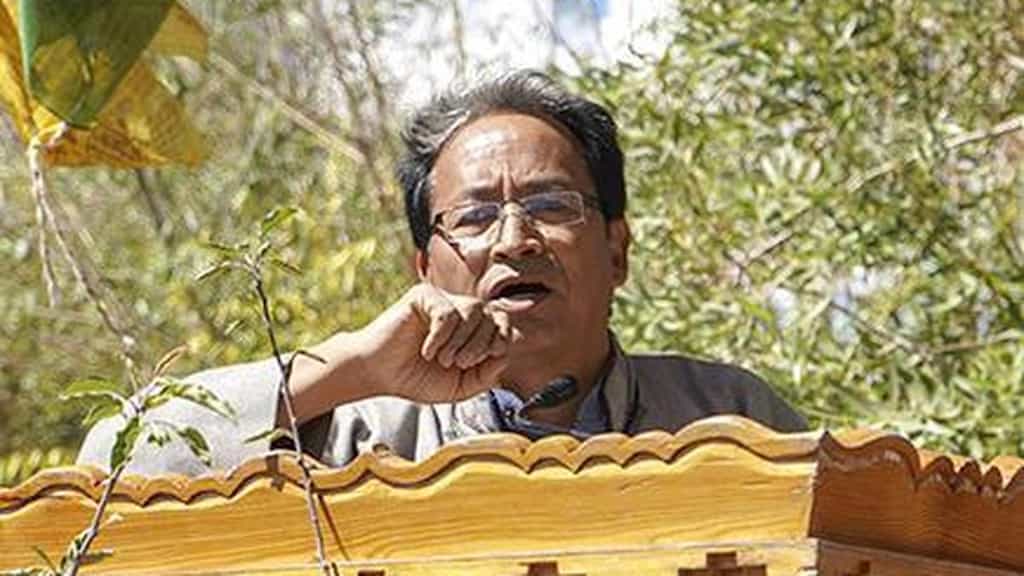
Sonam Wangchuk, a climate activist turned Ladakhi Statehood campaigner, impressed upon the Supreme Court that malice on the part of authorities was at the bottom of his detention, evident from the fact that local authorities chose to “hide” his public messages calling for peace after protests for Statehood led to violence and multiple deaths.
Two days after the violence, Mr. Wangchuk was detained under the National Security Act (NSA), 1980 on September 26, 2025, and then shifted to the Jodhpur Central Jail in Rajasthan.
Opening the case for his release before a Bench of Justices Aravind Kumar and P.B. Varale on Thursday, senior advocate Kapil Sibal, appearing for both Mr. Wangchuk and his wife Gitanjali Angmo, submitted that “his messages for peace were misconceived as calls for violence”.
Mr. Sibal played Mr. Wangchuk’s messages to the Bench in open court. The videos of his messages and the evidence of his social media posts urging people to end the violence were not given to the detaining authority by the local authorities, he said.
“Is it not the duty of the local authorities to hand over the videos to the detaining authority? The detaining authority was oblivious of the videos. It is settled law that the even material in favour of the detainee be considered before passing a detention order,” Mr. Sibal argued.
The senior counsel said the attempt to overlook or even cast aside evidence favourable to the detainee pointed to deliberate malice, thus colouring the detention order.
“The videos were clear evidence that he was against the violence. This vital fact was not placed before the detaining authority,” Mr. Sibal contended.
Ms. Angmo has alleged that the Ministry of Home Affairs had nursed “strong reservations” about Mr. Wangchuk’s inclusion in the delegation of the Leh Apex Body and Kargil Democratic Alliance to the High Powered Committee formed to conduct talks with the government on issues of Statehood and Sixth Schedule safeguards for Ladakh. Mr. Sibal said the state action began suddenly just two months before the elections for the Ladakh Autonomous Hill Development Council, Leh, which was scheduled for October 2025. At the time, Mr. Wangchuk had publicly raised the issue of fulfilling the Sixth Schedule promises made during the 2020 elections.
“Allegations surfaced for the first time only in the last two months, August and September 2025, which immediately resulted in notices and actions against his institutions, including cancellation of land leases, CBI investigation, FCRA cancellation, Income Tax summons, and other proceedings,” he submitted.
Mr. Sibal argued that the complete grounds for the detention were only shared with Mr. Wangchuk after a “flagrant delay” of 28 days, despite his repeated representations to his detainers. It was submitted that Section 8 of the NSA required the detaining authority to share the complete reasons for detention within 10 days in order to afford the detenue the “earliest opportunity to make an effective representation against the order to the appropriate government”.
He said that four crucial videos which formed the “core evidentiary foundation” for the detention were supplied to the activist 28 days after the date of his detention, on the evening of October 23, just one day before his proceedings before the Advisory Board. The detention order itself did not reflect the ‘independent, subjective satisfaction’ of the Magistrate ordering the detention, as mandated under Section 3 of NSA, 1980, Ms. Angmo has contended.
The court scheduled the next hearing on January 12.
Editorial Context & Insight
Original analysis & verification
Methodology
This article includes original analysis and synthesis from our editorial team, cross-referenced with primary sources to ensure depth and accuracy.