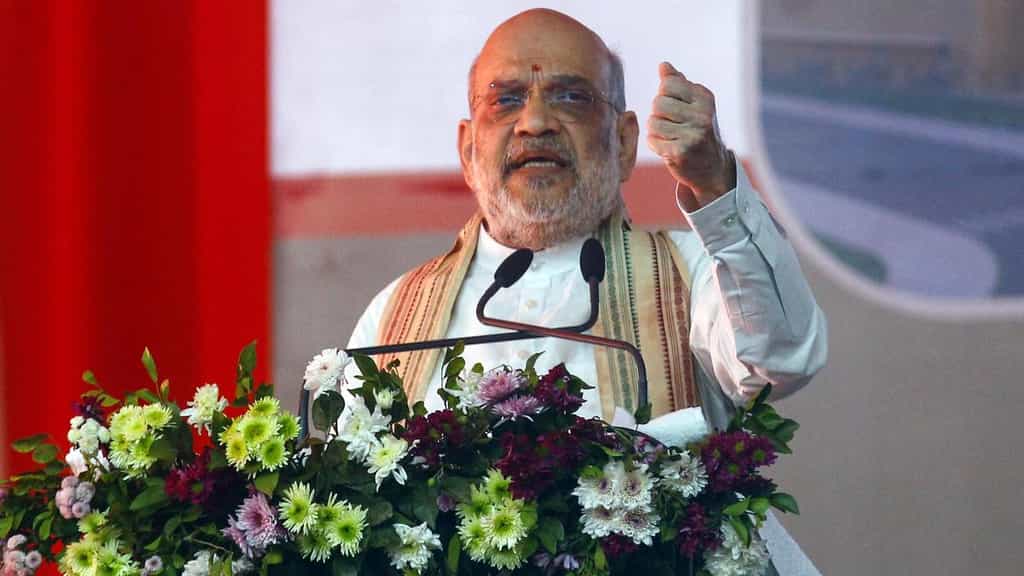
The Somnath temple’s centuries-long history of destruction and reconstruction reflects the resilience of India’s civilisational ethos rooted in Sanatana Dharma, Union Home Minister Amit Shah said on Tuesday (January 13, 2026), describing the shrine as a symbol of the nation’s enduring faith and traditions.
Speaking at a public programme in Mansa town of Gandhinagar district, Mr. Shah said historical invaders who attempted to raze the shrine had vanished with time, while the temple continued to stand at the same coastal site in Gir Somnath district as a symbol of enduring belief.
Referring to the inauguration of the Somnath Swabhiman Parv by Prime Minister Narendra Modi on Sunday (January 11, 2026), Mr. Shah said the year-long observance marked a millennium since Mahmud of Ghazni’s attack on the temple in 1026. He noted that although the shrine had been destroyed multiple times, it continued to be rebuilt and today remains a prominent monument of faith.
The Home Minister said a grand Somnath corridor is also being developed under the leadership of the Prime Minister, reinforcing the site’s historical and cultural significance. According to him, the temple represents the resilience of Indian civilisation and the continuity of its traditions.
Mr. Shah said the Somnath Swabhiman Parv would be observed across the country through various programmes aimed at deepening public awareness of India’s spiritual and cultural heritage.
Tracing the temple’s history, he said Somnath had faced repeated attacks by various invaders over the centuries but was reconstructed each time, reflecting what he described as a contrast between forces of destruction and the spirit of creation.
He also recalled the role played by leaders such as Sardar Vallabhbhai Patel, K.M. Munshi, the Maharaja of Jamnagar and former President Rajendra Prasad in rebuilding the temple after Independence, describing their efforts as an assertion of national self-respect.
During the event, Mr. Shah inaugurated and laid the foundation stone for development projects worth ₹267 crore, including a sports complex in Mansa, his native town. He said additional facilities would be added to the complex through ₹15 crore to be mobilised via corporate social responsibility funds and urged local representatives to ensure optimal use by youth in the region.
Editorial Context & Insight
Original analysis and synthesis with multi-source verification
Methodology
This article includes original analysis and synthesis from our editorial team, cross-referenced with multiple primary sources to ensure depth, accuracy, and balanced perspective. All claims are fact-checked and verified before publication.
Editorial Team
Senior Editor
Aisha Patel
Specializes in India coverage
Quality Assurance
Quality Assurance Editor
Fact-checking and editorial standards compliance