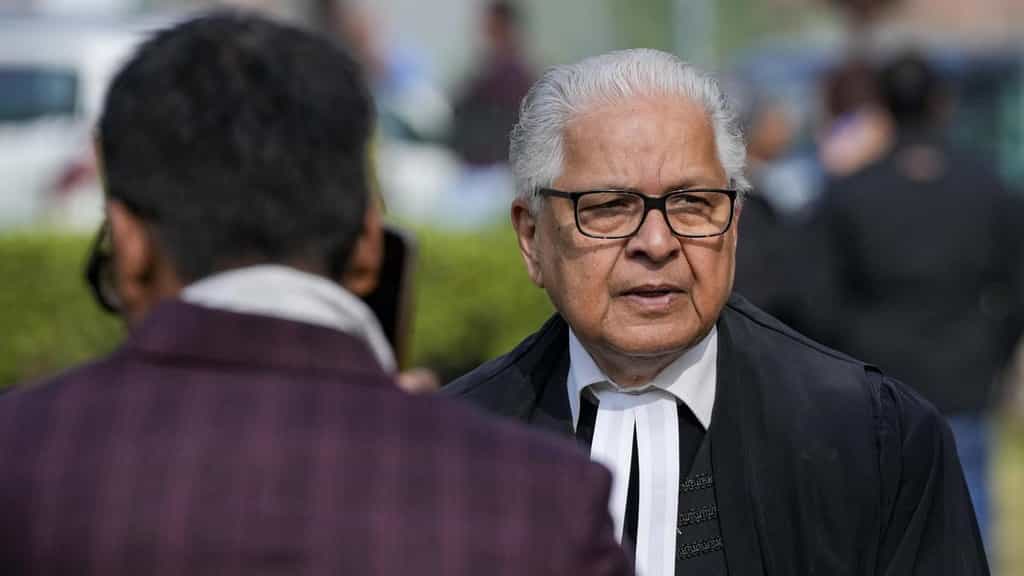
When a government seeks to intimidate its political opponents through the coercive apparatus of the state, the democratic space available to the Opposition inevitably shrinks, cautioned Ashwani Kumar, senior advocate and former Union Law Minister, in an interview with The Hindu. He was speaking on the release of his new book, Guardians of the Republic: Essays on the Constitution, Justice and the Future of Indian Democracy, dedicated to former Prime Minister Manmohan Singh.
“There is a discernible drift today towards a muscular state at the expense of a constitutional one. Reversing this trajectory is the foremost challenge confronting political leadership in contemporary democracies. What is needed are transformative leaders who possess the magnanimity to engage constructively with Opposition criticism of their policies,” he said.
Describing politics as the highest form of public service, Mr. Kumar warned that the near absence of dignitarian politics and civilised political discourse was deeply concerning for the future of Indian democracy and would increasingly deter young people from entering public life. “No one with even a bare modicum of decency will dare to step into the political arena. Few are willing to endure the utter humiliation that has become an indispensable feature of everyday politics,” he said.
He also pointed to a deficit in effective political messaging within the Opposition. Referring to the Opposition’s “vote chori” campaign and allegations that elections were being “stolen”, the former Congress leader said that although these were substantive concerns, they were undermined by weak articulation. “The Congress Party is raising the right issues, but it has been unable to convey its concerns to the people in a language and medium they understand. Political arguments must be broken down into ideas that are easily comprehensible,” he said.
He was, however, quick to add that democracy could never be safeguarded by institutions alone and that its survival depended on the vigilance of the citizenry. Pointing to a decline in institutional integrity, Mr. Kumar said this often stemmed from individuals lacking moral courage being placed in critical positions of authority. “To remedy this, the people of this country must rise to the occasion. Civil and dignified political discourse is an absolute necessity,” he said.
Expressing concern over what he described as an increasing crackdown on political dissent, Mr. Kumar said the Supreme Court’s decision denying bail to activists Umar Khalid and Sharjeel Imam in the 2020 Delhi riots conspiracy case was “wholly inconsistent” with settled judicial precedent, which affirms that “bail is the rule and jail the exception”. He also questioned whether the court could ever recompense them for the years lost should they ultimately be acquitted.
“Merely invoking the gravity of the offences alleged can hardly justify diluting the primacy of Article 21 of the Constitution, which guarantees the right to life and personal liberty. You cannot keep people languishing in prison for years without a conviction. The ruling runs contrary to the spirit of the Constitution,” he said.
On the scope of the Supreme Court of India’s review jurisdiction, Mr. Kumar said the court ought to have declined to entertain the 16th Presidential Reference, which he described as an “appeal in disguise” aimed at circumventing its limited review powers.
“If the Union government was unhappy with the April 8 judgment, it could have sought a review. But it knew that such a plea would be dismissed. Instead, it chose to invoke the Presidential Reference route. This was a carefully calibrated mechanism to ultimately dilute the ratio of the binding verdict in the Tamil Nadu Governor case,” he said. He added that the November 20, 2025 advisory opinion would now most likely be invoked to facilitate legislative amendments by Parliament.
However, Mr. Kumar said he did not agree with the Division Bench judgment insofar as it fixed timelines for the President to dispose of state Bills pending before them. “The office of the President occupies a higher sovereign position. The April 8 ruling ought to have confined itself to prescribing timelines for Governors alone,” he said.
Editorial Context & Insight
Original analysis and synthesis with multi-source verification
Methodology
This article includes original analysis and synthesis from our editorial team, cross-referenced with multiple primary sources to ensure depth, accuracy, and balanced perspective. All claims are fact-checked and verified before publication.
Editorial Team
Senior Editor
Shiv Shakti Mishra
Specializes in India coverage
Quality Assurance
Associate Editor
Fact-checking and editorial standards compliance