



Key takeaways
- Strands Robots combines AWS agent tooling with Hugging Face Storage Buckets for streamlined robotic policy iteration.
- HF Storage Buckets enable mutable, delta-only dataset syncs and zero-download streaming during GPU training runs.
- A unified LeRobot format allows the same agent instance to collect real-world data and deploy updated policies.
What happened
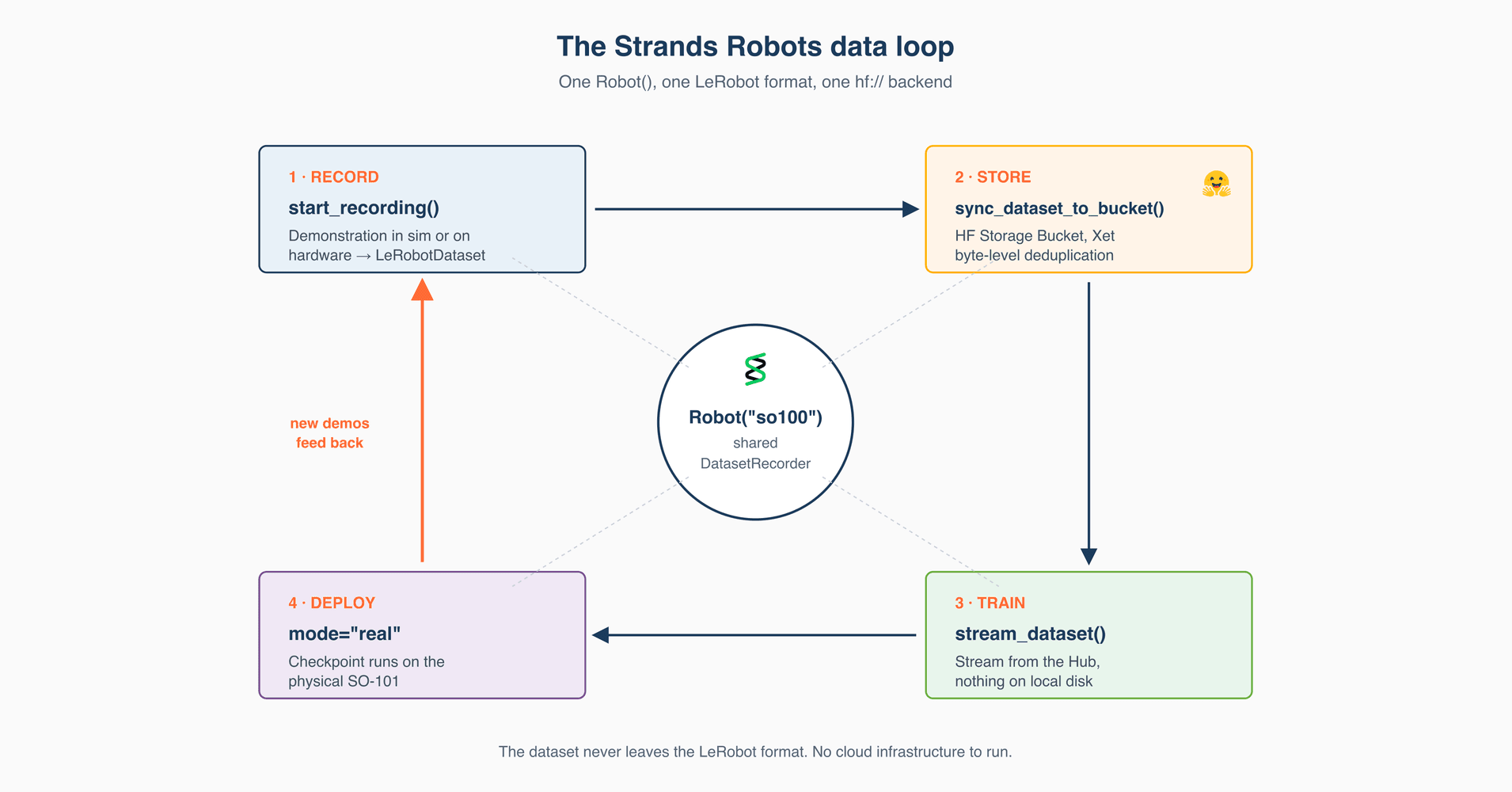
AWS has demonstrated an end-to-end streaming robotics data pipeline linking its open-source Strands Robots SDK with Hugging Face Storage Buckets and the standardized LeRobot dataset schema. 0 license, Strands Robots exposes physical robot hardware, simulation environments, and policy deployment primitives as modular agent tools. Through this architecture, developers can direct an autonomous agent to capture robot demonstrations, sync telemetry, and trigger policy learning within a single programmatic interface.
The system introduces Hugging Face Storage Buckets—a mutable, non-versioned object storage mechanism backed by Xet architecture—into the physical AI development cycle. Instead of treating every data collection pass as a permanent, version-controlled repository commit, the new bucket layer allows robot arms and mobile bases to write and overwrite streaming joint states and camera frames in place.
Telemetry syncs upload only delta changes, while GPU training clusters stream raw sensor video directly from the Hub on the fly.
Once a policy finishes training, it deploys directly back to the physical embodiment via the same object instance that initiated data collection, requiring minimal configuration changes. The entire pipeline retains on-disk compatibility with the broader LeRobot ecosystem, ensuring recorded demonstrations remain instantly accessible across tens of thousands of existing community models and robotics benchmarks.
Why it matters
Training physical AI systems continuously has historically suffered from severe data pipeline friction, network bottlenecks, and bloated cloud storage costs. Traditional workflows require practitioners to download entire multi-gigabyte or terabyte demonstration datasets to GPU instances before every training epoch begins, and then manually package checkpoints for remote hardware deployment.
By allowing compute instances to stream frames directly over the network while robots push incremental updates, this architecture drastically cuts unnecessary bandwidth consumption.
Furthermore, unifying data collection, policy training, and deployment under an agentic abstraction shifts robotics closer to self-improving physical systems. Because the agent manages both data evaluation decisions—such as detecting distribution drift and filtering unusable trajectories—and deployment rollouts, development teams can automate long-term field data collection campaigns. Removing IAM complexity, custom storage servers, and data conversion steps materially accelerates the pace at which physical robots learn complex manipulation skills.
What to watch
Keep an eye on how quickly open-source hardware projects and commercial robotics developers adopt agent-managed data loops over static datasets. As Hugging Face expands its Storage Bucket infrastructure, expect deeper integrations across diverse multi-embodiment registries, including bipedal humanoids, complex mobile manipulators, and dexterous multi-finger hands.
Observers should also monitor whether continuous streaming architectures become the standard benchmark for training physical foundation policy models directly on edge devices. Future developments will likely focus on closing the loop with automated self-evaluations, where agents autonomously determine when physical hardware requires policy retraining without human oversight.
On Hugging Face Hub