The parking lot was packed. That’s the first Strange Thing.
A little background. Just about every mall is struggling now, but the Neshaminy Mall in Bensalem, Pennsylvania is more or less comatose. As Defector’s Dan McQuade, a lifelong Pennsylvanian and mall fan, wrote in his fond remembrance of the shopping center, the once bustling complex is mostly a shuttered ghost town, with half of it set to be demolished. There are only two real reasons to go there: a well-stocked Barnes & Noble and the AMC movie theater.
And people do go there for the movie theater. It’s one of only three theaters in the Philly area with an IMAX screen, making it a destination for fans of prestige formats. I’m there often in my job as a critic, and I’m used to the IMAX auditorium being a full house. The parking lot outside of the theater at 8PM on New Year’s Eve, the night it’s showing Stranger Things 5: The Finale, however, was on another level. The concession line was overwhelming (tickets were free, but to reserve a spot guests bought a $20 concession voucher), and waits for snacks more involved than popcorn, soda, and candy were substantial. The energy was infectious. It was the most crowded I’ve seen a theater since Barbenheimer.
This was disconcerting. I knew, intellectually, that Stranger Things was a big deal. Netflix, notoriously opaque but quite ruthless in pruning shows that do not meet whatever metrics it does not share, has always treated the show like its Avengers or Star Wars. Regular PR blasts trumpet all manner of impressive stats, new episodes cause the service to crash, and the cast and iconography show up in ads and brand deals that no other Netflix show gets. Season 4 put Kate Bush’s “Running Up That Hill” back on the charts, one of many nostalgic hits the show has brought roaring back. Even in the dodgy world of streaming data, it’s clear Stranger Things has a big audience and remains a phenomenon even if later seasons are not the critical darlings the first was. It can be much harder to feel this.
There are many potential reasons: an increasingly fractured internet, the diffuse and curatorial nature of online fandom, Netflix’s conversation-killing binge-release strategy, and long gaps between seasons that snuffed out any sense of momentum. There’s also the show itself. Analyzing Stranger Things is not that difficult; the show has always more or less just meant what it said. There was no mystery it proposed that its characters wouldn’t solve, no reference that the show’s creators wouldn’t talk about (either themselves or through the show), and its narrative was almost entirely unconcerned with the world beyond Hawkins, Indiana. Even the Upside Down, the show’s other-dimensional realm of horrors, is so barren and empty that the final season declares its true nature to be a bridge and not a place, linking our world to the actual home of the show’s supernatural horrors. (And another surprisingly barren landscape.)
In practice, this makes Stranger Things a show that feels complex, but is quite easy to follow. Which also makes it the sort of thing all kinds of people would watch together. And maybe even drive out to a dead mall for on New Year’s Eve.
The second Strange Thing: According to the woman who scanned my ticket, this was the busiest she had seen this theater since Black Friday 2024, the weekend Gladiator II and Wicked both premiered. Back then, she remembers being told that theater staff expected 8,000 people for the day. On this night, they expected a crowd of 1,000 people to turn up over one hour.
I saw entire families, many in pajamas. Friends young and old. Lots of couples. There were Hellfire Club T-shirts, Demogorgon crowns and popcorn buckets (purchased in advance, from Target). Everyone was taking group selfies, posting photos or Instagram Reels of how crowded the concession area was. It’s New Year’s Eve, and everyone is having a ball.
Behind me in the concession line I met a woman named Gia who came with her daughters. They had been watching together since the first season in 2016 and love that the show’s exciting, “with lots of things happening.” They told me that they were nervous for the finale, “scared that people will die.”
There was a lot of that sort of talk. I overheard someone saying they thought Dustin was going to die, despite Steve’s efforts to save him. In the bathroom just before showtime, a teenager lamented how long his little brother was taking to wash his hands. “I swear to god,” he said. “If I miss a single fucking minute of this I’ll kill myself.”
I met one couple, Adam and Tiffany, who drove an hour to be there. Recently engaged and in their late 20s and early 30s, they began watching Stranger Things individually, as teenagers, before they started watching together. (He said this was season 3; she said it’s 4.)
“I like the nostalgia it brings to me, even though I didn’t grow up in the ’80s,” Adam said. He grew up watching E.T. and The Goonies, so he feels an affinity for the era in spite of his youth. He also loved the government conspiracy elements. “The first season it was really prevalent, with the MK Ultra stuff that it depicted. People didn’t know about it and it was a great way to expose people to it. I really enjoy that attitude the first season had and it kind of continues, especially in the latest season — the government does not always have your best interest in mind.”
Tiffany, for her part, feels like “we really have grown to know and love all of the characters, you know? I’m not ready to cry tonight.”
I must confess that I was continually surprised by all of this. I’ve grown accustomed to the asynchronous way most modern entertainment is enjoyed and discussed — often apologetically, as everyone triangulates how much of which shows they’ve seen and can talk about. Sports are among the only reliably communal experiences we get in front of our screens. Television as the characters on Stranger Things experienced it was communal, in shared living spaces where the screen fought for attention with the world around it. Television as Stranger Things fans have experienced it is virtually private, watched on a phone or laptop or TV at your convenience.
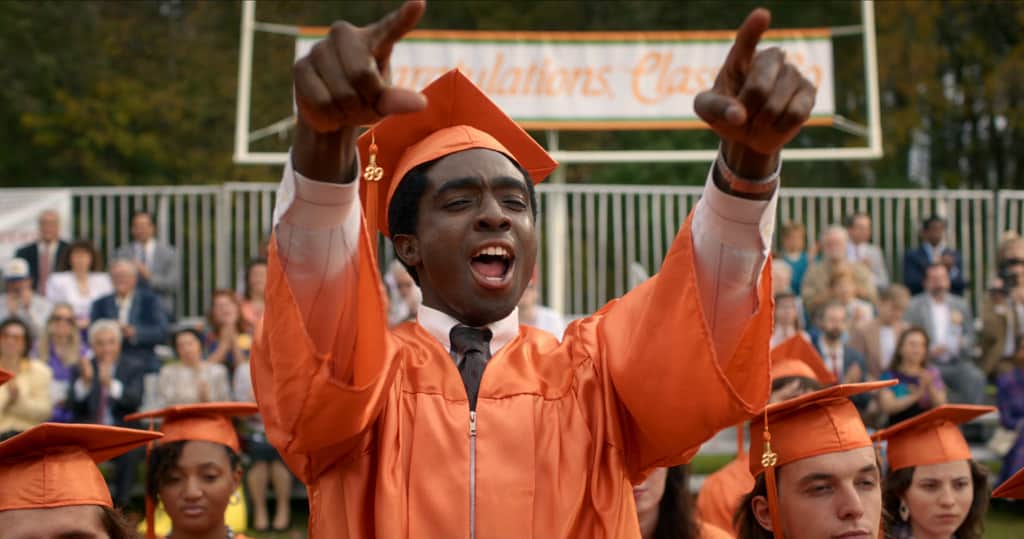
One last Strange Thing: Even for me, a Stranger Things hater, watching the finale in a packed house was frankly incredible. The crowd cheered early and often: when fan favorite Steve Harrington (Joe Keery) is saved from plummeting to his doom by his rival Jonathan Byers (Charlie Heaton); when newly minted fan-favorite character Derek Turnbow (Jake Connelly) gives the villainous Vecna the finger with his “Suck my fat one!” catchphrase; when Eleven (Millie Bobby Brown) stares down the massive, arachnid Mind Flayer in the finale’s climactic battle. When a character is thought to have died, a chorus of sniffles works its way through the room.
There is a sincerity to Stranger Things that is at odds with the cynicism of its marketing and imitators. The Duffer brothers are enthusiastic imitators that are happy to share their crib sheet, but they’ve always been open about what they’ve intended with Stranger Things. Despite all the dissonant things they’ve put inside of it as the show grew in every possible way, hopscotching from genre to genre often nonsensically, it remains a coming-of-age story about all the ways one can grow up.
It’s the secret weapon of the show, the way it’s not just about the four D&D-playing kids getting older, but their older siblings on the cusp of adulthood or their parents who sank into bad patterns and had to do some growing of their own. In this last season, the show leaned into its age, introducing younger siblings who are about to face things the core four did; caring for them is their final step to maturity.
Stranger Things’ relentless focus on nostalgia can make it easy to forget the present it aired in, and what it must have been like to grow up in that time. If you were a child watching it, you were a child watching when Donald Trump was elected the first time, when covid-19 took the world out from under you, when social media let our worst horrors beat a path right to your pocket. Your very own personal Upside Down.
“Life has been so unfair to you, so cruel,” Jim Hopper (David Harbour) tells his surrogate daughter early on in the finale, when Eleven is committed to dying in her fight against Vecna because she believes she doesn’t belong in the world anymore. He tells her to fight to imagine a life beyond the horror. “I know you don’t believe you can have any of this. But I promise you, we will find a way to make it real. You will find a way to make it real, because you have to. Because you deserve it.”
It’s a line that collapses the fourth wall, escaping the Hawkins / Upside Down of this movie-fueled vision of 1987 to crash right into the final moments of 2025. The roomful of fans, young and old, here with their families and partners and friends, taking selfies, hooting and hollering, haven’t just spent 10 years with characters on TV that feel like friends. They’ve grown up, and watched each other grow up, through hell. And the kids, young adults, and grown-ups of Stranger Things have gone through hell with them. A ludicrous, nonsensical nightmare parade that has, in some ways, rendered them unrecognizable from the people they were 10 years ago, the way bookish Nancy Wheeler (Natalia Dyer) has now become a rifle-toting monster slayer.
Marking the end of that journey in a theater full of people who have been on it with you? What a way to close out a year. What a nice note to start a new one on, going back out into the world with all your fellow fans, looking for the right side up.
Follow topics and authors from this story to see more like this in your personalized homepage feed and to receive email updates.
Editorial Context & Insight
Original analysis & verification
Methodology
This article includes original analysis and synthesis from our editorial team, cross-referenced with primary sources to ensure depth and accuracy.
Primary Source
The Verge