UPSC Weekly Quiz is a current affairs-based quiz on relevant topics from the past week, curated for the aspirants of competitive examinations. Attempt the weekly quiz every Saturday and find answers to the MCQs with explanations.
🚨 Click Here to read the UPSC Essentials magazine for December 2025. Share your views and suggestions in the comment box or at manas.srivastava@indianexpress.com🚨
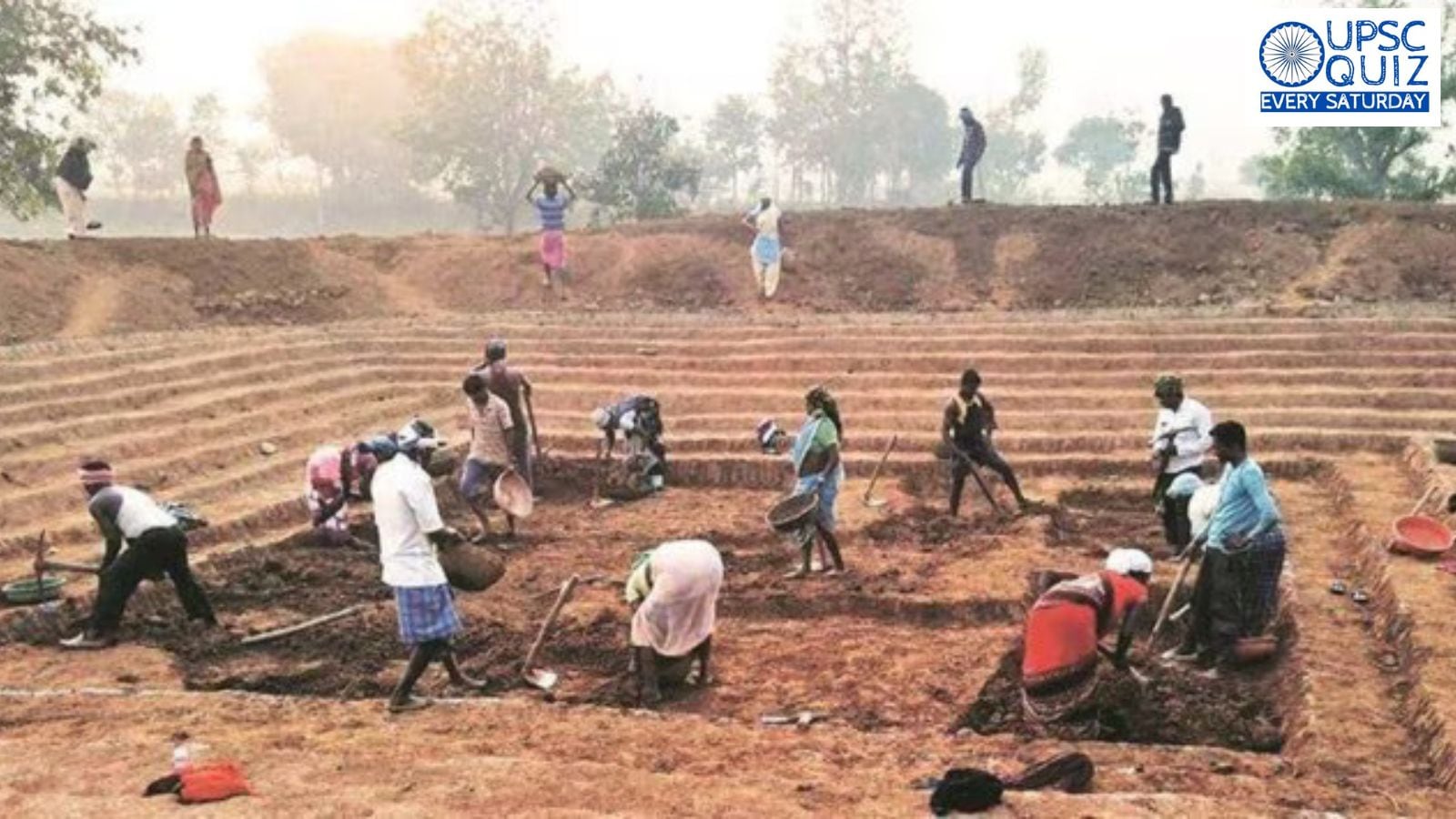
With reference to the Mahatma Gandhi National Rural Employment Guarantee Act (MGNREGA), consider the following statements: 1. Under MGNREGA, the Centre covered the full cost of wages, 75% of material costs, and up to 6% of the administrative costs.
2. The vision of MGNREGA is to enhance the livelihood security of rural households.
3. It promotes a bottom-up approach to planning and execution, empowering local communities to take charge of their development.
Which of the statements given above are correct?
— The Viksit Bharat – Guarantee for Rozgar and Ajeevika Mission (Gramin) Act (VB – G RAM G), which replaces the now repealed Mahatma Gandhi National Rural Employment Guarantee Act (MGNREGA), promises expanded entitlements, timely wage payments, and other reforms.
— The Viksit Bharat-Guarantee for Rozgar and Ajeevika Mission (Gramin) Bill — or VB-G RAM G Bill — proposes to raise the number of guaranteed wage employment days in a financial year from 100 to 125.
— Unlike the MGNREG Scheme (MGNREGS), which was primarily funded by the Centre, the new Bill proposes joint funding between the Centre and the state, which will likely lead to a higher financial burden on states.
— The Bill proposes a 60-day pause in the scheme during the peak agricultural seasons of sowing and harvesting, a move said to be aimed at ensuring farm labour availability.
— Under MGNREGA, the Centre covered the full cost of wages, 75% of material costs, and up to 6% of the administrative costs. VB – G RAM G replaces this with a uniform cost-sharing ratio rule: general category states will now finance 40% of all components, and hilly and north-eastern states 10%, irrespective of whether the spending is on wages, materials, or administration. Hence, statement 1 is correct.
— The vision of Mahatma Gandhi NREGA is to enhance the livelihood security of rural households across the country by providing at least 100 days of guaranteed wage employment in a financial year to every rural household whose adult members volunteer to do unskilled manual work. Hence, statement 2 is correct.
— The scheme encourages a sense of community and collective responsibility by strengthening Panchayat Raj institutions. Mahatma Gandhi NREGA promotes a bottom-up approach to planning and execution, empowering local communities to take charge of their development. Hence, statement 3 is correct.
Therefore, option (d) is the correct answer. (Other Source: nrega.dord.gov.in)
With reference to the Great Indian Bustard (GIB), consider the following statements: 1. These are listed as critically endangered by IUCN.
2. Rajasthan and Gujarat are the two most crucial habitats of the large avian species.
3. These species saw a decline due to frequent fatal collisions with the expanding transmission lines of renewable energy projects.
How many of the statements given above are correct?
— The new measures and directions will apply across Rajasthan and Gujarat, the two most crucial habitats of the large avian species. Hence, statement 2 is correct.
— The case dates back to 2019 when retired bureaucrat and environmentalist M K Ranjitsinh sought the top court’s urgent intervention to conserve the critically endangered Great Indian Bustard (GIB) and urgently frame an emergency response for its recovery. Hence, statement 1 is correct.
— The bird, which was already in decline with only 150 individuals per the last estimates, saw its numbers decline further after frequent fatal collisions with the expanding transmission lines of renewable energy projects. Hence, statement 3 is correct.
— The GIB’s poor frontal vision, combined with its heavy body, makes it difficult for them to detect the linear infrastructure and manoeuvre away, causing deaths due to collision.
With reference to the Karbi Anglong Autonomous Council, consider the following statements: 1. It enjoys special protections for tribal communities under the Sixth Schedule of the Constitution.
2. It is in Arunachal Pradesh. Which of the statements given above is/are correct?
— The violence pertains to the area under the Karbi Anglong Autonomous Council (KAAC), which has jurisdiction over the Karbi Anglong and West Karbi Anglong districts.
— This region enjoys special protections for tribal communities under the Sixth Schedule of the Constitution, which provides for a measure of autonomy in governance and regulations on the sale of land to non-tribals. According to the 2011 Census, Scheduled Tribes constituted around 56% of the area population, with the Karbis being the largest tribal community. Others include the Dimasas, Bodos, Kukis, and Garos. Hence, statement 1 is correct.
— Assam also has a history of Karbi insurgency, where many Karbi organisations demanded a separate state, and the movement was marked by killings, ethnic violence and abductions.
With reference to the BlueBird Block-2 mission, consider the following statements: 1. It is the largest-ever commercial communications satellite to be deployed in low Earth orbit (LEO).
2. The satellite is designed by the Indian Space Research Organisation.
3. The satellite will provide direct-to-mobile connectivity.
— The satellite, designed by the US company AST SpaceMobile, will be part of an LEO constellation that will provide direct-to-mobile connectivity. Hence, statement 2 is not correct and statement 3 is correct.
— The BlueBird Block-2 satellite will be the largest-ever commercial communications satellite to be deployed in low Earth orbit (LEO). As the name suggests, LEO is an orbit that is relatively close to Earth’s surface. It is normally at an altitude of less than 1,000 km. Hence, statement 1 is correct.
(@isroofficial5866/Yt via PTI Photo)
— The current mission is the third commercial one involving ISRO’s newest launch vehicle, after the launches of 36 satellites of OneWeb, a broadband satellite internet service provider, in 2022 and 2023. India had been chosen for these missions following Russia’s refusal in the wake of the Ukraine war, and with the European Space Agency’s (ESA) launcher, Ariane-5, going out of commission.
1. Ethanol used for blending attracts 18 per cent GST and 5 per cent when used for other industrial purposes.
2. Oil marketing companies (OMCs) pay GST on ethanol purchases but cannot claim an input tax credit.
3. The ethanol price paid by OMCs does not include the ex-mill price.
— In recent parliamentary sessions, the government has underscored the importance of the ethanol blending programme, citing its benefits for farmers and significant foreign exchange savings. With the blending rate climbing from 1.5 per cent in 2013-14 to a targeted 20 per cent by 2025-26, ethanol is fast becoming a significant component of India’s energy mix, making India one of the few large economies to achieve such a high ratio.
— Ethanol used for blending attracts 5 per cent GST (18 per cent when used for other industrial purposes), while petrol is taxed through central excise and state-level value-added tax (VAT). The dual tax structure originates from India’s partially reformed fuel taxation regime, where petroleum products were exempted from the GST framework. Hence, statement 1 is not correct.
— Consequently, oil marketing companies (OMCs) pay GST on ethanol purchases but cannot claim an input tax credit, since the final product, that is, petrol, is not a GST-taxable item. Hence, statement 2 is correct.
— This makes the ethanol component appear more expensive than it actually is, as the GST paid on it becomes a non-recoverable cost. The ethanol price paid by OMCs includes the ex-mill price, GST, and transportation charges. Hence, statement 3 is not correct.
With reference to the Akash missile, consider the following statements: 1. It is a short-to-medium range air-to-air missile.
2. The Akash weapon system can simultaneously engage multiple targets in group mode or in autonomous mode.
3. It can counter electronic systems that deceive detection systems.
4. The missile has 100 per cent indigenous components.
— The development of the Akash, a short to medium range surface-to-air missile, was started by DRDO in the late 1980s as part of the Integrated Guided Missile Development Programme led by Dr APJ Abdul Kalam. Hence, statement 1 is not correct.
(Source: PTI photo)
— It is primarily designed to provide air defence cover to the vulnerable areas and critical installations. The Akash weapon system can simultaneously engage multiple targets in group mode or in autonomous mode. It features built-in electronic counter-counter measures (ECCM), which means it has onboard mechanisms that can counter electronic systems that deceive detection systems. Hence, statements 2 and 3 are correct.
— Akash was inducted into the IAF in 2014, and into the Indian Army the next year. Both the IAF and the Army currently operate multiple squadrons and groups of missiles, respectively. The DRDO has said the Akash missile has 96% indigenous components. Hence, statement 4 is not correct.
With reference to the Sahyog portal, consider the following statements: 1. It is maintained by the Indian Cyber Crime Coordination Centre (I4C).
2. It was launched to expedite the process of sending notices to IT intermediaries by the appropriate government or its agency.
— The MHA issued these notices under section 79(3)(b) of the IT Act through its arm of Indian Cyber Crime Coordination Centre (I4C), even as X Corp has resisted onboarding on MHA’s Sahyog portal, which uses the same provision of the IT Act to issue takedown notices.
— The Sahyog portal was launched in 2024 by the Union Home Ministry last year to expedite orders to block objectionable content. It is maintained by the Indian Cyber Crime Coordination Centre (I4C). Hence, statement 1 is correct.
— Sahyog portal has been launched to expedite the process of sending notices to IT intermediaries by the appropriate government or its agency under Clause (b) of Sub-section (3) of Section 79 of the IT Act, 2000 to facilitate the removal or disabling of access to any information, data or communication link being used to commit an unlawful act. Hence, statement 2 is correct.
With reference to the region in news and its associated countries, consider the following pairs: 1. Sa Kaeo province – Cambodia
2. Banteay Meanchey – Thailand Which of the pairs given above is/are correctly matched?
— Cambodia reported that Thailand hit a site in the country’s northwest with an airstrike, even as the two countries held talks to try to put an end to renewed combat that erupted in early December just months after a ceasefire ended a previous round of border fighting.
— Thailand deployed F-16 fighter jets to drop four bombs on a target in Serei Saophoan in the northwestern province of Banteay Meanchey in Cambodia.
— Cambodia said a similar airstrike dropped 40 bombs on a target in Chok Chey village in the same province. There were no reports of casualties from that raid, but the ministry said that houses and infrastructure in the Chok Chey target area were destroyed.
— Thailand’s military confirmed the attack, saying that a joint army-air force operation was conducted to protect Thailand’s Sa Kaeo province, which borders Banteay Meanchey and where the two nations have overlapping territorial claims.
With reference to quantum physics, consider the following statements: 1. From nuclear power to semiconductors, computers, electronics, and MRI scanners, all have emerged from the principles of quantum physics.
2. The United Nations had declared 2027 as the Year of Quantum Science and Technology.
— Quantum physics is counterintuitive. In the words of American physicist Richard Feynman, “no one understands it”. Yet, surprisingly, it has touched every aspect of our lives. From nuclear power to semiconductors, computers, electronics, lasers, and medical diagnostic tools such as MRI scanners, all have emerged from the principles of quantum physics. Hence, statement 1 is correct.
— Commemorating these achievements, the United Nations had declared 2025 as the Year of Quantum Science and Technology. Hence, statement 2 is not correct.
— The emerging quantum technologies hold promise for precise atomic clocks, navigation systems, quantum computers for solving certain classes of hard problems, high-resolution sensors, and secure messaging and banking transactions.
With reference to radio broadcasting, consider the following statements: 1. In India, private radio broadcasting started in 1927.
2. All India Radio began operations in 1936.
3. The United States was the first country to begin public broadcasts in 1919.
— Radio Ceylon, one of the world’s oldest radio broadcasters, turned 100 last week. At a time when radio was a novelty and decades before TV would transform South Asia’s media landscape, Radio Ceylon officially began broadcasting from December 16, 1925. This was the first radio broadcaster in Asia.
— In India, while private radio broadcasting started in 1927, All India Radio began operations only in 1936. The Netherlands was the first country to begin public broadcasts in 1919, followed by the US in 1920. The BBC followed in 1922 and Radio Ceylon entered the airwaves soon after. Hence, statements 1 and 2 are correct.
— The Netherlands was the first country to begin public broadcasts in 1919, followed by the US in 1920. The BBC followed in 1922 and Radio Ceylon entered the airwaves soon after. Hence, statement 3 is not correct.
Which of the following became the first country to formally recognise the self-proclaimed Republic of Somaliland?
— Israeli PM Benjamin Netanyahu congratulated Somaliland’s president, Abdirahman Mohamed Abdullahi, praised his leadership and invited him to visit Israel. He said that the declaration “is in the spirit of the Abraham Accords, signed at the initiative of President Trump.”
1. Japan aims to build a ‘Synchronised, Hybrid, Integrated and Enhanced Littoral Defence’ (SHIELD) system, which utilises a “massive” fleet of unmanned air, sea-surface, and underwater drones.
2. Greenland, a former Danish colony, has the right to declare independence under a 2009 agreement but remains heavily reliant on fishing and Danish subsidies.
Which of the statements given above is/are true?
— The Japanese cabinet on Friday approved a draft budget of $780 billion, out of which a record $58 billion is allocated for defence. The allocation, which is nearly 10 per cent more than what was provided in the previous budget, is aimed at increasing Japan’s strike back capability and improving coastal defences with surface-to-ship missiles and unmanned arsenals.
— On December 21, 2025, President Donald Trump appointed Louisiana Governor Jeff Landry as the first-ever US special envoy to Greenland, the autonomous territory of Denmark.
— Greenland, a former Danish colony with a population of about 57,000, has the right to declare independence under a 2009 agreement but remains heavily reliant on fishing and Danish subsidies.
— Its strategic position between Europe and North America makes it a key site for the US ballistic missile defence system, while its mineral wealth has heightened the interest in reducing reliance on Chinese exports.
Stay updated with the latest UPSC articles by joining our Telegram channel – IndianExpress UPSC Hub, and follow us on Instagram and X.