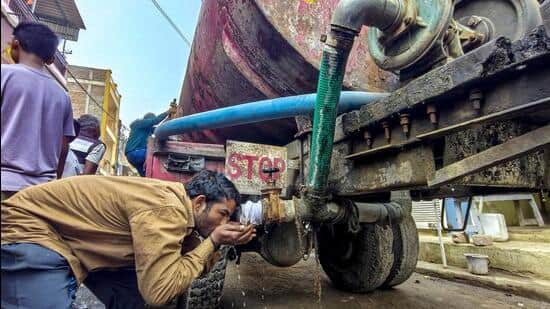
More than a week after residents of Bhagirathpura in Indore fell ill from consuming contaminated water, test reports of water samples on Saturday confirmed the tap water was a cocktail of deadly pathogens — including E coli, Salmonella and Vibrio cholerae bacteria, along with viruses, fungi and protozoa — that caused polymicrobial infections leading to multi-organ failure and sepsis among patients, officials said.
At least 10 people have died and 210 have been hospitalised since the outbreak began on December 25, with residents blaming officials for ignoring months of complaints about foul-smelling water in the congested locality. As many as 32 patients are being treated in intensive care units.
“The test report and culture report of 26 samples confirmed polymicrobial contamination, meaning multiple microbes were found. The culture report also confirmed the presence of E coli, Salmonella and Vibrio cholerae,” said Sudam Khade, divisional commissioner, Indore, adding that multi-organ failure and sepsis from the resulting infections led to the death of six people.
One of the sources is raw sewage leaking from a toilet at Bhagirathpura police outpost that had no septic tank, but officials also stated that there were multiple breaches in the 30-year-old pipeline that allowed untreated human waste to mix with drinking water supplied to around 50,000 residents in a city that is consistently ranked as India’s cleanest.
Samples have now been sent for chemical testing as well, Khade said, to identify the presence of any other toxic chemicals.
Doctors and experts, however, criticised the delay in testing, saying the lag likely contributed to deaths as polymicrobial infections require rapid pathogen identification for targeted treatment. “Polymicrobial infection is fatal, especially for people with low immunity like the elderly and children. The initial days are crucial for deciding line of treatment as the multiple microbes can spread through the bloodstream and cause multi-organ failure and sepsis. The delay in detection is very dangerous,” said Dr Deepak Dwivedi, a Bhopal-based microbiologist.
Dwivedi added that testing should also be performed for viruses, not just bacterial culture, as it is important to decide further preventive measures.
The diagnostic confusion on the ground revealed the crisis of information.
Dr Abhyuday Verma, owner of Verma Hospital, which treated more than 130 affected patients, said his facility began receiving patients on December 25. “At first, we thought it was contaminated food causing diarrhoea. On December 26, 10 more patients arrived, reporting they had consumed tap water that smelled foul despite being colourless. Soon we realised that it was not just diarrhoea. The symptoms were more severe and some patients were not responding to the line of treatment, so we began treating for cholera. But things were unclear; the situation worsened in three days. We informed the health department about the situation and then they started monitoring on December 29,” he said.
Verma recounted one death: “70-year-old Nandlal Pal died of cardiac arrest at our hospital, but his death was shocking for us as he had recovered from the diarrhoea” — suggesting septic complications even after apparent recovery.
Another doctor, who did not wish to be named, questioned the surveillance system. “Eight to 10 patients were visiting our hospitals per day, but how can the Urban Primary Health Centres and Sanjeevani clinics have ignored the surge in patients? In three days, 300 patients visited the health facilities, but the facilities remained closed on Sunday (December 28). They started treating patients on December 29, when panic gripped the area.”
Dr Vinod Bhandari, chairman of the medical college, acknowledged delays but also blamed residents. “The delay definitely caused trouble, but we can’t blame only the system. The people didn’t realise the severity of the situation and reached hospitals with much delay,” he said, adding that most deaths were caused due to comorbidity.
Dr Nikhil Ojha, appointed by the chief medical and health officer to monitor patients at private hospitals, said: “The first two days — December 29 and 30 — were very crucial. We were waiting for the test result but patients were being provided with the best treatment. We shifted the patients to medical colleges as patients needed multi-speciality treatment. The small clinics and hospitals did a great job but they were unable to handle the patients having multiple medical issues. The situation was controlled when we shifted the patients to medical colleges.” A board of doctors has been formed to investigate the cause of other deaths to ensure compensation to next of kin, Khade added.
The incident sparked political outrage, with the Congress attacking the BJP government over the delays. “In the cleanest city, it took eight days to confirm the presence of infection and 10 days to identify the cause of infection. This is not a case of infrastructure failure but it is a case of medical negligence too,” said KK Mishra, spokesperson, Congress.
BJP spokesperson Dr Hitesh Bajpai defended the government’s response. “This is true that fatality from diarrhoea is usually low, but cholera and other infections are not easily managed. The state government controlled the situation effectively without knowing the exact cause.” As many as 11,000 houses were surveyed and 3,052 patients were found with mild symptoms, while 210 were admitted to hospitals.
Editorial Context & Insight
Original analysis & verification
Methodology
This article includes original analysis and synthesis from our editorial team, cross-referenced with primary sources to ensure depth and accuracy.