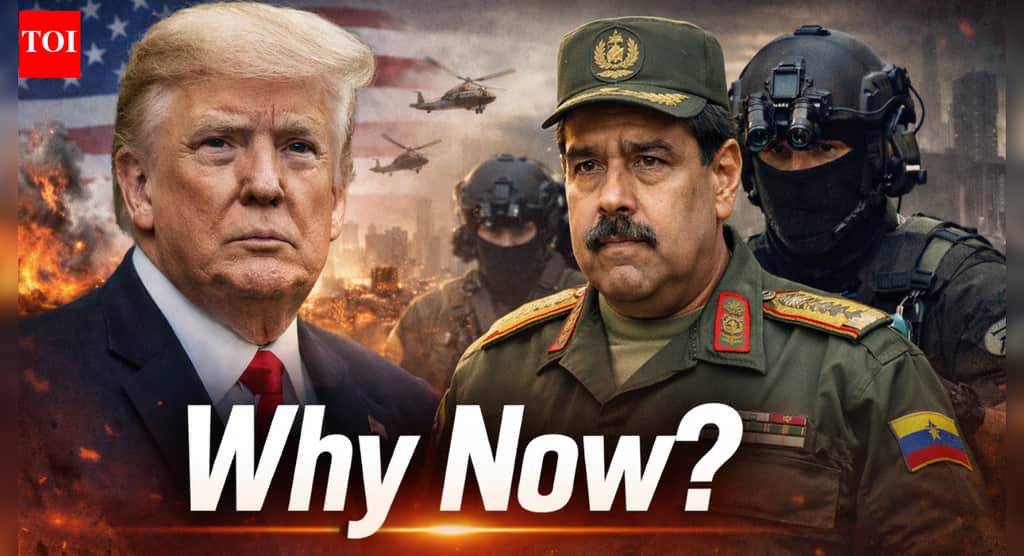
For years, Washington had spoken of Nicolás Maduro in the language of indictments, sanctions and moral outrage. He was branded a narco-terrorist, accused of presiding over a criminal state and routinely dismissed as an international pariah.
Yet despite the rhetoric, one line remained uncrossed: No US administration, Republican or Democrat, had dared to physically seize the sitting leader of a sovereign country since Panama more than three decades ago.That restraint ended abruptly on Saturday.In a large-scale strike that stunned Latin America and unsettled US allies, American forces captured Venezuela’s president and flew him out of the country, capping months of covert pressure and open threats.
The White House framed the operation as a decisive blow in a widening war on drugs and organised crime, casting Maduro’s arrest as the inevitable outcome of a long campaign against a “narco-terrorist regime”.But the operation was about far more than law enforcement. It intersected with oil, migration and domestic US politics, and with Washington’s determination to reassert its dominance in a region it believes is slipping from its control.
It also carried a message for America’s rivals, at a moment of heightened global rivalry and shifting power balances.So why did the United States move to depose Maduro — and why now?
The capture of Maduro capped months of rising US military pressure in the region. Beginning in late 2025, Washington quietly amassed a large naval and air force near Venezuela. By autumn, the US had stationed multiple guided-missile destroyers, amphibious assault ships and a nuclear submarine within striking distance of Venezuela. The largest addition was the USS Gerald R. Ford carrier strike group, the newest and most powerful carrier in the fleet, with over 5,000 crew and advanced F-35 jets on board. The Pentagon formally announced on 24 October 2025 that the Gerald R. Ford would be sent to the Caribbean, calling it a “show of force far beyond any past counter-narcotics effort”. According to one report, this deployment brought the total to roughly 18 US Navy warships (plus submarines and Marine units) active in the region at once.
The naval presence went hand-in-hand with increasingly bellicose rhetoric. Trump and his aides repeatedly warned that Venezuela was at the centre of a regional threat. Vice President Marco Rubio and others claimed (without public evidence) that Maduro was leading a drug-laundering syndicate known as the “Cartel de los Soles” into the US – a narrative the administration used to justify its posture. On two occasions in late 2025, Trump himself went on public radio and at a summit meeting and announced that US forces had “hit” a Venezuelan drug-loading facility on the coast.
He blustered that “we hit all the boats” and even threatened “boots on the ground” in Venezuela if necessary. One senior adviser quipped that Trump wanted to “keep on blowing boats up until Maduro ‘cries uncle’”.By late December, US warships and spy planes were patrolling routinely off Venezuela, and the White House had warned civilian airlines to avoid Venezuelan airspace as “potentially hazardous”.
Speaking after the operation, Trump said he had to delay the strike by four days because of poor weather and heavy cloud cover, saying the “weather has to be perfect” before forces moved in.According to General Dan Caine, Chairman of the Joint Chiefs of Staff, skies “broke just enough” on Friday night, creating a narrow window for aircraft and helicopters to penetrate toward Caracas.At 10.46pm EST on Friday, Trump gave the final go-ahead for the mission.
While the White House has framed the strike as part of a campaign against narco-terrorism, Dr Melanie Garson, Associate Professor of International Security and Conflict Resolution at University College London, argues that the timing reflects a convergence of strategic opportunity and political calculation.“It is clear that this was a well prepared operation that had been in the planning for a significant amount of time,” she said, pointing to the exposure of Venezuelan oil tanker “ghost fleets” and the wider global context, including recent Chinese military exercises around Taiwan."The relative weakness of Caracas’s allies also mattered. “The fact that Venezuela’s other key allies, Russia and Iran, currently have their own challenges is likely also a factor for US action,” she told The Times of India.Domestic politics in Washington appear equally important. As the Trump administration approaches both the anniversary of Donald Trump’s inauguration and the United States’ 250th anniversary, Dr Garson said the 47th POTUS would be keen to demonstrate that he has delivered on campaign promises, particularly those centred on restoring US influence in the Americas and pursuing a more openly interest-driven foreign policy.
The chief justification given by US officials has been Maduro’s alleged ties to illicit narcotics. In a series of indictments and speeches, the Biden administration called him a “narco-terrorist” who presided over cocaine exports to the US The Justice Department unsealed charges accusing Maduro of conspiring with rebel groups and gangs to flood American cities with drugs. Likewise, US policy announcements since 2020 had emphasized Venezuela’s role in organized crime.
Maduro was the kingpin of a vast criminal network responsible for trafficking colossal amounts of deadly and illicit drugs into the United States. He personally oversaw the vicious cartel known as Cartel de las Solas, which flooded our nation with lethal poison. Responsible for the deaths of countless Americans
Trump during the briefing after Maduro's capture
For example, Trump’s executive order of January 20, 2025 declared that certain foreign “criminal organizations” would be treated as terrorist groups, specifically naming Venezuela’s Tren de Aragua street gang as a target. One senior official told Reuters that Trump was prepared to use “every element of American power” to stop drugs from reaching the US and “bring those responsible to justice”.President Trump and his spokesmen regularly accused Maduro of shipping cocaine and operatives into the United States.
Trump claimed publicly that Venezuelan military officials ran a “Cartel de los Soles” trafficking ring. In July 2025 he doubled the bounty on Maduro to $50 million, reiterating that he was wanted as a major drug trafficker. When Maduro was captured, Trump framed it as a blow to the drug trade – a narrative echoed by US generals and lawmakers. The Treasury Secretary put it bluntly in late 2025: “We will not allow the illegitimate Maduro regime to profit from exporting oil while it floods the United States with deadly drugs,” he said, sanctioning oil traders accused of evasion.
Despite this official line, many experts are skeptical that Venezuela truly is a major drug hub. Extensive reporting and US government data suggest the opposite: independent authorities have said Venezuela plays only a minor role in South American cocaine flows and essentially none in synthetic opioids. The UN Office on Drugs and Crime and the US DEA report that most illicit cocaine to the US still comes via Peru and Colombia, and that virtually all fentanyl comes from Asia.
Indeed, the DEA’s latest threat assessment does not even list Venezuela as a primary concern. An Al Jazeera’s analyst noted, Maduro “certainly pales in comparison” to Colombian and Mexican cartels, and a classified intelligence report reportedly found he has no direct control over any trafficking network.
Oil is the other obvious prize in Venezuela. The country sits atop the world’s largest proven oil reserves, roughly 17 % of the global total, although decades of mismanagement and sanctions have shrunk its output.
By 2025 Venezuelan production had plummeted to barely over 1.0 million barrels per day, down from over 3 million a few decades.Trump openly said that US energy giants would move in to rebuild Venezuela’s decrepit oil industry once Maduro was ousted. “We’re going to have our very large United States oil companies – the biggest anywhere in the world – go in, spend billions of dollars, fix the badly broken infrastructure and start making money for the country,” he told reporters. He even promised that these companies would be “reimbursed” for the oil facilities they restore, strongly implying a formal US role in the industry.
We have the greatest oil companies in the world, the biggest and the best, and we’re going to be very much involved in it
Currently, US sanctions still forbid American companies from buying Venezuelan crude. The Biden administration (continued under Trump) has maintained an embargo to deny Maduro foreign revenue. In fact, on December 31, 2025 the US Treasury sanctioned four shipowners and four oil tankers involved in Venezuela’s oil exports, branding their cargo as funding Maduro’s “illegitimate narco-terrorist regime”.
So far, only one US company, Chevron has a presence in Venezuela, and it has been careful to obey all laws.
When Trump boasted he would open the market to US “oil majors,” industry leaders remained publicly silent or cautious. In practice, any renewal of exports will require navigating layers of sanction law and likely paying hefty fines or reparations to expropriated firms.Still, the rhetoric makes clear what many strategists assume: Venezuela’s oil fields are a coveted asset.
Rebuilding the industry would demand vast investment (one analyst cited by The Guardian put it at over $100 billion to double output by 2030).
Beyond drugs and oil lies a grander strategic motive. Trump explicitly framed the intervention in the language of American hegemony. Referring to the 19th-century Monroe Doctrine – which asserted US primacy in the Western Hemisphere – Trump declared that his administration was updating it for the 21st century. He quipped that this new policy might be called the “Donroe Doctrine,” after himself. At a news conference, he vowed that “American dominance in the Western hemisphere will never be questioned again”. This bluster underscored an underlying message to US rivals: Latin America is being reclaimed as a US sphere of influence.
The Monroe Doctrine is a big deal, but we’ve superseded it by a lot, by a real lot. They now call it the Don-roe Doctrine. American dominance in the Western Hemisphere will never be questioned again
Indeed, the Trump team released a document in early December 2025 calling for complete US control of the hemisphere “politically, economically, commercially and militarily,” and explicitly authorizing military intervention to secure energy and minerals.
In essence, this “Trump corollary” to Monroe justifies using force to guarantee US access to resources – a view echoed by Secretary of State Rubio.According to Dr Garson, it reflects “a continued tilt away from Europe towards increasing influence closer to home”, aimed at denying rival powers access to strategic assets such as oil and critical minerals.
“It is a continued tilt away from Europe to increasing influence closer to home and denying adversaries access to strategic assets such as oil and critical minerals vital to tech dominance,” she said.The capture of Maduro was thus presented not only as a move against crime but as a warning shot against China, Russia or any others seeking footholds in South America. Trump and supporters pointed to Venezuela’s alliances with Cuba, Iran and Moscow as justification: by crushing Maduro’s government, the US asserted that it will not tolerate leftist regimes aligning with anti-American powers.This ideological message stirred alarm in the region. Many Latin American governments, even right-wing ones, publicly deplored the US intervention.
Mexico’s president called it a dangerous precedent, and Brazil’s Lula said it was “an unacceptable line” for Washington to cross. By contrast, Argentina’s libertarian leader Javier Milei – an ideological ally of Trump – hailed it as the dawning of “freedom” for Venezuela.
China and Russia immediately condemned the attack, charging it with violating international law and Venezuelan sovereignty.
Shut out by Washington and hemmed in by sanctions, Venezuela has spent the past few years quietly building a geopolitical escape hatch, by drawing closer to three of the United States’ most persistent adversaries: Russia, China and Iran.
What has emerged is not a formal alliance, but a web of transactional partnerships bound together by oil, arms and a shared hostility to US pressure.Russia has positioned itself as Caracas’s most overt political and military backer. Moscow has supplied aircraft, air-defence systems and maintenance support to Venezuela’s ageing armed forces, while joint energy and security agreements signed in recent years signal a long-term commitment.
For the Kremlin, Venezuela offers something few partners can: a strategic foothold in the Western Hemisphere, close to US shores, and a stage on which to challenge American dominance.China has been Venezuela’s largest creditor, extending billions of dollars in oil-backed loans and investing in joint ventures in the Orinoco oil belt. Much of Venezuela’s crude exports now flow eastward to service debt, tying the country’s economic recovery closely to Chinese interests.
In return, Caracas gains financing and diplomatic cover at a time when Western capital is largely unavailable.
“Iran invested in a fibre-optic manufacturing facility in Venezuela. China has provided significant loans (suggested $60 billion since 2007) in oil-for-loans programmes. There has been a huge growth in extra-hemispheric activity around Latin America and the Caribbean, this action in Venezuela is a clear signal to these states that the US is redrawing the lines practically and ideologically,” Dr Garson told TOI.Iran on the other hand has supplied fuel, refinery components and technical expertise to keep Venezuela’s oil sector functioning despite sanctions, and has reportedly cooperated on drone technology and security training. The partnership is deeply pragmatic, rooted in mutual survival rather than ideology.Together, these relationships have helped Nicolás Maduro’s government endure isolation and resist US pressure.
Timing matters. Trump has made immigration a defining issue of his second term, pledging “mass deportations now” and moving to strip legal protections from hundreds of thousands of Venezuelans in the US. The Venezuelan-American population has grown dramatically since 2000, driven by economic collapse and political repression at home.Trump has repeatedly blamed Maduro for the influx, accusing him of emptying prisons and forcing criminals to migrate north.
Ending instability in Venezuela, the White House argues, would reduce pressure on the US border.United States Representative Alexandria Ocasio-Cortez, a democrat, lashed out at Maduro’s capture claiming that the real motivator was not the drug war but “oil and regime change.”She then went on to add that this was a ploy to distract from the Epstein case.
The capture of Maduro does come less than a month after the US Department of Justice began releasing a large new tranche of documents from the Jeffrey Epstein files under the Epstein Files Transparency Act — a law President Donald Trump signed that requires disclosure of unclassified materials related to the late sex offender’s case.
The newest batch, comprising tens of thousands of pages, contains numerous references to Trump, including records suggesting he flew on Epstein’s private jet multiple times in the 1990.
Venezuela’s economy is in deep crisis, its institutions weakened, and the challenge of governance and security now looms large. The coming days will test whether Washington’s bold gambit can translate into stability or risks plunging the nation into deeper turmoil.Inside Venezuela, a power vacuum has emerged. Vice-President Delcy Rodríguez insists Maduro remains the legitimate leader and has been declared interim president by the country’s Supreme Tribunal, adding to the uncertainty. Opposition figures see an opening. Nobel Peace Prize-winning leader María Corina Machado hailed Maduro’s ousting as the “hour of freedom” and called for the restoration of democratic governance and recognition of the 2024 election results, positioning her movement to assert authority.
Given his refusal to accept a negotiated exit, the government of the United States has fulfilled its promise to uphold the law. We are going to restore order, free political prisoners, build an exceptional country, and bring our children back home.
Dr Garson in her conversation with TOI said that avoiding long-term instability would depend on empowering legitimate political leadership and striking the right balance between pressure and incentives. “The US will need to ensure phased sanction reduction and investment that rewards progress towards stability and democratisation,” she said.
Editorial Context & Insight
Original analysis & verification
Methodology
This article includes original analysis and synthesis from our editorial team, cross-referenced with primary sources to ensure depth and accuracy.
Primary Source
Times of India