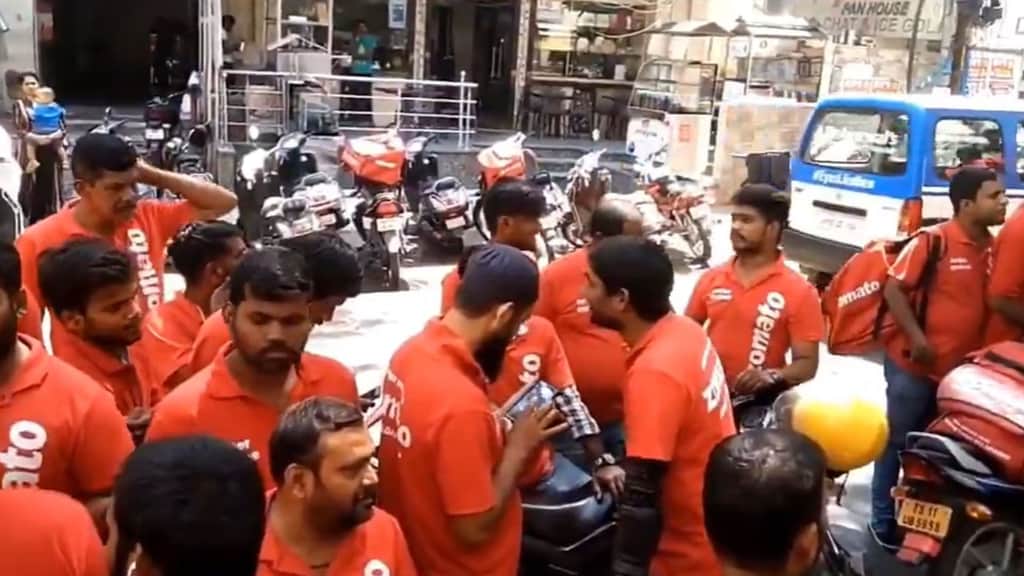
When Zomato CEO Deepinder Goyal publicly declared — claims disputed by unions — that the recent gig workers’ strike had “failed,” the statement was meant to project normalcy. Orders were delivered, apps stayed online, and capital circulated uninterrupted. But what this moment really affirmed was not the resilience of service delivery but the success of platform capitalism in organising labour so completely that even collective resistance struggles to appear as resistance at all. The uninterrupted flow of orders was presented as evidence of fairness, when it is better understood as proof of how thoroughly disruption has been engineered out of the system.
This framing is inseparable from a broader ideological claim: That platforms are benevolent “job creators” and that exploitation, if it exists at all, is a misunderstanding. The gig economy is thus positioned as a solution to unemployment rather than a symptom of a crisis-ridden labour market. But this situation cannot be grasped through the familiar language of demand, supply, or consumer choice. Capitalism did not stumble into this configuration, nor did it ever “forget” labour. It actively organised labour’s disappearance from the field of social recognition.
In India, this disappearance has always been structured through caste. Long before platforms, labour was hidden, segregated, and devalued: Domestic work enclosed within households and feminised; factory labour disciplined by time and space; sanitation, waste, and care work — overwhelmingly performed by Dalit and caste-oppressed workers — pushed to the margins of public life, indispensable yet disposable. Informal labour was visible only as a necessity, never as rights-bearing work. This invisibility was not a failure of capitalism but one of its enabling conditions. Caste functioned as a social technology that stabilised exploitation across generations.
What platforms offer is not emancipatory visibility but a regime of operational visibility oriented entirely toward capital. Labour is tracked, timed, rated, and priced with unprecedented precision while remaining politically invisible and structurally voiceless. The worker appears to the consumer only as an interface — a body at the door, a moving dot on a map — never as a worker with claims, collective power, or bargaining capacity. This is exposure without power, bodily presence without rights.
Goyal’s defence of the gig model rests precisely on this separation. By emphasising that the “average” delivery partner works only a limited number of days per year, that most treat the platform as a source of secondary income, and that workers freely log in and out without fixed shifts or geographies, gig work is framed as choice rather than compulsion. But this framing mistakes the effects of surplus labour for freedom. The decisive question is not whether labour appears voluntary, but under what conditions labour-power is sold — and whether workers have the power to refuse.
The platform economy operates amid chronic unemployment and deepening informalisation, where large sections of the population are rendered surplus to the requirements of formal accumulation. Platforms “create jobs” by absorbing surplus labour into fragmented, on-demand tasks without stabilising income, guaranteeing work, or socialising risk. By over-onboarding workers, they convert demand for services into an oversupply of labour. This replaceability and the “low-entry barrier” are not accidental. It is the organising principle. Low average working days do not signal autonomy but churn, income volatility, algorithmic throttling, and permanent discipline.
This is why the insistence that gig work is merely “secondary income” is so central. Historically, service labour — especially feminised and caste-marked labour — was treated as supplementary, presumed to be subsidised by households, caste networks, or obligation. Platform capitalism generalises this logic across the working class. Earnings are framed as optional even as unemployment, jobless growth, and the erosion of stable employment make them structurally necessary. Flexibility becomes the alibi through which capital disclaims responsibility for social reproduction — health, injury, downtime, ageing, and survival itself.
Where Goyal’s narrative becomes most effective is in how it denies coercion by recruiting the consumer into legitimising the system. The problem, he suggests, is not exploitation but misunderstanding. Critics fail to grasp system design or rider choice. Responsibility is displaced downward. Every order becomes a referendum on the economy itself. To question the platform is to question your own convenience; to criticise gig work is to indict your own participation. Exploitation is reframed as a moral discomfort rather than a structural relation.
By framing platforms as neutral intermediaries and job creators responding to consumer demand, capital disappears as a class actor. If workers are underpaid or insecure, this is recast as an unfortunate by-product of collective desire for speed and affordability. Structural power is translated into consumer preference. The ramifications are clear. First, class antagonism is dissolved into lifestyle choice. Second, structural coercion is obscured, and third, unemployment is depoliticised. Collective demands — minimum guaranteed pay, limits on algorithmic opacity, bargaining rights, social security detached from platform metrics — are dismissed as anti-consumer or unrealistic. Finally, democratic accountability erodes: Platforms govern labour conditions without being recognised as employers, while the state retreats into facilitation rather than regulation.
Seen in this light, the so-called “failed” strike does not signal worker illegitimacy. It has done something far more threatening: It has forced a moral panic. The flurry of CEO statements, data dumps, and reassurances is not evidence of confidence but of deflection. The strike exposed how platforms are designed to fragment labour, absorb disruption, and sustain extraction while insisting that exploitation does not exist at all. What capital fears is not the discomfort of the consumer but of the organisation — because visibility becomes dangerous only when it hardens into collective refusal.
This is why contemporary CEO discourse on gig work slides so urgently into the language of guilt. Inequality appears troubling, we are told, because it has become visible and personal: The worker at the door, the rider on the screen. But guilt is not a political response; it is a containment strategy. It individualises responsibility, moralises consumption, and displaces structural critique. Attention is redirected from wages, control, and power to individual behaviour — whether consumers tip enough, order too often, or feel sufficiently uneasy.
Moral panic performs a crucial function here. By reframing the crisis as one of perception rather than coercion, platforms convert a collective labour question into an ethical dilemma for users. The system remains intact, extraction continues uninterrupted, and responsibility is scattered across millions of consumers. Working-class politics, by contrast, is not concerned with whether consumers feel awkward. It asks who controls production, who sets prices, and who captures surplus value — because exploitation becomes a political problem only when caste-segmented and informal labour begins to act as a class.
The writer is Assistant Professor, Jindal Global Law School, OP Jindal Global University
Editorial Context & Insight
Original analysis & verification
Methodology
This article includes original analysis and synthesis from our editorial team, cross-referenced with primary sources to ensure depth and accuracy.
Primary Source
The Indian Express