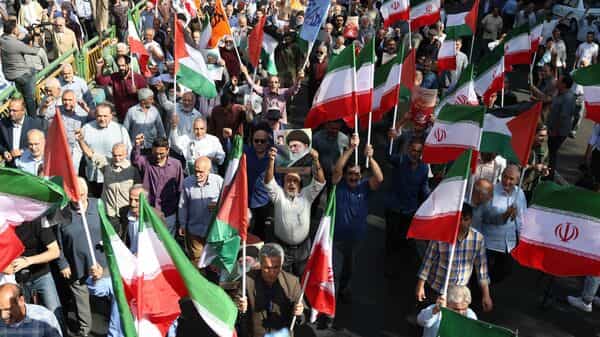
Protests continued across Iran on Friday morning after the country’s exiled crown prince called for nationwide demonstrations, the Associated Press reported. Protesters took to the streets despite a blockade on internet services and international telephone calls.
Protesters were seen chanting slogans against Iran’s government around bonfires as debris littered the streets in the capital, Tehran, and other areas, the agency reported based on short online videos that it said were shared by activists from the country.
In another development, Iranian state media alleged ‘terrorist agents’ of the US and Israel set fires and sparked violence. It also said there were ‘casualties,’ without elaborating on the numbers.
Internet access and telephone lines in Iran were disrupted on Thursday night after demonstrators joined a protest called by exiled Crown Prince Reza Pahlavi.
Internet monitoring firm Cloudflare and advocacy group NetBlocks reported sharply reduced internet traffic, attributing the outage to government interference.
Calls from Dubai to Iran, both landlines and mobile, were reportedly blocked, news agency AP reported.
The current protests, the biggest wave of dissent in three years, began last month (28 December) in Tehran's Grand Bazaar by shopkeepers condemning the currency's free fall
The protests against Iran's Islamic regime, led by Supreme Leader Syed Ali Hosseini Khamenei, have intensified in Tehran, with Iranians, angered by a soaring cost of living amid a flailing economy and crackdowns by security forces, taking to the streets, shouting slogans against the ruling theocratic regime.
The protests also represented the first test of whether the Iranian public could be swayed by Crown Prince Reza Pahlavi. The prince’s father, Mohammad Reza Pahlavi, the last shah of Iran, fled the country just before the country’s 1979 Islamic Revolution.
Pahlavi lives in the United States, based in the Washington, DC . He has spent most of his adult life in exile there advocating for democratic change in Iran and has not lived in Iran since 1978
Demonstrations have included cries in support of the shah, something that could bring a death sentence in the past but now underlines the anger fuelling the protests that began over Iran’s ailing economy.
So far, violence around the demonstrations has killed at least 42 people while more than 2,270 others have been detained, said the US.-based Human Rights Activists News Agency.
“The evidence shows that the scope of the crackdown is becoming more violent and more extensive every day," said Iran Human Rights director Mahmood Amiry-Moghaddam.
The demonstrations were sparked by Iran’s struggling economy but have grown into a broader challenge to the country’s theocratic leadership. Witnesses reported, as per AP, that people in Tehran shouted from their homes and rallied in the streets after Pahlavi’s call for mass demonstrations.
“What turned the tide of the protests was former Crown Prince Reza Pahlavi’s calls for Iranians to take to the streets at 8 p.m. on Thursday and Friday,” Holly Dagres, a senior fellow at the Washington Institute for Near East Policy told the news agency.
“Per social media posts, it became clear that Iranians had delivered and were taking the call seriously to protest in order to oust the Islamic Republic. This is exactly why the internet was shut down: to prevent the world from seeing the protests. Unfortunately, it also likely provided cover for security forces to kill protestersm,” Dagres told AP
The chants included “Death to the dictator!” and “Death to the Islamic Republic!” Others praised the shah, shouting: “This is the last battle! Pahlavi will return!” Thousands could be seen on the streets before all communication to Iran cut out, AP
Pahlavi called for European leaders to join US President Donald Trump in promising to “hold the regime to account.”
“I call on them to use all technical, financial, and diplomatic resources available to restore communication to the Iranian people so that their voice and their will can be heard and seen,” he added. “Do not let the voices of my courageous compatriots be silenced.”
Iranian President Masoud Pezeshkian called for “utmost restraint" in handling the protests, urging security forces to avoid violence and coercion.
“Any violent or coercive behaviour should be avoided," Pezeshkian said in a statement.
Iran’s Foreign Minister Abbas Araghchi said Tehran had no intention of going to war with the United States or Israel, but warned it would respond decisively to any renewed attack.
US President Donald Trump has, however, ruled out meeting with Pahlavi, suggesting that Washington is not ready to back a successor to the Iranian government, should it collapse.
This amid reported of Pahlavi's meeting with Trump next week.
On Thursday, Trump called Pahlavi, a “nice person” but Trump added that, as president, it would not be appropriate to meet with him.
Iran has faced rounds of nationwide protests in recent years. As sanctions tightened and Iran struggled after the 12-day war, its rial currency collapsed in December, reaching 1.4 million to $1. Protests began soon after, with demonstrators chanting against Iran’s theocracy.
In an interview with talk show host Hugh Hewitt aired Thursday, Trump reiterated his pledge.
Iran has “been told very strongly, even more strongly than I’m speaking to you right now, that if they do that, they’re going to have to pay hell,” Trump said.
Editorial Context & Insight
Original analysis & verification
Methodology
This article includes original analysis and synthesis from our editorial team, cross-referenced with primary sources to ensure depth and accuracy.
Primary Source
mint - news