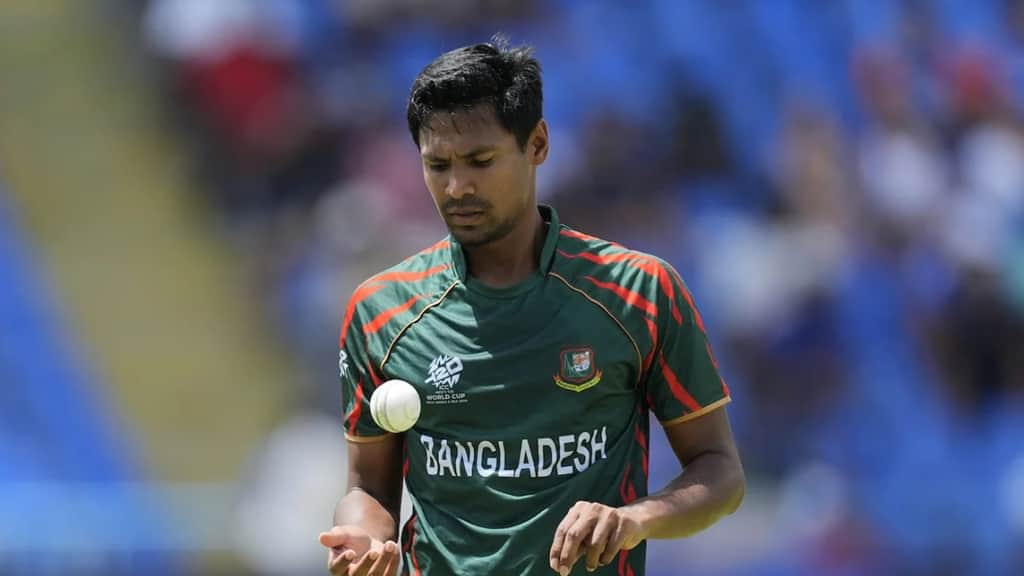
Mustafizur Rahman barely wooed controversies, was the darling of volatile press folk of his country, so much so that they followed him to cover IPL games, and a poster boy back home. (AP Photo)
If the British lawyer Cyril Radcliffe’s compass had veered a fraction to the east, Mustafizur Rahman could have turned up for India. He would not have been in the eye of a political storm that finds him out of the IPL next summer. He hails from Tetulia in the Satkhira district, on the southwestern reach of Bangladesh, a twisted patch stuffed between West Bengal’s North 24 Parganas and Bangladesh’s Khulna districts.
The favourite sport of Tetulia—40 kilometres further from Satkhira town—was football. However, the youngest of six siblings, he followed his brothers to the local streets for a hit with a tennis ball. “When I was young, I wanted to be a batsman. I wanted to hit the ball long and clean. One of my idols was Shahid Afridi, but I could not hit long. I was more of a defensive batsman,” he once told Dhaka Tribune. The Pakistani’s dasher was his first wicket too, a caught behind, which he later admitted shyly the batsman had not nicked.
The source of encouragement was his cricket tragic father, Abul, a farmer who took him to an academy in Satkhira where he entrusted his eldest son, Mokhlesur, to ferry him back and forth, 40km on his bike. How he transformed into a bowler, like myths, has several interpretations. A story goes that he once casually turned his arm over and impressed a famous local batsman. Another tale goes that the coaches at the Satkhira academy repurposed him into a seamer, seeing his height ((5′ 11″) .
Whatever the real story be, when the gaze of district coach Muffachinul Islam’s fell on him during a trial, his talents were unrefined. “I learned that he had never bowled with a leather ball, did not wear spikes and had a jerky action and landed on the wrong foot,” he once told this paper. But he had one gift most boys of his age didn’t. “The wrists.” Nimble, flappy wrists that could assume unusual contortion and snap through 90 degrees at release. “We knew he could never bowl fast, but he could develop other weapons that could make him a successful bowler,” he said.
Mustafizur Rahman being presented a special signed jersey by MS Dhoni during his days with CSK. (X/Mustafizur Rahman)
Foremost among his tools of bluff is the off-cutter (he has the angler, the yorker and bouncer). Its deviousness would claim most elite batsmen of his generation, from Rohit Sharma and Virat Kohli to Suryakumar Yadav and Jos Buttler. Like his origin, his trademark ball, too, has a story. When attending an U-19 camp Dhaka, he was paired with wicket-keeper batsman Anamul Haque in the nets. Anamul queried if he could bowl a slower one. He didn’t have one. But the exuberance of youth made him nod his head in affirmation. “I thought I would roll my fingers across and drop the pace. To my surprise, the ball bounced and turned, like an off-spinner would,” he once said. “I got him out a couple of times, and after the session, I knew I had found my strength.”
He strikes batsmen without build-ups. He glides through his action, more Chaminda Vaas than his favourite bowler Mohammed Amir. At release, the exertion intensifies, but the follow-through is lucid and the face regains its peaceful exterior. A perfectly executed cutter jumps and stops at the batsman, testing his ability to pause his reactions. If the real quick ones test how fast a batsman could react, Mustafizur interrogates the elasticity of their reflexes. The recurring pattern of dismissal is the batsman spooning drivable balls to cover, deceived by pace and the length they belatedly realise was not quite drivable.
Months after his T20I debut, he became a hot property in the IPL auction. In 2016, Sunrisers Hyderabad coughed up Rs 1.40 crore to acquire his services. Nearly a decade later, he cost Kolkata Knight Riders Rs 9.20 crore, an reiteration that even at 30 and ravaged by injuries, he remains a force. His body of work is immense—405 T20 wickets at a thrifty economy rate of 7.43, his country’s highest wicket-taker in T20Is (177), and the fourth highest in ODIs (158). Having turned for clubs in the IPL, PSL, BBL and England’s T20 Blast, he has an estimated net worth of two million dollars.
He can claim to be his country’s finest, or one of the finest. He certainly was the most loved. Of mild manners and a tranquil face, he is rarely riled. Even when MS Dhoni tried to bump him during an ODI in Mirpur, he did not get frazzled. He avoided Dhoni’s gaze and staggered back to his run-up. He had not the pantomime theatrics of Mushfiqur Rahim or the conceit of Shakib-Al-Hasan. He barely wooed controversies, was the darling of volatile press folk of his country, so much so that they followed him to cover IPL games, and a poster boy back home. But now he finds himself in the eye of a politics-tinted controversy.
Editorial Context & Insight
Original analysis & verification
Methodology
This article includes original analysis and synthesis from our editorial team, cross-referenced with primary sources to ensure depth and accuracy.
Primary Source
The Indian Express