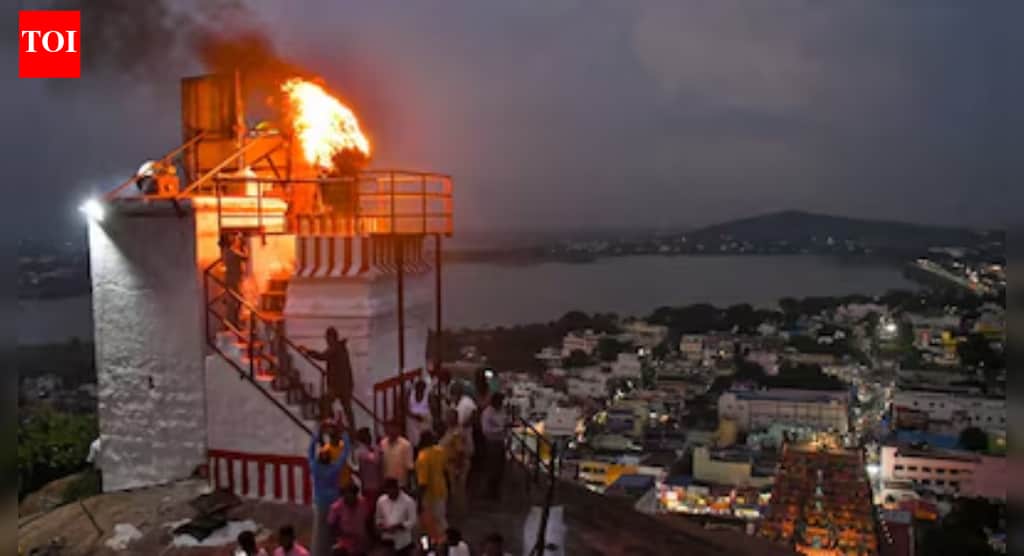
MADURAI: Madras High Court on Tuesday upheld the order passed by the single Judge (Justice G R Swaminathan), directing the Subramaniya Swamy temple management to light Karthigai deepam at the deepathoon (stone pillar) on one of the peaks of Thiruparankundram hill, apart from the other usual places.A division bench of Justice G Jayachandran and Justice K K Ramakrishnan observed that it is ridiculous and hard to believe the fear of the mighty state that allowing representatives of the Devasthanam to light the lamp at the stone pillar near the top of the hill, located within its territory of Devasthanam land, on a particular day in a year, will cause disturbance to public peace. “Of course, it may happen only if such disturbance is sponsored by the state itself.
We pray no state should stoop to that level to achieve their political agenda,” the Judges observed.The Judges observed that the appellants failed to produce formidable evidence to show that Agama Sastra of Saivites prohibits lighting a lamp at a place which is not straight on top of the deity in the sanctum sanctorum; nor is it the case of the Devasthanam or the TN govt that lighting deepam is not a custom prevailing in Thiruparankundram hill.
“The stone pillar with provision to light the lamp, in Tamil, is called ‘Deepathoon’. The location of the pillar is in the portion of the hill declared by a competent civil court as property of the Devasthanam. The Wakf Board, as on date, has no locus standi in this matter. For the first time in the course of argument in the intra-court appeals, on behalf of the Wakf, a mischievous submission was made that the lamp pillar belongs to dargah,” the Judges observed.The Judges observed that, being at a vantage point, the stone pillar called deepathoon, which is on a different rock summit and lower than the peak on which the dargah is located, is the ideal place to light deepam. Religious practices always carry a purpose. The practice of lighting deepam at an elevated place during the Karthigai Deepam festival and other festivals is for the devotees at the foothill and its surrounding areas to see and worship.“As Saint Thirumoolar says, the light is the personification of Lord Shiva. When there is a custom of lighting the lamp at the elevated place available, and a place is available within the limits of Devasthanam property, there is no plausible reason for the Devasthanam to refuse to comply with the wishes of its devotees, when such a request is not against morality or public policy,” the Judges observed.Hence, the Judges directed the Devasthanam to light the deepam at the deepathoon during the Karthigai festival during the Tamil month of Karthigai.
No public shall be allowed to accompany the Devasthanam team. Archaeological Survey of India (ASI) shall impose appropriate conditions to preserve the monument at the hill. The district collector shall coordinate and supervise the event.The court passed the order while disposing of a batch of appeals challenging the order passed by the single Judge. Separate appeals were preferred by Madurai district collector, executive officer of the temple, Madurai city commissioner of police, HR and CE department commissioner, Sikandar Badusha Dargah, and Tamil Nadu Wakf Board.During the course of hearing, TN govt submitted that though various claims were made by the officials regarding the nature of the stone pillar, the state did not form any opinion since, as of today, no emphatical data is available to prove that the stone pillar is a deepathoon: firstly, whether it is a deepathoon; secondly, when it was put up; and thirdly, for what purpose it was put up. No deepam was lit there so far.Senior counsel appearing for the petitioners/respondents submitted that the state and the HR and CE department initially said that there was no evidence to show that the stone pillar was a deepathoon. They then said it (deepathoon) is a granite pillar, a survey stone which is an ASI structure. They further said that the stone pillar was a Jain structure. Multiple claims were made by the state to complicate this matter.
Editorial Context & Insight
Original analysis & verification
Methodology
This article includes original analysis and synthesis from our editorial team, cross-referenced with primary sources to ensure depth and accuracy.
Primary Source
Times of India