

Key takeaways
- How much do you hate typing?
- Unlike its software-focused peers, Relay is building a dedicated, portable microphone for high-fidelity voice-to-text anywhere.
- Zhu says when he and Xu worked at Nothing, they used Wispr Flow's transcription software to “type” most of their messages at work.
What happened
How much do you hate typing? The advent of large language models has rapidly advanced voice-to-text technology. Whether it's Wispr Flow joining your meetings to summarize discussions or Google debuting smarter on-device dictation in its latest Pixel smartphone, these tools do far more than transcribe: They intelligently strip filler words, clean up unscripted thoughts on the fly, and seamlessly mediate multilingual conversations. Now, a new startup is entering the fray.
The company says it stores data locally on the user's device, where users can manually edit or delete it. When the data is sent for processing, it passes through Relay's servers in transit to Google's servers, but Relay does not retain the data. Still, granting AI models eyes on your operating system adds inherent privacy and security trade-offs, like with Microsoft's Recall.
Relay's transcription isn't nearly as impressive as what I've recently tried with Google's Rambler feature on its Pixel 11 series. It doesn't capture every word perfectly and can mess up punctuation sometimes. It can similarly understand when you misspeak and restate sentences, cutting the parts that don't matter. And yes, it can insert emoji for you, though it did this inconsistently in my tests.
When I asked it to add a heart emoji, for example, it did it flawlessly. ” How romantic. It generally knows when you want it to perform an action that's separate from the message.
For example, I sent a message via Relay to my wife saying I really want to eat at a particular restaurant, and in the same breath, I asked Relay to provide a Google Maps link to the spot—and it did. This can be a little hit or miss, though. I'll chalk it up to the beta.
I haven't used it long enough for the software to adapt to my way of speaking, but you can add notes in the Relay app to make it follow certain patterns. For example, I rarely end a sentence with a period in my Slack messages, so I told it to avoid adding periods, and it followed the rule.
Why it matters
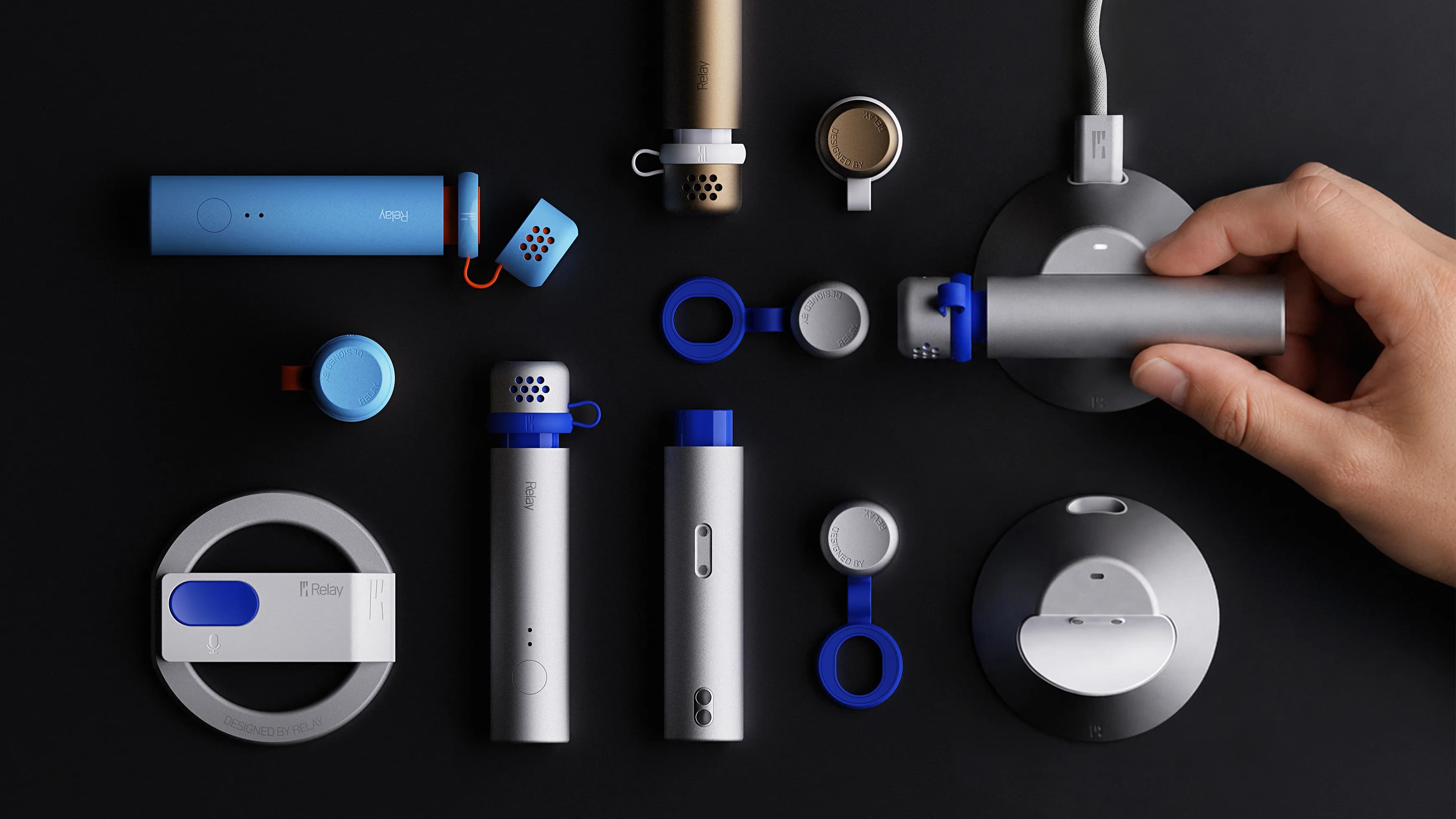
Unlike its software-focused peers, Relay is building a dedicated, portable microphone for high-fidelity voice-to-text anywhere. Based in London, Relay was founded by two former Nothing employees: Cookie Xu, who was Nothing's head of AI and services, and Raymond Zhu, a hardware product manager. While the company is debuting its software today, the hardware—what it calls the Relay Q—won't be available until early 2027.
Zhu says when he and Xu worked at Nothing, they used Wispr Flow's transcription software to “type” most of their messages at work. He says it greatly helped with thinking out ideas, but they kept running into an issue: talking loudly in an office. “In the office, we never really could get the right volume for input,” Zhu tells WIRED.
“If I whisper too quietly, the Mac wouldn't be able to pick it up; too loud and my coworker next to me can hear. Sometimes I would actually pull out my earbud and go like this,” he says over a video call, holding an earbud in front of his mouth to demonstrate.
” Relay is exclusive to macOS at launch, though the company has plans to bring it to Windows, iOS, and Android. It's starting with the desktop because Zhu believes conversations are most complex there. Chats with friends and family are simple on phones, but at work in front of a computer, you're sharing ideas, brainstorming, and using varied tone and formality.
Though the microphone is still months away from being ready, I've been using a beta version of Relay's macOS app, which works with or without the dedicated mic. During setup, you'll need to choose a hotkey that will trigger Relay in any text field—the default is Fn. Press and hold the key while your cursor is in any text field, and Relay activates and handles the voice dictation.
The voice-to-text engine is powered by Google's Gemini models. It can also perform contextual actions—dubbed Skills—like asking it to message a colleague in Slack, which prompts Relay to launch the app, find the recipient, and draft the text. I had some trouble with this Slack skill, though it didn't have trouble crafting a calendar event in Google Calendar.
Relay has some preset skills you can enable for popular apps like WhatsApp and Gmail, but you can make your own and connect other apps. That automation requires sweeping system permissions. Relay needs access to your microphone, but you can grant it access to record a snapshot of your screen anytime it's activated, which is how it can execute those Skills.
What to watch
There's a good deal of customization for specific people that you regularly speak with, which it detects, so you can ensure your messages to your boss sound professional, while messages to your friends are casual. Or you can even set it so that messages to a coworker living in a different country are translated into their language.
I'm relying on a Mac Mini and the microphone in Apple's Studio Display monitor—some of these accuracy issues could be resolved once Relay's hardware arrives. For instance, right now there's a small delay when I press the function key on the keyboard and when Relay activates, but that delay would be far shorter with dedicated hardware. Speaking of, the Relay Q is a cylindrical gizmo with a microphone at the end.