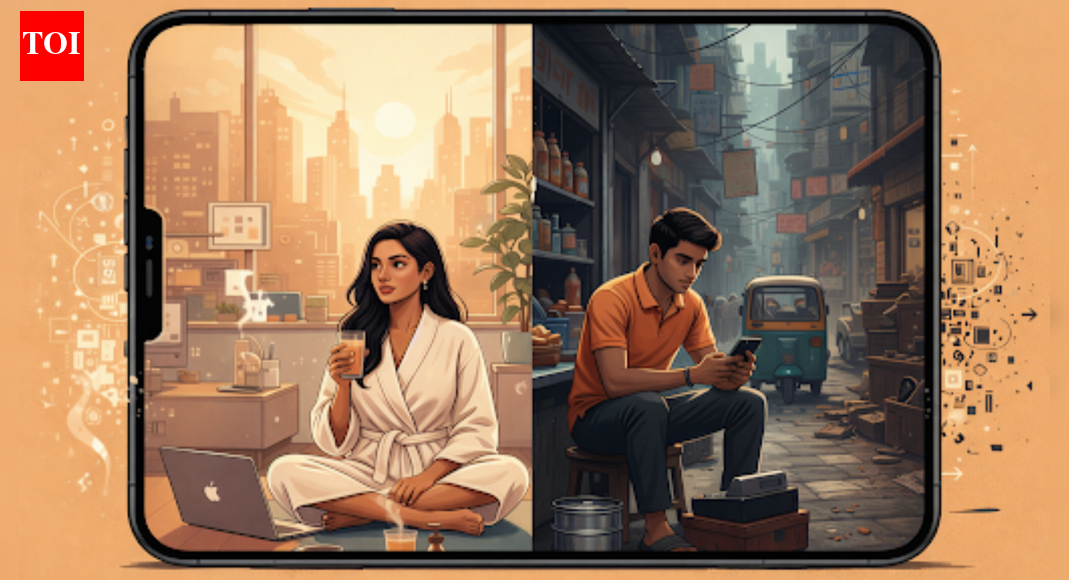
4 am in the morning, I wake up out of nowhere. I'll just go back to sleep, but wait, let me do something more important first. Check my Instagram. Why? No reason. Just scrolling it will make me feel better. This was the case for most of the Indians in 2025. Every single second consuming something different. While waiting for elevators. Between meetings. At family gatherings. Late at night, when rooms were dark and the phone screen became the only source of light.Moving between very different versions of India on the same screen, often without stopping to notice the shift.One swipe showed a bright, well-lit apartment. Soft music played in the background as a young professional filmed a slow, calm morning routine—skincare applied carefully, coffee brewed just right, quiet stretches, gentle reminders about choosing yourself and protecting your energy.The next swipe looked very different. A cramped desk. A lunchbox placed beside a register. A short caption about getting through another Monday.This was not about deciding which India was real and which was staged. Both were real. Both were being lived every day. What mattered was what happened when people consumed these lives back-to-back, sometimes dozens of times a day, and how this constant contrast quietly shaped expectations, ambition, insecurity, and hope, without ever announcing that it was doing so.
The first India learned how to exist online with ease. It understood framing, timing, trends, and the unspoken rules of visibility. This was one of early access—people who grew up with better education, better devices, stronger networks, and the quiet assurance that choices would always exist, even when things didn’t work out the first time.Their lives unfolded smoothly through reels and stories: brunches at familiar cafés, gym selfies, brand collaborations, and work-from-anywhere careers where leisure and labour blurred into one aesthetic loop.
Even struggle appeared softened, filtered through good lighting and reframed as growth rather than risk.
This side of the feed created the illusion that viewers were already living this life—or could live it, if they tried hard enough. People mirrored what they saw: GRWMs with the best products, clothes, similar cafés, similar poses, similar captions, similar aspirations.What often went unacknowledged was that this life being shown might not be real or is genuinely affordable only to those who already had comfort, security, and time.
Café-hopping, wellness routines, and aesthetic productivity require resources—not just a camera.There is always someone younger who seems further ahead, someone freer who appears less burdened and someone richer who makes effort look effortless.
The other India became harder to ignore in 2025.This was everyday life—the kind most Indians know well. Fixed work hours. Long travel. Tight budgets. People who still picked up their phones at the end of the day.
Nine-to-five workers. Homemakers. Delivery partners.For a long time, these lives were not seen online. Then, slowly, they started appearing on the feed.This created a new kind of content- normal lives and hard work. It meant you no longer needed a “fun” or exciting life to make videos. You didn’t have to wait for trips, parties, or special moments. You could simply record your day—waking up, getting ready, going to work, coming back home, and sleeping.
And people would still watch it and appreciate it.
This shift made many more people feel like they could create content.Alongside this was another side of Indian reels, one that has existed for a long time, mostly from rural India. Here, young people made all kinds of videos—dancing, lip-syncing, and short skits. There was no expensive setup, no training, no rules. Just a phone, cheap internet, and courage.Many of these creators were children or young adults who bought phones they could barely afford, just to make videos. Much of the audience responded with ridicule. Comment sections filled with laughter and the word “cringe.”But they were doing the same thing everyone else was—trying to get noticed. Just in their own way, based on what they thought would get views.
A major reason behind this change is the growing presence of Tier-2 and Tier-3 cities online.India now has nearly 700 million smartphone users, many of them using affordable phones and low-cost internet. Together, they are driving the growth of a $440 million interactive media market in FY2025, which is expected to grow at around 45% every year until FY2030, as reported by Redseer.More than 70% of India’s roughly 500 million social media users now come from Tier-2 and smaller cities. A similar number also use digital payments and online services.This shift began after 2016, when Jio sharply reduced the cost of mobile data, bringing millions of people from smaller cities and towns online for the first time. These changes made it easier for people not just to watch content, but to take part in it.
For a long time, growth stories focused mainly on big cities.
Smaller towns were seen as “future markets”—important, but always coming later. That idea broke down once cheap data and affordable smartphones became common.Today, most internet users in India live outside metro cities. More importantly, they are no longer just viewers. They create content, leave comments, share opinions, sell products, and influence others.This demographic shift has altered the feed at a structural level.
Language diversity has expanded, context has become local. This change was driven by a few key factors: Together, these forces removed many of the old barriers to entry—and opened the feed to a much wider India.
When these two sides appear in the same feed—often within seconds of each other—the result is a quiet emotional whiplash that few people consciously acknowledge.Admiration turns into envy. Envy slips into guilt. Guilt softens into reassurance—all within a minute.
A luxury reel triggers dissatisfaction, a routine work vlog restores balance, or sometimes even pride. Yet the relief is brief.The feed pulls emotions in opposite directions, forcing viewers to constantly recalibrate how they feel about their own lives. Over time, this back-and-forth creates a subtler effect: insecurity and an inability to locate oneself clearly within what is being seen.People are left unsure of how to feel about their own progress, their ambition, or their contentment.
Are they doing well, or falling behind? Should they want more or be grateful for what they have? The scroll never offers answers, only comparisons.No generation before has encountered inequality this closely or this frequently. Seen the urban-rural divide this closely. Difference now doesn’t arrive through reports or statistics. It interrupts people mid-scroll—with faces, voices, and intimate detail—leaving behind not just awareness, but a lingering confusion about self-worth and where one truly stands.
For the second India in particular, social media did not feel like a trick or illusion. It felt like a window that opened just wide enough to let light in.For many, social media acts like a beacon of hope. How one viral reel can get them brand collaborations and make them famous and eventually one day get them to the point where it becomes their main stream of income.For those who show up everyday for reels and their content, social media is more than just social media for them. After all, it is the best source to follow your passion while also earning a living through it.There's an audience for every type of content, and with more content, people become more confused, and that in turn leads to more space for content.
As platforms matured, they stopped monetising content alone. They began monetising people.By 2025, even those with no desire to be creators felt pressure to package their lives as watchable.
Couples documented weddings for reach and revenue. Morning routines were filmed before they were fully lived. Fitness journeys, mental health struggles, grief, healing, and growth were shaped into consumable formats.And as said above, literally any type of content will garner views, so it feels weird not put yourself on the internet.The boundary between authenticity and performance blurred.Moments were evaluated not just by how they felt, but by how they would appear on screen. Watching ordinary people turn visibility into income raised an unspoken question: If they can do it, why not me?Slowly, the self became a product—edited, optimised, and positioned—even when no brand deal ever arrived.What disappeared was not honesty, but privacy. Not every moment needed an audience, yet the architecture of platforms suggested otherwise. The line between living and performing thinned until it was barely visible.
In 2025, India did not scroll through a single reality. It scrolled through many layers at once. Luxury appeared beside labour. Somewhere between two swipes, people were quietly asked to locate themselves.On one side, it showed how much more privileged we are than many others online. On the other, it reminded us of how much less we have compared to someone else. Should they feel grateful—or complain?The distance between lives collapsed, even when the gap between them stayed the same.Scrolling slowly changed how people measured time, success, and self-worth. Not through thought or reflection, but through feeling. It trained attention to move faster, reduced patience, and shaped empathy unevenly.
It offered possibility without certainty, visibility without stability, and connection without rest.The question was no longer whether social media showed India accurately.It became about what happens to a society that consumes all its contradictions at once, every single day, without pause.By the time people looked up from their screens, the scroll had already begun shaping how they saw their own lives.