Since 1990, there has been a renewed interest in B.R. Ambedkar, regarded widely as the architect of the Constitution of India. On his 99th birth anniversary in April that year, the country’s highest award— the title of Bharat Ratna— was conferred on him posthumously and his widow, Savita Ambedkar received it from President R. Venkataraman. Prime Minister V.P. Singh had declared 1990 as the Year of Social Justice.
In Tamil Nadu, the then Chief Minister M. Karunanidhi, in May, announced in the Assembly that the Madras Law College would be named after Ambedkar. During his previous spell, he got an arts and science college in Vyasarpadi in north Chennai named after the architect of the Constitution.
In no time, the country, particularly northern States, was rocked by students’ agitation against the decision of the Singh’s government to earmark 27% of jobs in the Central government and public sector undertakings for the socially and educationally backward classes (SEBCs or Other Backward Classes - OBCs), which triggered a spell of apprehension among Scheduled Castes and Scheduled Tribes that their quota scheme - 15% for SCs and 7.5% for Scheduled Tribes in the Union government and similar arrangements in States - would be adversely hit. This factor had also provided one more reason for the underprivileged people to remember Ambedkar vigorously. When the Supreme Court had cleared the 27% quota for OBCs, it also stipulated that the quantum of reservation should not exceed 50%.
This had, in turn, kindled fears among the SC/STs in Tamil Nadu whether their share— 18% for SCs and 1% for STs— would be cut proportionately so as to keep the quota for the BCs/Most Backward Classes/SC/STs at 50% from existing 69%. However, the AIADMK government, led by Jayalalithaa, had led a successful campaign for the retention of the 69% quota system for which it got widespread support from most of the political parties.
It was under the circumstances that Jayalalithaa, on April 14, 1993, laid the foundation stone for a ₹1-crore Dr. Ambedkar centenary memorial hall opposite the lyappan temple on Greenways Road in Raja Annamalai Puram. To be located on a five-acre site that formed a part of the Adyar estuary, the multi-purpose edifice would also have a modern conference hall and a library consisting of books authored by Ambedkar. Only about a week earlier, the then Transport Minister K.A. Sengottaiyan (now in the Tamilaga Vettri Kazhagam) had stated that the Pallavan Transport Corporation, operating in the city and its suburbs, would be bifurcated and the new corporation named after Ambedkar, according to a report of The Hindu on April 7, 1993.
When the government had begun filling a portion of the estuary with sand, the Citizen consumer and civic Action Group (CAG), represented by its trustee Sriram Panchu, moved the Madras High Court against the construction of the memorial at the given site. While clarifying it was not against the construction of any memorial for Ambedkar, the CAG pointed out the estuary had been attracting migratory birds. A board had been put up, proclaiming against poaching. “As the area has been classified as a forest land, it is not open to the authorities to convert the same for non-forest purposes,” stated a report published in this daily on December 25, 1994.
Three months later, the High Court permitted the State government to construct the proposed memorial over an extent of 1.5 acres instead of the original five acres). However, it restrained the construction of any auditorium or building other than the monument. Disposing of a writ petition filed by the CAG, Justice A. Kanakaraj, directed the Government to remove the sand spread on the other side of the plot for the construction and restore the area to its original position. The entire low-lying wetland in the survey area and its subdivisions vested with the Chennai Metropolitan Development Authority should be maintained and preserved as a low-lying wetland. The authorities should not permit or authorise the construction of any type, be it an office or a commercial complex, the judge said.
Six months later, the memorial project took a new turn with the Union Ministry of Environment and Forests (MoEF) informing the State government that reclamation of land in the Adyar estuary would be a “prohibited activity” as the area was covered under the Coastal Regulation Zone (CRZ), The Hindu reported on September 17, 1994.
There was a regime change in May 1996 with the return of the DMK president M. Karunanidhi as Chief Minister and in the next two years, all the legal hurdles were cleared.
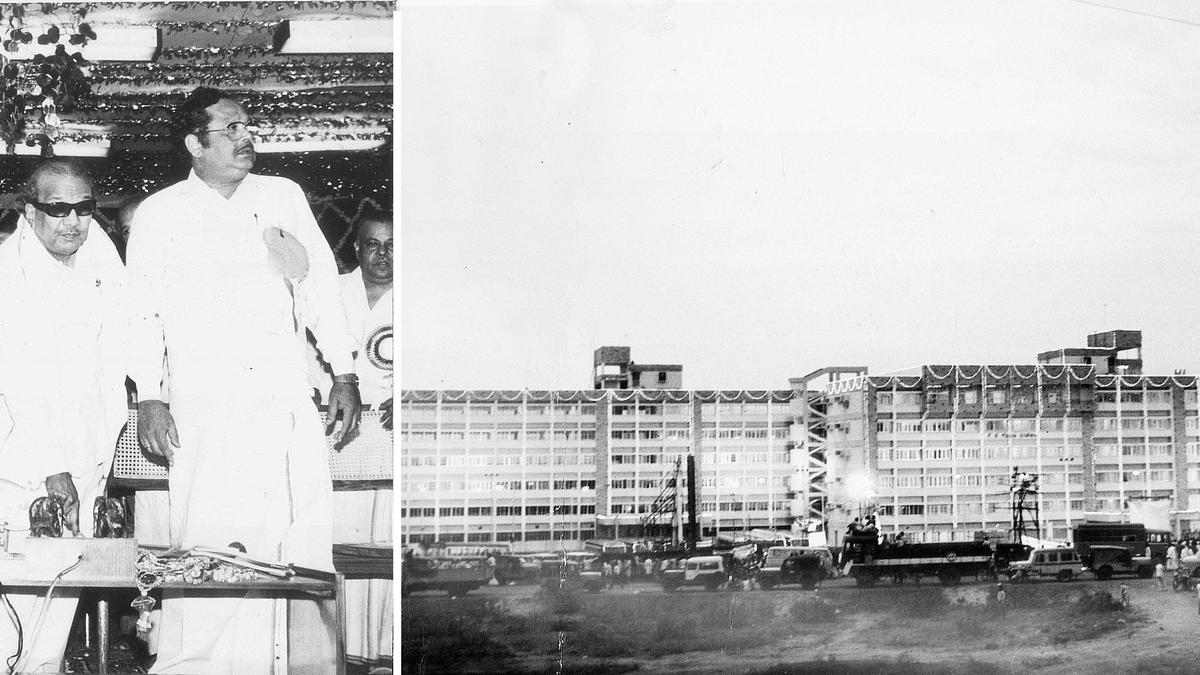
Exactly 27 years ago (December 23, 1998), the Chief Minister laid the foundation stone for the second time. Now, the cost was revised to ₹ 5 crore while the project execution was entrusted to the Public Works Department (PWD). In about one-and-a-half years, the memorial was built over a plinth area of 8,285 sq.ft with a semi-circle dome of 55 ft diameter of 55 ft. While declaring open the memorial, Karunanidhi called for an end to caste and communal clashes, saying that was the best tribute that could be paid to the memory of Ambedkar, according to a report of this newspaper on June 11, 2000. On the occasion, he recalled how he, in the early 1990s, had impressed upon the then Governor and Chief Minister of Maharashtra, P.C. Alexander and Sharad Pawar, to stick to the decision of renaming the Marathwada University after Ambedkar. In the late 1990s, Chennai got a law university, also named after the architect of the Constitution. In 1997, the then President K.R. Narayanan inaugurated the university in the presence of Karunanidhi.
In October 2022, Chief Minister M.K. Stalin unveiled a statue for Ambedkar on the premises of the memorial. The Viduthalai Chiruthaigal Katchi (VCK) founder and Chidambaram MP Thol. Thirumavalavan donated the statue.
A former IAS officer, hailing from Maharashtra, once expressed his desire that like his State, Tamil Nadu too should have a massive monument for Ambedkar. More than brick and mortar structures, Karunanidhi’s appeal, made 25 years ago, for ending conflicts in the name of caste would be far more appropriate.