If you are a student of space history or tracked the space industry before billionaires and venture capital changed it forever, you probably know the name Rocketdyne.
A half-century ago, Rocketdyne manufactured almost all of the large liquid-fueled rocket engines in the United States. The Saturn V rocket that boosted astronauts toward the Moon relied on powerful engines developed by Rocketdyne, as did the Space Shuttle, the Atlas, Thor, and Delta rockets, and the US military’s earliest ballistic missiles.
Rocketdyne’s dominance began to erode after the end of the Cold War. The company started in 1955 as a division of North American Aviation, then became part of Rockwell International until Boeing acquired Rockwell’s aerospace division in 1996. Rocketdyne continually designed and tested large new rocket engines from the 1950s through the 1980s. Since then, Rocketdyne has developed and qualified just one large engine design from scratch—the RS-68—and it retired from service in 2024.
The rise of the commercial space industry precipitated a steeper decline at Rocketdyne. Boeing sold the Rocketdyne division to Pratt & Whitney in 2005 for $700 million, or approximately $1.2 billion adjusted for inflation. This was the year before SpaceX launched its first rocket, and a few years before NASA wound down the Space Shuttle program.
While Rocketdyne’s ownership merry-go-round kept spinning, the company’s competitors pushed forward. SpaceX and Blue Origin, backed by wealthy owners, took a fresh approach to designing rockets. Apart from the technical innovations that led to reusable rockets, these newer companies emphasized vertical integration to cut costs and minimize reliance on outside supply chains. They wanted to design and build their own rocket engines and were not interested in outsourcing propulsion. Rocketdyne’s business was—and still is—entirely focused on selling ready-made engines to customers.
The launch startups that followed in the footsteps of SpaceX and Blue Origin have largely imitated their approach to insourcing. There are at least nine medium to large liquid-fueled rocket engines in production or in advanced development in the United States today, and just one of them is from the enterprise once known as Rocketdyne: the RS-25 engine used to power the core stage of NASA’s Space Launch System (SLS) rocket.
Even United Launch Alliance, Rocketdyne’s primary customer after the end of the shuttle program, chose a new booster engine produced by Blue Origin for its new Vulcan rocket.
The parent company of Aerojet purchased Rocketdyne in 2013 to form Aerojet Rocketdyne. L3Harris closed its acquisition of Aerojet Rocketdyne in 2023, creating a space propulsion and power systems business unit and retiring the historic Rocketdyne name. Now, just two-and-a-half years later, L3Harris announced Monday it is selling a 60 percent stake in its newly created propulsion and power business to AE Industrial Partners, a Florida-based private equity firm. L3Harris will retain 40 percent ownership.
With its controlling stake, AE Industrial Partners said it plans to restore the Rocketdyne name “in recognition of its heritage and longstanding innovation within space propulsion technology.” AE Industrial called Rocketdyne a “key strategic national asset” in a statement announcing the transaction, which values the Rocketdyne enterprise at $845 million. The deal is expected to close in the second half of this year.
“Rocketdyne is more than just a company; it is the birthplace of US rocket propulsion,” said Kirk Konert, managing partner at AE Industrial. “This transaction will not only modernize and give new life to a pioneer of space and national defense technology, but it will also create a new hybrid model of agile collaboration, combining the stability and power of a national defense prime with the innovation of a specialized investor.”
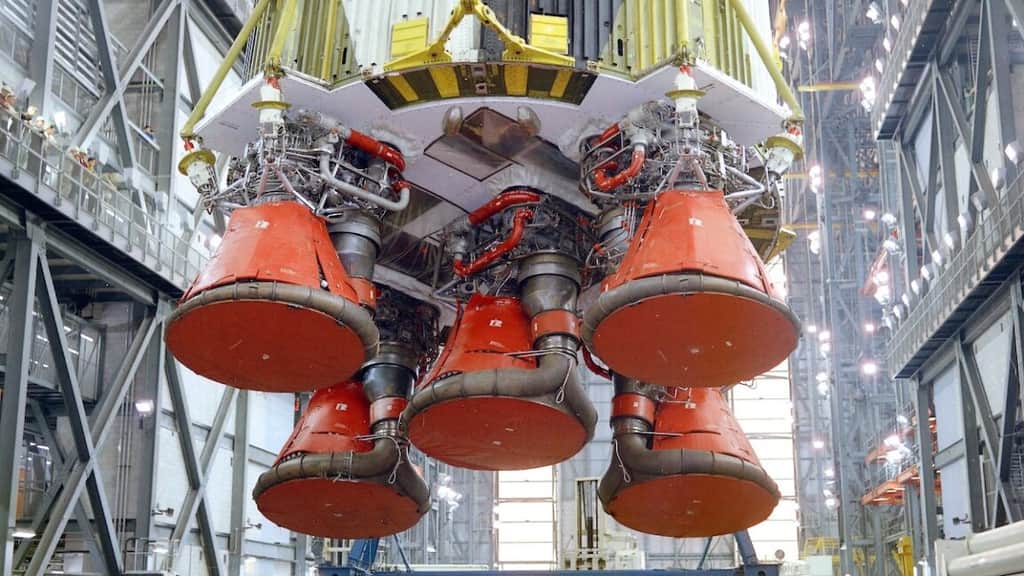
The RS-25 engine, by far the largest in L3Harris’ portfolio and a former Rocketdyne product, is not part of the sale. The RS-25 was initially known as the Space Shuttle Main Engine and was designed for reusability. The expendable heavy-lift SLS rocket uses four of the engines, and NASA is burning through the 16 leftover shuttle-era RS-25 engines on the first four SLS flights for the agency’s Artemis Moon program. The second SLS flight is set to launch in the coming months on a mission carrying four astronauts beyond the Moon.
L3Harris will retain total ownership of the RS-25 program. The company has a contract with NASA to build new RS-25 engines for SLS flights beyond Artemis IV. But the new RS-25s will come at an expense of about $100 million per engine, significantly more than SpaceX sells an entire launch on a Falcon 9 rocket. The engine contract is structured as a cost-plus contract with award and incentive fees paid by the government to L3Harris.
The SLS rocket’s exorbitant cost has driven calls for its cancellation, although lawmakers in Congress last year signaled their support for keeping the program alive through at least Artemis V. Beyond 2030, the rocket’s future is in doubt.
Aerojet Rocketdyne’s work on solid-fueled propulsion, ballistic missile interceptors, tactical missiles, and other military munitions will also remain under L3Harris control. The split of the company’s space and defense segments will allow L3Harris to concentrate on Pentagon programs, the company said.
So, what is AE Industrial getting in its deal with L3Harris? Aside from the Rocketdyne name, the private equity firm will have a majority stake in the production of the liquid-fueled RL10 upper stage engine used on United Launch Alliance’s Vulcan rocket. AE Industrial’s Rocketdyne will also continue the legacy company’s work in nuclear propulsion, electric propulsion, and smaller in-space maneuvering thrusters used on satellites.
AE Industrial said its plans for the RL10 engine include “applying modern manufacturing discipline” at the RL10’s factory in West Palm Beach, Florida. RL10s have flown on rockets since the 1960s, and historically required significant touch labor and manual fabrication, driving up their cost.
“Our strategy is to identify critical technologies and build them into world-class companies,” Jon Lusczakoski, principal at AE Industrial, said in a statement. “Rocketdyne’s unparalleled heritage offers the perfect foundation for this mission. We see a unique opportunity to apply our deep experience in scaling space systems to this iconic business—ensuring Rocketdyne remains a critical pillar of national security while aggressively evolving to meet the demands of the future.”
AE Industrial has experience buying up space companies and taking them to new heights. The firm became the primary shareholder in Firefly Aerospace and York Space Systems in 2022, providing each company with needed cash at a critical moment. Firefly has not achieved much success with its original rocket, the Alpha, but it became the first company to complete a fully successful commercial landing on the Moon last year. Firefly also has a major strategic partnership with Northrop Grumman to develop a new medium-lift rocket.
York Space Systems has more than $1 billion in contracts with the US military’s Space Development Agency to build more than 100 satellites for the Pentagon’s missile tracking and data relay constellation in low-Earth orbit. AE Industrial also established the space and defense tech company Redwire in 2020.
Editorial Context & Insight
Original analysis & verification
Methodology
This article includes original analysis and synthesis from our editorial team, cross-referenced with primary sources to ensure depth and accuracy.
Primary Source
Ars Technica