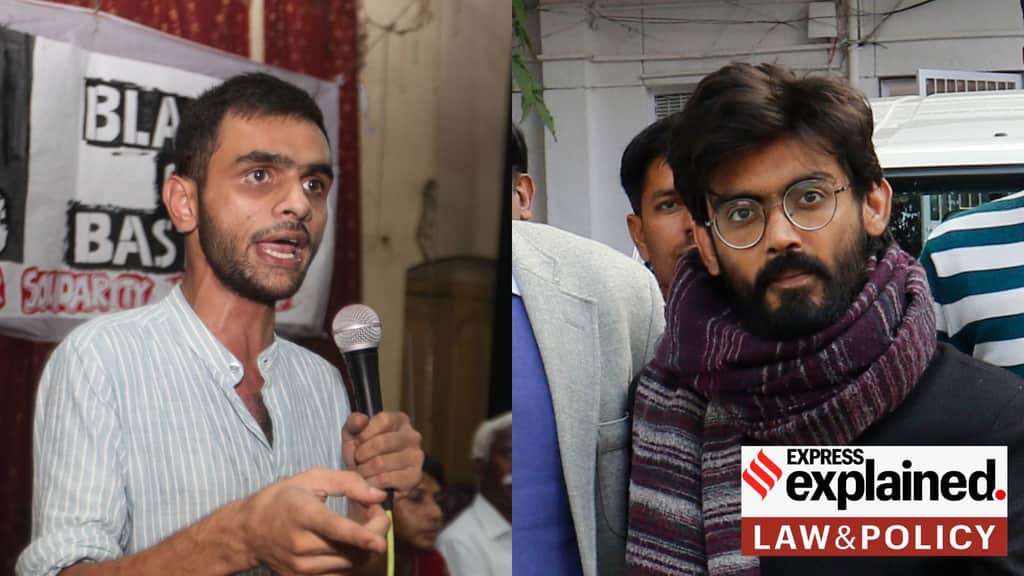
The Supreme Court on Monday denied bail to Umar Khalid and Sharjeel Imam in the 2020 Delhi riots conspiracy case, while granting relief to five other accused — Gulfisha Fatima, Meeran Haider, Shifa Ur Rehman, Mohd Saleem Khan, and Shadab Ahmed.
The Bench of Justices Aravind Kumar and N V Anjaria, in its ruling, created a framework of differentiated roles of the alleged conspirators, distinguishing the “architects” of the conspiracy and its “facilitators”.
The SC held that in an alleged conspiracy of this magnitude, the “ideological drivers” cannot claim parity with those accused of merely executing orders on the ground.
The central theme of the judgment is “individualised assessment of culpability”. The SC observed that the roles attributed to the accused vary significantly, noting a “discernible differentiation” in the hierarchy of the alleged conspiracy.
For Khalid and Imam, the court found that the prosecution material places them at the level of “conceptualisation, direction, orchestration, or mobilisation”. They are described in the verdict as the “ideological drivers” and “masterminds”, who formulated the strategy of converting protests against the Citizenship (Amendment) Act into disruptive chakka jams or road blockades to paralyse Delhi. The judgment says the allegations against the principal accused indicated a central and directive role.
In contrast, the five accused, who were granted bail, were characterised by the SC as “local-level facilitators” or “site-level executors”. Their roles were described as “derivative”, meaning they acted upon directions received from the top tier. The court reasoned that keeping these “minor participants” in custody indefinitely, when the investigation is complete, and the trial is lagging, would be disproportionate.
One of the key aspects of the ruling is what constitutes a “terrorist act” under Section 15 of the Unlawful Activities (Prevention) Act (UAPA).
The defence argued that the accused were merely organising protests and road blockades, which amount to political dissent rather than terrorism. However, the SC rejected this argument, saying Section 15 is not limited to the use of conventional weapons such as bombs or firearms. It noted that the definition includes acts done using “any other means of whatever nature” that are likely to threaten the economic security of India or disrupt essential services.
The SC accepted the prosecution’s theory that the “sustained choking of arterial roads” and the “systemic disruption of civic life” were not benign protests but calibrated acts intended to threaten the unity and integrity of India. The court held that when such blockades are designed to cause a breakdown of public order and are synchronised to coincide with international events – such as the 2020 visit of United States President Donald Trump – they prima facie attract the definition of a terrorist act.
Khalid was one of several civil society activists, retired bureaucrats and journalists who had separately challenged before the SC the wide ambit of several provisions of the UAPA. These included questions over what constitutes striking terror “by any other means” under Section 15. These pleas, however, were withdrawn from the SC in 2024 when the court nudged them to approach a High Court instead. Subsequently, they approached the Delhi HC, where the pleas have since been pending. If there were a definitive ruling on the ambit of Section 15, it could have helped Khalid.
This interpretation directly impacts the grant of bail. Under Section 43D(5) of the UAPA, no accused can be released on bail if the court is of the opinion that the accusations are “prima facie true”. Applying this to Khalid and Imam, the court found that the material — including witness statements, WhatsApp chats and meeting records — sufficiently established a prima facie case of conspiracy. Consequently, the statutory bar on bail operated with full force against them.
All appellants presented an argument regarding the length of their custody. The accused have been in jail since 2020, with the trial still stuck at the stage of framing of charges. They relied on the SC’s 2021 ruling in Union of India v. K.A. Najeeb, which held that constitutional courts can grant bail despite the UAPA bar if there is no likelihood of a speedy trial, to protect the right to life and liberty under Article 21 of the Constitution.
However, on Monday, the SC clarified that K.A. Najeeb does not provide a mechanical rule where delay automatically trumps the statute. The court has said delay does not operate as a “trump card” that automatically displaces statutory restraint but rather serves as a trigger for heightened judicial scrutiny.
The SC also concluded that the delay was partly due to the voluminous evidence — more than 1,000 documents and 835 witnesses — and procedural objections raised by the defence, and could not be solely attributed to the prosecution.
The court ruled that the plea of delay must be balanced against the gravity of the offence and the role of the accused. For the alleged “masterminds” — Khalid and Imam — the gravity of the offence and their “conspiratorial centrality” meant that the statutory embargo on bail outweighed the factor of delay.
However, for the facilitators, whose roles were limited to logistics or local mobilisation, the court held that continued incarceration had become punitive. Since they did not possess the “autonomous capacity” to threaten the trial process, the balance tilted in favour of their liberty.
For Fatima, alleged to be a local organiser at the Seelampur protest site, the SC noted her role was confined to the operational execution of directions and lacked strategic centrality. The court also applied the principle of parity, noting that similarly placed co-accused — Natasha Narwal and Devangana Kalita — had already been granted bail.
Haider, accused of managing protest sites and finances, was found to have a role that was “situational and derivative” rather than originating.
In the case of Rehman, who allegedly provided financial and logistical support as the president of the Alumni Association of Jamia Millia Islamia, the court found no evidence that he exercised autonomous decision-making authority over the broader conspiracy.
Khan, accused of being a local executor in Chand Bagh, was termed in the judgment as having an “operational” role.
In the ruling, Ahmed was described as functioning at an “executory tier without demonstrated autonomy”.
For the five accused granted relief, the SC has imposed strict conditions to ensure they do not tamper with evidence or influence witnesses. They must execute a personal bond of Rs 2,00,000 with two local sureties and remain within the National Capital Territory of Delhi.
They have been directed to surrender their passports and report to the Delhi Police’s Crime Branch police station twice a week. The court has also restrained them from making any public commentary regarding the case and prohibited them from contacting witnesses.
For Khalid and Imam, the SC acknowledged their concern regarding the pace of the trial and directed the trial court to proceed with “due expedition”. The court has also provided a specific window for them to seek bail again. They can apply for bail before the trial court either upon the completion of the examination of the “protected witnesses” relied upon by the prosecution or upon the expiry of one year from the date of this order, whichever is earlier.
Editorial Context & Insight
Original analysis & verification
Methodology
This article includes original analysis and synthesis from our editorial team, cross-referenced with primary sources to ensure depth and accuracy.
Primary Source
The Indian Express