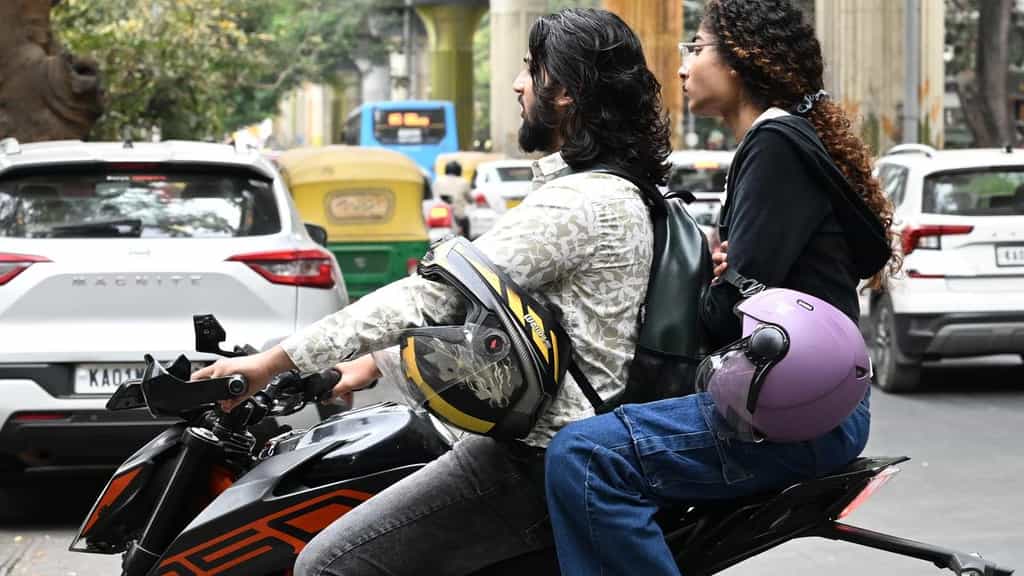
In 2025, riding without a helmet and driving without a safety belt topped the list of traffic violations in Bengaluru.
However, the numbers have declined compared to previous years, according to ASTraM data accessed by The Hindu.
Overall violations also dropped, with the Bengaluru Traffic Police (BTP) issuing 69.88 lakh challans in 2025. In comparison, more than 80 lakh violations were recorded in 2024, 90 lakh in 2023, and one crore in 2022.
Riding without a helmet accounted for 29.09% of total violations, followed by pillion riders without helmets (16.13%), wrong parking (15.97%), driving without a safety belt (10.46%), jumping traffic signals (9.47%), and no-entry driving (4.33%).
The BTP issues challans for 27 different types of violations.
The data also shows that most of the violations were recorded at police stations covering high-density corridors and market areas. East Bengaluru’s Jeevan Bima Nagar recorded the highest number of violations (38,367), followed by HAL Airport Road, Bellandur, Shivajinagar, and Jnanabharathi.
Meanwhile, 2025 also saw the traffic police returning to the streets to intercept vehicles and penalise commuters. The data shows that 87% of challans were issued contactless and 13% through physical contact. In 2024, 94% of challans were contactless, and 6% involved contact. However, many are unhappy with this change, saying it not only increases malpractices within the department but also poses safety risks, as violators tend to evade police interception.
Contact or contactless policing?
A senior traffic police officer attributed the decline in violations to a combination of field enforcement and tech-driven policing, saying these measures improve road safety and discipline among commuters.
Rajkumar Dugar, convenor of Citizens for Citizens (C4C), argued that the fall in violations is mainly due to the fear of cameras and contactless booking of cases. “The presence of cameras across the city is always in the back of people’s minds, which forces commuters to follow the rules while people try to evade officers who are catching violations on the ground,” he said.
However, Karthik Reddy, Joint Commissioner of Police (Traffic), clarified that on-field enforcement is carried out only for visible violations and that there is no random interception.
“To ensure officers are not demanding money or indulging in unethical practices, we have mandated the use of body-worn cameras. So there is very little scope for harassment of commuters,” Mr. Reddy told The Hindu.
But Mr. Dugar said traffic regulation often takes a back seat when violations are intercepted in the field. “For example, near the Mount Carmel College underpass, there is heavy congestion every day. Instead of managing traffic at the spot, the police are often seen catching violators some distance away,” he explained. Mr. Dugar said that this is not an isolated incident, as many commuters have flagged similar issues over the last six months.
Notably, the Intelligent Traffic Management System (ITMS) was introduced in 2022 to enable contactless enforcement in the city and allow traffic police to focus better on on-ground traffic regulation.
Mr. Dugar suggested that instead of on-field interception, technology should be strengthened and fine collection practices for camera-recorded violations improved.
“The BTP should introduce a system that gives violators 60 to 90 days to clear fines and send challans regularly. For those who do not clear their fines, the amount should be increased by a fixed percentage after the deadline,” he said.
Akshay Mitra, a techie, suggested that the BTP should strengthen the technology to penalise speed-limit violations across the city and other violations that pose risks to commuters and affect road safety.
The data also shows that safety-related violations, apart from not wearing helmets and seat belts, are booked less frequently. Speeding, a major cause of fatal accidents, especially on the city’s outskirts, receives less attention. The data shows that only 40,439 overspeeding cases and 18,887 cases of riding on footpaths were booked in 2025, even though these rules are widely violated.
Similarly, in the case of footpath parking, which forces pedestrians to walk on the road and increases safety risks, 1.28 lakh cases were booked. Mr. Mitra said the BTP should focus more on these violations on the ground, rather than primarily targeting helmetless riding and similar offences.
(This is the second of a three-part series, in which we look at trends and patterns in Bengaluru’s traffic violations.)
Editorial Context & Insight
Original analysis and synthesis with multi-source verification
Methodology
This article includes original analysis and synthesis from our editorial team, cross-referenced with multiple primary sources to ensure depth, accuracy, and balanced perspective. All claims are fact-checked and verified before publication.
Editorial Team
Senior Editor
James Chen
Specializes in India coverage
Quality Assurance
Associate Editor
Fact-checking and editorial standards compliance