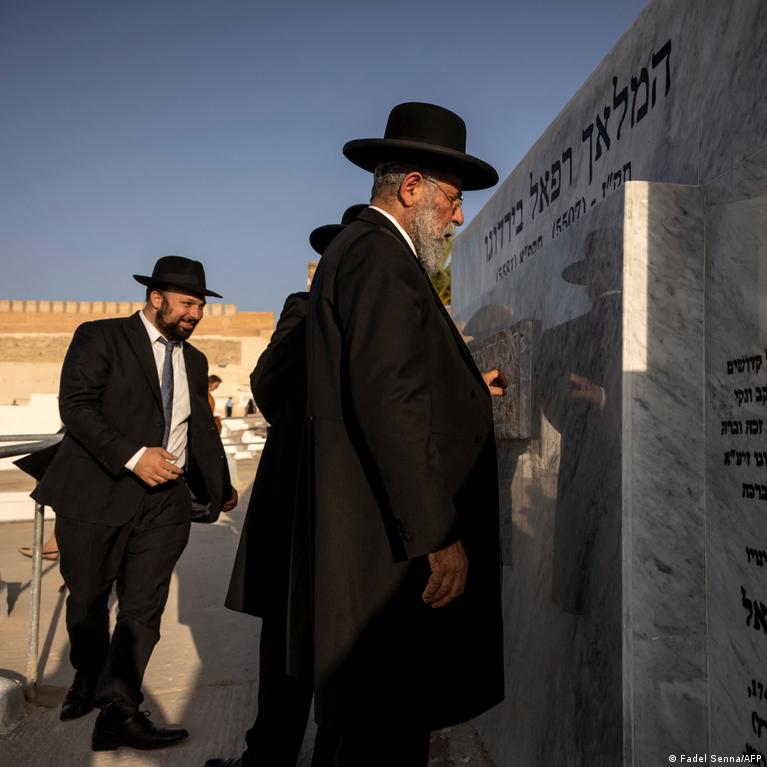
The only known Jewish museum in the Arab world is tucked away in a residential neighborhood of the Moroccan economic metropolis of Casablanca, guarded by a lone soldier.
Among other items, the museum contains black-and-white photos of Jewish life in Morocco from the 1920s and 1930s. The pictures show craftsmen at work, celebrations and family life. Display cases contain Torah scrolls and clothing, a few old manuscripts ― all relics from a time when Morocco still had a large Jewish community.
Around 300,000 Jews lived in the Arab country, which had a population of 7 million at the time, when the state of Israel was founded in 1948. After that, most emigrated, motivated in part by anti-Jewish pogroms in the cities of Oujda and Jerada in the same year, in which more than 40 Jews died. About 1 million Israelis with Moroccan roots live in the Jewish state today. Around 3,000 to 5,000 Jews remained in Morocco, most of them living in Casablanca.
Although Jews represent a tiny minority in terms of numbers, synagogues and kosher restaurants are still part of the cityscape of Casablanca today.
"Jews are an essential part of society. They have thus created a special connection between Morocco and Israel," Moroccan historian Jamal Amiar told TelQuel magazine.
For a long time, the country struggled to officially recognize this special connection. It was not until the 2011 constitution that Jewish culture was recognized as an enriching element of Morocco's identity, along with the traditions and language of the Amazigh, who were often referred to as Berbers in the past.
"For us, it is normal for Jews, Christians and Muslims to live together," says Brahim Dargha, a man in his forties who works as a driver, in an interview with DW.
Dargha is a Muslim from the Rif Mountains, a marginalized region in northern Morocco. He lives with an Israeli friend in Casablanca, he says, proudly emphasizing his own Amazigh heritage. "We, the Jews and the Amazigh, are the original Moroccans; the Arabs only came later," he says.
The first Jews arrived in Morocco in ancient times after the destruction of the Jewish temple and mingled with the native Amazigh. After the Reconquista, the reconquest of the Iberian Peninsula by Christian kingdoms from the Moors at the end of the 15th century, many Jews from Spain sought refuge from persecution in Morocco. King Mohammed V, who ruled the country at the time, protected the country's Jewish minority during the Second World War, after the Vichy regime instituted anti-Jewish laws. He treated the Jews like his own subjects and resisted their extradition from Morocco.
But over the years, relations between different communities have not always been conflict-free. There have been attacks on Jews, including the pogroms in the 1940s and the terrorist attacks carried out by suicide bombers on Western and Jewish institutions in Casablanca in 2003 — however, a form of coexistence has developed.
The Jewish community in Morocco has been unsettled since October 7, 2023, the day of the attack by militant group Hamas, which is considered a terrorist organization by the US, the EU and others, and Israel's subsequent war in Gaza. Israeli tourists are now staying away.
Direct flights between the two countries, which had been in place since the signing of the Abraham Accords and the establishment of official diplomatic relations in 2022, have been canceled again. Since the normalization agreements, Morocco had been popular with Israeli tourists. Around 200,000 visited the country per year.
Today, the Jewish community is torn between its Moroccan homeland and its Jewish identity. There have been no documented attacks on Jewish citizens to date, but someone did spray paint "Death to the Jews" on the wall of a kosher restaurant in Casablanca.
Some Jews are afraid, while others emphasize that Jews live more safely in Morocco than in Europe.
"I'm not saying anything," says the saleswoman at a speciality delicatessan in Casablanca, which sells kosher wines, snacks and fish products.
But there are also Jewish voices that are firmly pro-Palestinian.
Sion Asidon, 77, a well-known left-wing activist in Morocco, founder of the organization Transparency Maroc and a decades-long advocate for civil rights, organized protests in the port of Tangier against the delivery of aircraft parts to the Israeli army.
In August, Asidon suffered a head injury under unexplained circumstances. He was in a coma for several months and died in early November. At his funeral in the Jewish cemetery in Casablanca, Palestinian flags were carried next to a coffin with Hebrew lettering.
Something like this "only happens in Morocco," wrote Ahmed Benchemsi of Human Rights Watch on Twitter.
Even before October 7, broad sections of the population were skeptical about normalizing relations with Israel. During demonstrations against the Gaza war and also during the nationwide youth protests called Gen Z 212 at the end of September, voices were heard calling for an end to normalization of dealings with Israel.
However, King Mohammed VI is sticking to the Abraham Accords, which set out economic and, in some cases, military cooperation between the two countries. This is not least because Morocco's government has received an important political concession in return for its cooperation with Israel: The Donald Trump administration in the US has recognized Morocco's claims to Western Sahara.
"I'm not afraid of the demonstrations against Israel," Kobi Yfrah, founder of the Kulna initiative, which works to preserve Jewish heritage in Morocco, told DW.
Yfrah was born in Dimona, Israel, and moved to Marrakesh several years ago, where he now lives.
"Moroccans don't see us as 100% Israeli," he says. "They see us as Moroccan Jews."
Nevertheless Morocco's Jews find themselves in a difficult political environment.
"The vast majority of Moroccans today do not agree with Rabat having the same relations with Israel as it did before October 7," says historian Jamal Amiar. "This is not a rift, but a veritable chasm."
But there are more optimistic voices, too.
"There is genuine coexistence between Muslims and Jews in Morocco," Jacky Kadoch, spokesman for Morocco's Jewish community, told the Africanews website. "It will survive this crisis too."
This article was originally written in German.