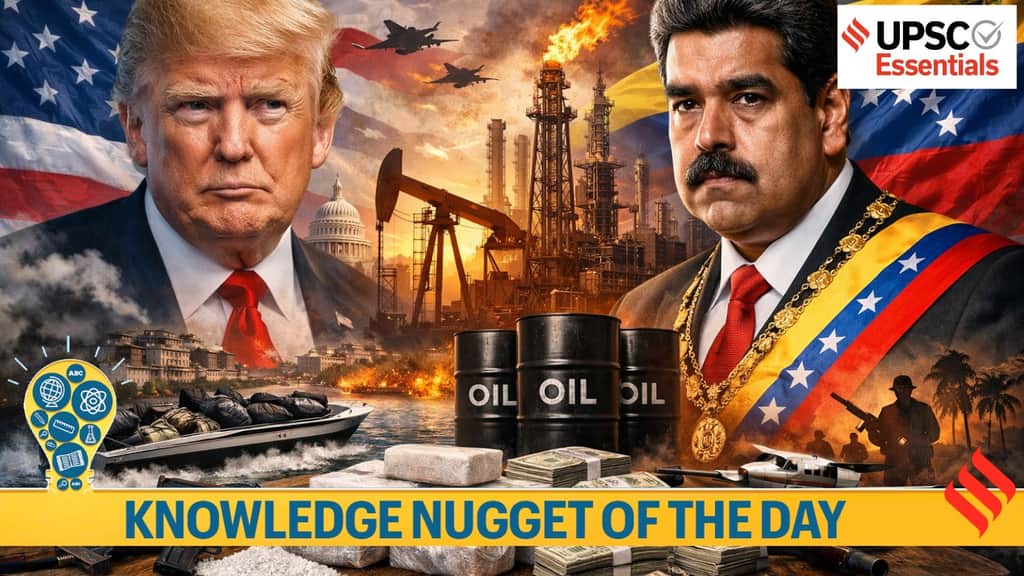
Take a look at the essential events, concepts, terms, quotes, or phenomena every day and brush up your knowledge. Here’s your UPSC Current Affairs knowledge nugget for today on Venezuela’s President Nicolás Maduro’s Arrest.
(Relevance: Drug trafficking is a major threat to a country’s security. India is also sandwiched between the Death (Golden) Triangle and the Death (Golden) Crescent, which poses a significant challenge in controlling the illicit drug trade. The illicit drug trade is the biggest concern that the world is facing. Therefore, it becomes important to understand Venezuela’s President Nicolás Maduro’s arrest from the lens of the war on drugs and beyond it.)
In a dramatic escalation of its long-running standoff with Venezuela, the United States launched large-scale military strikes on Caracas early Saturday and captured President Nicolás Maduro and his wife, Cilia Flores. President Donald Trump said the operation was aimed at ending what Washington describes as a “narco-terrorist regime” and securing a “transition” in the oil-rich South American nation.
For UPSC aspirants, however, the significance of this development goes beyond immediate geopolitics. It opens up important avenues to understand associated dimensions such as the fentanyl crisis and Venezuela’s strategic oil reserves.
US President Donald Trump releases first photo of Nicolas Maduro on board the USS Iwo Jima.
1. The recent developments come weeks after Trump began threatening ground strikes in the South American nation, even as he insisted that he would push for regime change as part of his effort to curtail the flow of illegal drugs and immigrants.
2. Last month, he designated “illicit fentanyl and its core precursor chemicals” as weapons of mass destruction (WMD).
Deaths per 100,000 (2016 to 2021) Trump's Policy Shift: 2025-2026
1. According to the World Health Organisation (WHO), fentanyl is a potent synthetic opioid drug which is used as a pain reliever and as an anaesthetic. It is about 50-100 times more potent than morphine.
2. Opioids are a class of drugs that “derive from, or mimic, natural substances found in the opium poppy plant”, according to the website of the US-based Johns Hopkins Medicine. They are highly addictive and produce a variety of pleasurable effects ranging from pain relief to euphoria. Patients who use prescription opioid-based painkillers are especially vulnerable to addiction and opioid abuse.
3. Besides fentanyl, some common opioids include oxycodone, morphine, codeine, and heroin. The issue with fentanyl is that it can be 30 to 100 times more potent than heroin or morphine and is fast-acting, leading to a rapid and high number of overdose deaths. Fentanyl-related overdoses resulted in more than 69 per cent of the total overdose deaths in the US.
4. India does manufacture synthetic opioids such as Fentanyl and Tramadol. However, it is not the legal export of the drug that is a cause of concern. Illicit trade of Fentanyl and its precursor chemicals NPP and ANPP are what the US is targeting.
US Special Forces seized Nicolas Maduro and his wife, Cilia Flores, and transported them via helicopter to a US Navy ship offshore before flying them to the US. (Al-generated graphic)
1. Oil is no stranger to conflict. Unsurprisingly, it has emerged as the key factor in America’s capture of Venezuela’s President Nicolás Maduro on Saturday (January 3).
2. Soon after Maduro’s capture, US President Donald Trump said Washington would take control of Caracas’s oil sector and that American majors would pump in billions of dollars to revive the struggling Venezuelan oil industry and fix its broken oil infrastructure.
3. Notably, Venezuela has the largest oil reserves globally, estimated at over 300 billion barrels or a fifth of the proven oil reserves all over the world. The world’s largest oil exporter, Saudi Arabia, is second to Venezuela in terms of proven oil reserves. But Venezuela produces around 1 million barrels per day (bpd) of crude, while global output is over 100 million bpd.
4. The relatively insignificant oil production by Venezuela, despite massive potential, is a result of a combination of factors that include US sanctions on the country’s oil and gas sector constraining its energy exports, apart from a severe economic crisis in Venezuela and a debilitating lack of investment in the country’s oil and gas infrastructure.
5. The US President said major American oil companies would return to Venezuela to refurbish its energy infrastructure, arguing that any US presence would be paid for by “money coming out of the ground.” His remarks revived memories of US-led interventions in Iraq and elsewhere, where control over energy resources became a defining controversy.
6. Venezuela’s government and several international critics accused Washington of using oil as the real motive behind the operation.
1. According to the United Nations Office on Drugs and Crime (UNODC), two significant regions of drug production and drug trafficking are the “Golden Crescent” and “Golden Triangle”. Golden Crescent includes illicit opium production areas in Iran, Afghanistan, and Pakistan; and the “Golden Triangle” covers Myanmar, Thailand, and Laos.
2. “India has been seen as sandwiched between the Death (Golden) Crescent and Death (Golden) Triangle. The country is being flooded with drugs, especially heroin and methamphetamine, from these two regions. Nearly 90 per cent of the world’s demand for these drugs is being met from these two regions. India is both a big market and a transit route for other countries,” wrote Rakesh Asthana.
3. In 2023, Union Home Minister while speaking at conference on ‘Drugs Smuggling and National Security’ said that “Earlier the main area of drug smuggling was called ‘Golden Triangle’ and ‘Golden Crescent’, but the government of India has proposed internationally that it should be named as ‘Death Triangle’ and ‘Death Crescent’. This approach shows the direction and intensity of our fight against drugs.”
With reference to the fentanyl, consider the following statements: 1. It is a potent synthetic opioid drug used as an analgesic.
2. It is less potent than morphine. Which of the statements given above is/are correct?
🚨 Click Here to read the UPSC Essentials magazine for December 2025. Share your views and suggestions in the comment box or at manas.srivastava@indianexpress.com🚨
Editorial Context & Insight
Original analysis & verification
Methodology
This article includes original analysis and synthesis from our editorial team, cross-referenced with primary sources to ensure depth and accuracy.
Primary Source
The Indian Express