

Key takeaways
- Google Deepmind has expanded its multi-agent system Co-Scientist from a hypothesis generator into a lab-integrated research partner.
- What's technically new is the closed-loop research workflow: the system derives hypotheses from a research question, creates experimental…
- The expanded system was validated across three disciplines with increasing autonomy.
What happened
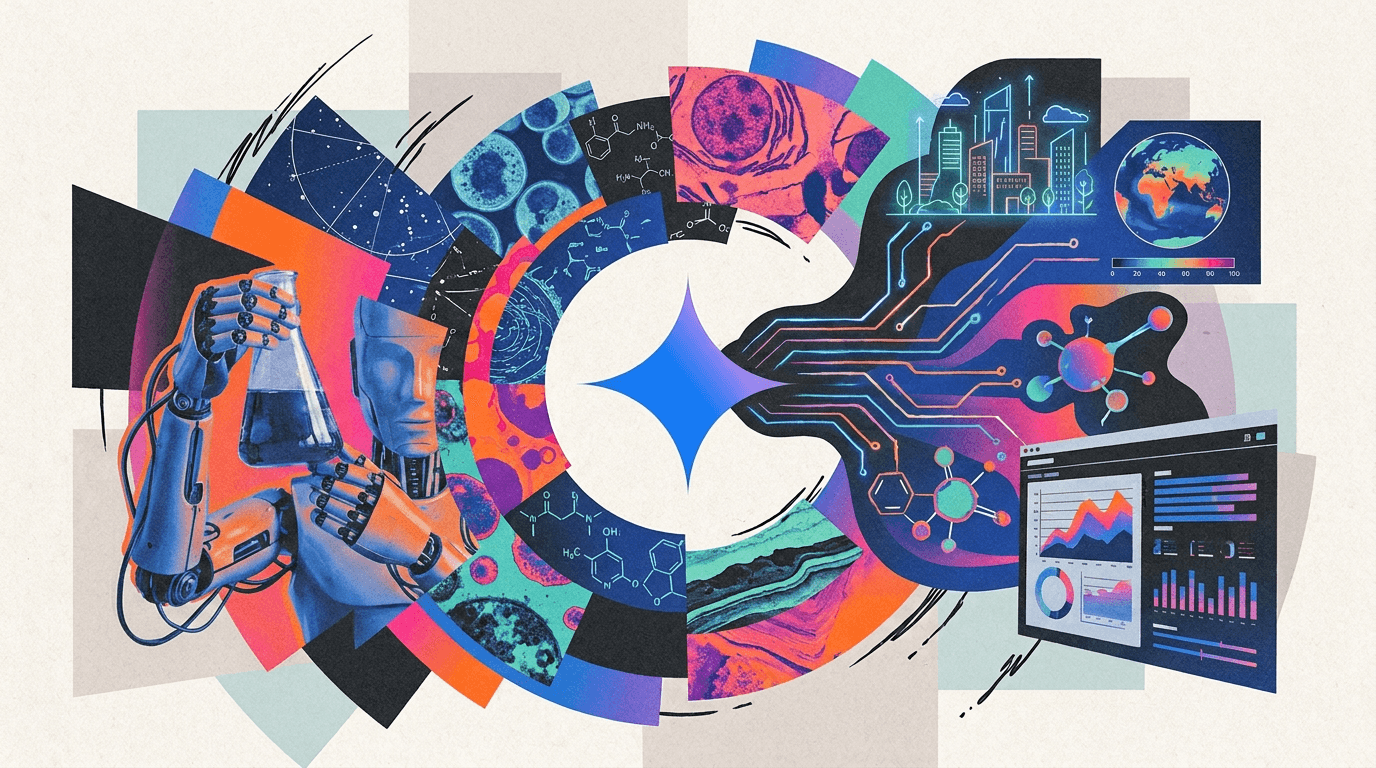
Google Deepmind has expanded its multi-agent system Co-Scientist from a hypothesis generator into a lab-integrated research partner. According to Google, the system has delivered experimentally validated results across three disciplines. Built on current Gemini models, Co-Scientist now plans experiments, writes code, and controls lab equipment instead of just generating hypotheses.
A computer science experiment ran without any human involvement beyond the initial setup. Co-Scientist designed "Agent_H," a medical AI architecture that classifies incoming queries, generates dozens of response candidates in parallel, and refines them. After correcting for overly long responses, Agent_H outperformed six frontier models on health benchmarks, including GPT-5 and Claude Opus 5. But the benchmark results didn't hold up against human evaluation.
1 Pro in just one, a lower risk of potentially harmful responses. The automated benchmark evaluators also correlated only weakly with the physicians' judgments. High benchmark scores don't mean a system actually delivers better answers from a clinical perspective, the researchers say, which raises questions about what these benchmarks are really measuring. A core problem with LLM-based autonomous research systems is AI bullshit.
When an AI agent is rewarded for good results, it has an incentive to make things up. Previous analyses documented fabrication rates of 80 to 100 percent in existing systems. Co-Scientist addresses this two ways. The system is penalized for fabricated or plagiarized content, and a separate verification module cross-checks every numerical claim against the actual results of the executed code.
In a double-blind study with 30 domain experts and 450 independent reviews, the researchers evaluated 150 autonomously generated papers. With reliability modules active, Co-Scientist fabricated key results in 4 percent of cases. Without them, the rate hit 46 percent. The comparison system reached 90 percent. Completely fabricated data never appeared in Co-Scientist's output but showed up in 44 percent of the comparison system's papers.
But we are deeply excited about the potential of LLMs to help people and accelerate real-world progress," Schmidgall writes. Automated research is currently one of the most hyped-up AI applications. OpenAI plans to unveil an AI agent system this fall that can conduct research at least at intern level.
Why it matters
What's technically new is the closed-loop research workflow: the system derives hypotheses from a research question, creates experimental plans, programs, or machine-readable lab protocols, analyzes results, and generates scientific manuscripts. Verification modules cross-check numerical claims in the text against the execution logs of the generated code to cut down on fabricated results. 0 and with shortcomings in fact-checking and literature review.
The expanded system was validated across three disciplines with increasing autonomy. Co-Scientist designed synthesis recipes for humans to execute in materials science, built a prediction pipeline with expert feedback in biology, and worked entirely on its own in computer science. For material synthesis, the researchers paired Co-Scientist with a semi-automated high-temperature furnace.
The system found a safer pathway for a sought-after 2D material previously produced mainly through hazardous etching and generated complete growth recipes tailored to the lab's equipment. After 25 rounds with human refinement, the team produced layered structures whose properties resemble the target material, but definitive confirmation of the atomic structure is still pending. In a second experiment, three semiconductor thin films were synthesized on the first try.
Co-Scientist used Gemini 3 Deep Think for direct equipment control, cutting recipe development from days down to minutes. Humans still had to load samples and precursor materials manually, and the fast mode produced smaller, less uniform crystals than carefully optimized recipes would. Whether the recipes transfer to other labs remains open, lead author Samuel Schmidgall writes.
In biology, Co-Scientist autonomously built an image analysis pipeline that predicts which patterns genetically engineered E. coli colonies form at different chemical concentrations. Predictions generated with Gemini 3 Pro Image matched unpublished lab results for three out of four shape features. The researchers acknowledge the system only reasons between known conditions and can't predict behavior in entirely new systems. That would be far more remarkable.
What to watch
Near-plagiarized content dropped from 60 percent to 16 percent. 7 percent of potentially harmful research directions. Despite the gains, the researchers still observed leftover errors. " The researchers see the results as progress toward closed-loop multi-agent AI systems that improve through experimental feedback and could speed up scientific research. "There is a long journey ahead before AI systems can navigate the physical realities of science.