“This is a very significant contribution to the astronomical community.”
Prior to World War II the vast majority of telescopes built around the world were funded by wealthy people with an interest in the heavens above.
However, after the war, two significant developments in the mid-20th century caused the burden of funding large astronomical instruments to largely shift to the government and academic institutions. First, as mirrors became larger and larger to see deeper into the universe, their costs grew exponentially. And then, with the advent of spaceflight, the expense of space-based telescopes expanded even further.
But now the tide may be turning again.
On Wednesday evening, former Google CEO Eric Schmidt and his wife, Wendy, announced a major investment in not just one telescope project, but four. Each of these new telescopes brings a novel capability online; however, the most intriguing new instrument is a space-based telescope named Lazuli. This spacecraft, if successfully launched and deployed, would offer astronomers a more capable and modern version of the Hubble Space Telescope, which is now three decades old.
A billionaire with a keen interest in science and technology, Schmidt and his wife did not disclose the size of his investment in the four telescopes, which collectively will be known as the Schmidt Observatory System. However, it likely is worth half a billion dollars, at a minimum.
“For 20 years, Eric and I have pursued philanthropy to seek new frontiers, whether in the deep sea or in the profound connections that link people and our planet, committing our resources to novel research that reaches beyond what might be funded by governments or the private sector,” Wendy Schmidt said in a statement to Ars. “With the Schmidt Observatory System, we’re enabling multiple approaches to understanding the vast universe where we find ourselves stewards of a living planet.”
Essentially the Schmidts have taken innovative telescope concepts that scientists have proposed for government funding and will provide the money needed to build them. Their gift has enormous potential to advance the study of astronomy and astrophysics.
Named for the deep sky blue of the rock Lapis lazuli, Lazuli is an optical space telescope with a mirror diameter of 3.1 meters (by comparison, the primary mirror of the Hubble Space Telescope is 2.4 meters). It is intended to launch as early as late 2028 and begin scientific operations in 2029.
There are some notable differences between Hubble and Lazuli, starting with the orbit. Lazuli will be located much farther from Earth, in an elliptical orbit with an apogee of 275,000 km and a perigee of 77,000 km, the latter distance about twice as high as geostationary orbit. This will afford the telescope a much clearer view than Hubble, located about 500 km above Earth and increasingly affected by the passage of Starlink and other communications satellites in its observations. At this higher altitude the Lazuli team believes it can maintain control of the telescope at all times and have a rapid data downlink.
“We sit on decades of technological developments since Hubble,” said Arpita Roy, lead of the Astrophysics & Space Institute at Schmidt Sciences, in an interview. “Lazuli is a very modern take on Hubble, with a larger mirror, swifter response, and different instruments.”
The instruments are a wide-field camera, a spectrograph, and notably, a chronograph to blot out the light from stars to reveal the atmospheres and other details of exoplanets orbiting them.
Schmidt Sciences will act as the overall integrator and manager of the Lazuli project. The president of the philanthropic organization, Stuart Feldman, said he was not ready to disclose the telescope’s primary contractors yet. But he said a key goal of this telescope, and the other three projects, is to move quickly. Moving from a telescope concept to launching hardware in less than five years would be rapid indeed.
Feldman said in an interview that the major space telescopes planned, built, and launched by NASA have tended toward 25-year gestation periods. It is common today for an astronomer to design instruments on observatories that will only be used by their graduate students upon nearing retirement. Moving expeditiously should also better control costs.
Feldman said he had “moderate-high confidence” that deploying and operating Lazuli would be a success. “We are taking far more risks than NASA would be willing to do,” he acknowledged. “But we are doing things rigorously, and aiming for a very high probability of success.”
No privately funded observatory remotely close to Lazuli’s scope has ever been launched into space. If successful it would be, in many ways, historic.
The other three telescopes that will be funded by the Schmidts will be based on the ground, in the southern and western United States, but they are no less innovative than Lazuli. All three of the proposed telescopes are modular and take advantage of recent advances in computing power, storage, and AI processing and analyzing data.
The design of each of the telescopes selected for the Schmidt Observatory System feels very modern. Their designs are enabled by recent developments in miniaturization of electrical components, more powerful computers, artificial intelligence, lower-cost launch, and other trends.
These telescopes could probably not have been built even five years ago. Feldman said the storage for some of the ground telescopes requires petabytes. AI will be crucial to poring over all of this data to uncover new and novel observations. And prior to the current class of commercial heavy-lift rockets, a telescope had to scrimp on mass and power; but now, with cheaper and brawnier launch, it’s easier just to throw more solar cells on an instrument.
The plan is to freely and openly share data from the telescopes. The Schmidts have emphasized that this is not a commercial project in any way. They will not be selling time on the telescopes. Rather there will be an open competition for the best scientific ideas and observations to make.
“We are basically providing a gift to the global astronomical community,” Feldman said. “We wish the data to be openly available for all of the instruments.”
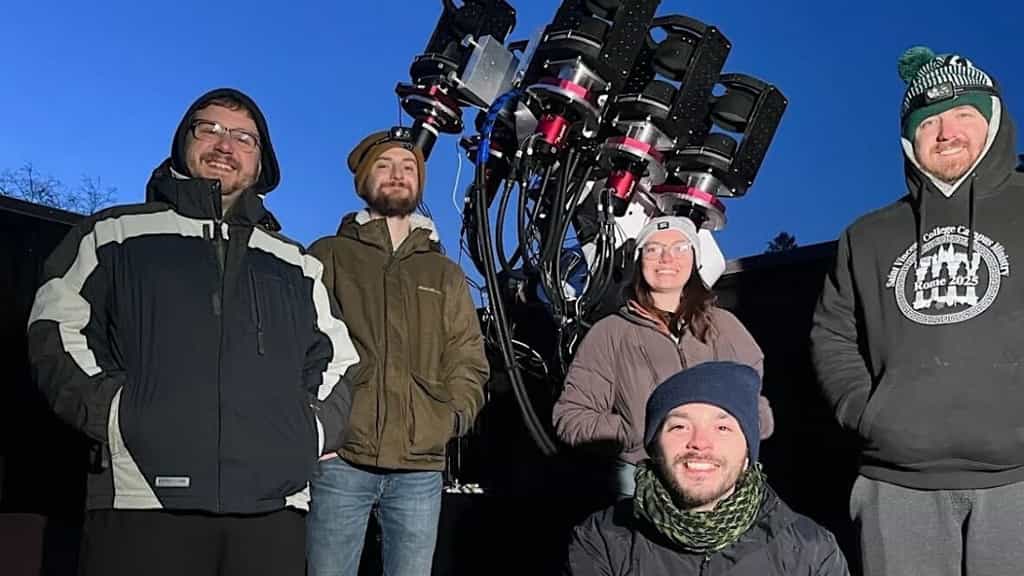
The Schmidts’ approach also includes tapping into emerging commercial space companies, such as Observable Space, which is building the Argus Array telescopes.
“The Argus Array’s commitment to open data and open science represents a new model for how astronomical discovery should happen,” Dan Roelker, CEO of Observable Space, said. “We’re excited to partner with the University of North Carolina and Schmidt Sciences to build the more than 1,200 telescopes designed not just for today’s questions, but for discoveries we haven’t imagined yet.”
The Schmidts have been reticent to speak about costs, but Feldman acknowledged that building and launching a space telescope will easily cost in the “hundreds of millions of dollars.” And that’s just one of the four telescopes.
“Putting up a whole valley filled with 20-foot antennas is not child’s play either,” he said. “This is a very significant contribution to astronomy.”
Editorial Context & Insight
Original analysis & verification
Methodology
This article includes original analysis and synthesis from our editorial team, cross-referenced with primary sources to ensure depth and accuracy.
Primary Source
Ars Technica