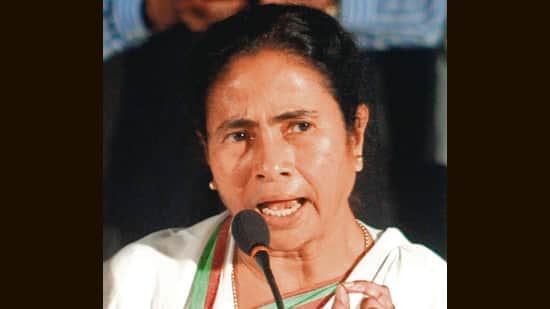
The ongoing special intensive revision (SIR) of electoral rolls in West Bengal is being conducted in a “deeply flawed, arbitrary and unconstitutional” manner that could disenfranchise large sections of genuine voters ahead of future elections, chief minister Mamata Banerjee has told chief election commissioner (CEC) Gyanesh Kumar.
In a four-page letter written to CEC Kumar on January 3, Banerjee accused the Election Commission of India (ECI) of presiding over an exercise marked by confusion, procedural violations and administrative high-handedness, and warned that the process, if allowed to continue in its present form, would strike at the “very foundation of democratic governance”.
The CM said she was “constrained once again” to intervene after her earlier letters in November and December 2025 failed to prompt corrective action. Instead, she alleged, conditions on the ground had worsened, with the revision exercise being rushed through without adequate planning, training or clarity of purpose.
At the heart of Banerjee’s charge is the allegation that the SIR lacks uniform rules and clearly defined timelines, with different states following different criteria. She said instructions were being changed frequently, often through informal channels such as WhatsApp messages and text communications, rather than statutory notifications or circulars — a practice she said had no legal sanctity for an exercise of such constitutional significance.
The TMC supremo also raised serious concerns over the alleged misuse of technology, claiming that IT systems used in the revision were unstable and unreliable, and that backend deletions of voters’ names were being carried out without due process. She alleged that Electoral Registration Officers (EROs), the statutory authorities under the Representation of the People Act, were being bypassed, raising questions over who authorised such deletions and under what legal authority.
In a pointed comparison, Banerjee flagged what she described as the selective and discriminatory application of rules across states. The Family Register, she noted, was accepted as valid proof of identity during the SIR in Bihar but was being rejected in West Bengal through informal instructions, without any statutory order. Similarly, domicile and permanent residence certificates issued by the state government were reportedly not being recognised, while migrant workers were being summoned for hearings despite being eligible electors.
The letter also details what Banerjee termed “coercive and insensitive” hearing practices. Voters, including the elderly and seriously ill, were allegedly being asked to travel 20–25 kilometres to attend centralised hearings, often without being informed of the reasons, the documents required, or being given any proof of submission. She warned that mandatory inter-district and inter-state verification of documents would inevitably delay the process and result in wrongful deletions.
Banerjee further accused the Commission of sidelining the elected state government by appointing observers and micro-observers without consulting panels submitted by the state. She claimed many such officials lacked experience and were acting beyond their mandate, undermining neutrality and public trust. The denial of access to booth-level agents during hearings, despite their role in polling stations, was cited as another blow to transparency.
“The cumulative effect of these actions demonstrates an ad hoc exercise that opens the door to arbitrariness and potential misuse,” Banerjee wrote, urging the ECI to immediately rectify the flaws or halt the SIR altogether. Failure to do so, she warned, would result in “irreparable damage” and large-scale disenfranchisement of eligible voters.
It may be noted that the political rhetoric escalated after a TMC delegation, led by party national general secretary Abhishek Banerjee, visited the ECI headquarters in New Delhi on Wednesday. Addressing the media afterwards, Abhishek launched a blistering attack on the CEC, saying: “You are a nominated official, but I am an elected representative … we are answerable to the masses.” His statement embodied the party’s larger strategy to frame the confrontation as one between elected representatives defending voters’ rights and an unelected bureaucracy.
Abhishek accused the CEC of “losing his temper” during the meeting, alleging that he was evasive on key questions and had resorted to unhelpful conduct when challenged. He went further and dared the Commission to publicly release footage of the meeting, saying such transparency would serve accountability.
TMC leaders have also seized upon the figure of 1.36 crore “logical discrepancies” and approximately 58.2 lakh provisional deletions from Bengal’s draft electoral rolls as grounds for political outrage, claiming these adjustments risk disenfranchising large numbers of voters if handled arbitrarily. They have demanded that the methodology and legal basis for categorising entries be disclosed publicly.
Meanwhile, the ECI has defended the SIR as a necessary exercise to clean up electoral rolls and strengthen the voter list ahead of elections. It has also asked political parties to refrain from intimidating electoral staff and has reiterated that the process is guided by law and standard practice. The final electoral rolls are scheduled for publication in mid-February.
The state’s chief electoral officer did not comment on Banerjee’s letter but the BJP said that although the SIR is being carried out in 12 states and Union Territories, Banerjee was the only one raising objections
“Everybody has the right to protest but why is Mamata Banerjee the only chief minister doing so? SIR is being carried out in 12 states and Union Territories. It seems she doesn’t want the rectification of the electoral rolls,” Bengal BJP unit president Samik Bhattacharya said.
Editorial Context & Insight
Original analysis & verification
Methodology
This article includes original analysis and synthesis from our editorial team, cross-referenced with primary sources to ensure depth and accuracy.