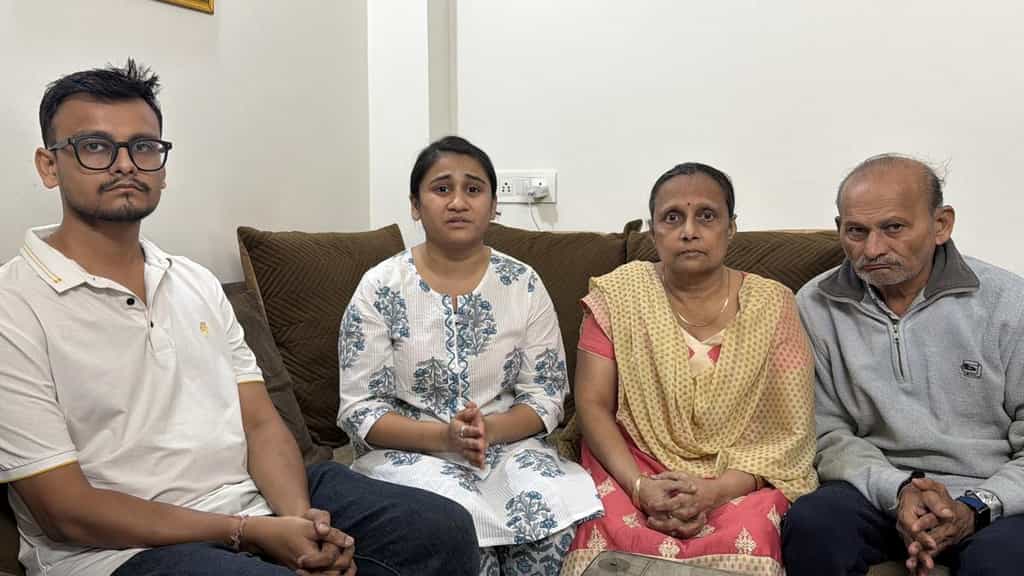
For Dhara Shah, motherhood has come to mean vocabulary drills, grammar lessons and two brief, supervised visits a month to see her four-and-a-half-year-old daughter. Ariha, an Indian citizen, has been in foster care in Germany since infancy— a separation that has stretched into its fifth year despite the dismissal of abuse allegations against her parents.
The Gujarat-born mother has been learning German for nearly three years to communicate with her daughter, who speaks only the language of her foster homes. Ms. Dhara has become the sole interpreter for her husband, Bhavesh Shah, who does not know the language. Family members in Ahmedabad told The Hindu that Ms. Dhara translates during the couple’s tightly regulated visits with their daughter.
The couple moved to Berlin in 2018 after Mr. Bhavesh secured a job as a software engineer. Ariha was born in February 2021. The lives were upended seven months later, in September, when German child welfare authorities took the baby into foster care following allegations of abuse.
According to the family, those allegations were found to be unsubstantiated and formally dismissed in early 2022. However, German child welfare authorities maintained that the injuries observed indicated “negligence in care” rather than abuse. On that basis, a court terminated the parents’ custody rights and ordered that Ariha remain in foster care.
“Even after the abuse charges were proved false, custody was not restored,” said Kinjal Shah, Ariha’s maternal aunt, speaking from Ahmedabad. “On grounds of alleged negligence, their parental rights were terminated. In the last four years, the authorities have tortured the child by moving her across five foster homes in Germany.”
Both parents are currently unemployed and are permitted to meet their daughter only twice a month, under supervision. The foster home where Ariha is now placed is in a remote village nearly two hours from Berlin, further limiting contact, Ms. Kinjal said.
For Dhara, learning German has become both a necessity and a quiet act of resistance against distance. Family members say she continues her language lesson so she can speak directly to her daughter and understand every word during their brief meetings.
“As a mother, this is the only way she feels close to Ariha,” said Ms. Kinjal. “She is learning a new language just to be her child’s voice—and to hear her child’s. Ariha can’t speak any other language because she has grown up entirely in foster care.”
Despite repeated representations by New Delhi, the German Government has so far not agreed to India’s request that Ariha be allowed to return and be raised in a foster care in India.
The issue was raised at the highest political level during Prime Minister Narendra Modi’s meeting with German Chancellor Friedrich Merz in Ahmedabad on Monday.
Later, Foreign Secretary Vikram Misri said the Prime Minister had personally taken up the matter. “PM Modi mentioned this to the German Chancellor. We will continue to follow up with the German Government and stay with the family at every step,” he said.
Ms. Kinjal said that Ariha repeatedly asks her parents why they are not taking her home, a question they struggle to answer. “The authorities have not only separated her from her parents but have also taken away her cultural identity— her language, her religion and, above all, her identity as an Indian citizen,” Ms. Kinjal said, adding, “When the parents are free and can travel at any time, why should an innocent child be made to suffer?”
The financial strain has compounded the family’s distress. Ms. Kinjal said that recently, the family was served a foster care maintenance bill of ₹20 lakh for the period between 2022 and 2024, along with ₹16 lakh towards legal expenses. “My brother-in-law lost his job a few months ago due to the recession. They are struggling to clear the monthly bills and even to travel to India to meet officials and Ministers in New Delhi. At this difficult time, our Jain community has stepped in to support them,” Ms. Kinjal said.
Expressing her anguish, Ariha’s maternal grandmother, Bhartiben Vijaybhai Shah, said she had been unable to speak to or meet her granddaughter. “The parents are not allowed to let her talk to us over the phone. There is no point in travelling there as we are not permitted to meet her. As grandparents, we have only seen her as an infant. It is heartbreaking,” she said.
With the matter now directly raised with German Chancellor Merz, the family remains hopeful that Ariha will be allowed to return home soon. They fear that prolonged separation may irreversibly distance the child from her family as she grows older.
Editorial Context & Insight
Original analysis and synthesis with multi-source verification
Methodology
This article includes original analysis and synthesis from our editorial team, cross-referenced with multiple primary sources to ensure depth, accuracy, and balanced perspective. All claims are fact-checked and verified before publication.
Editorial Team
Senior Editor
Dr. Elena Rodriguez
Specializes in India coverage
Quality Assurance
Copy Chief
Fact-checking and editorial standards compliance